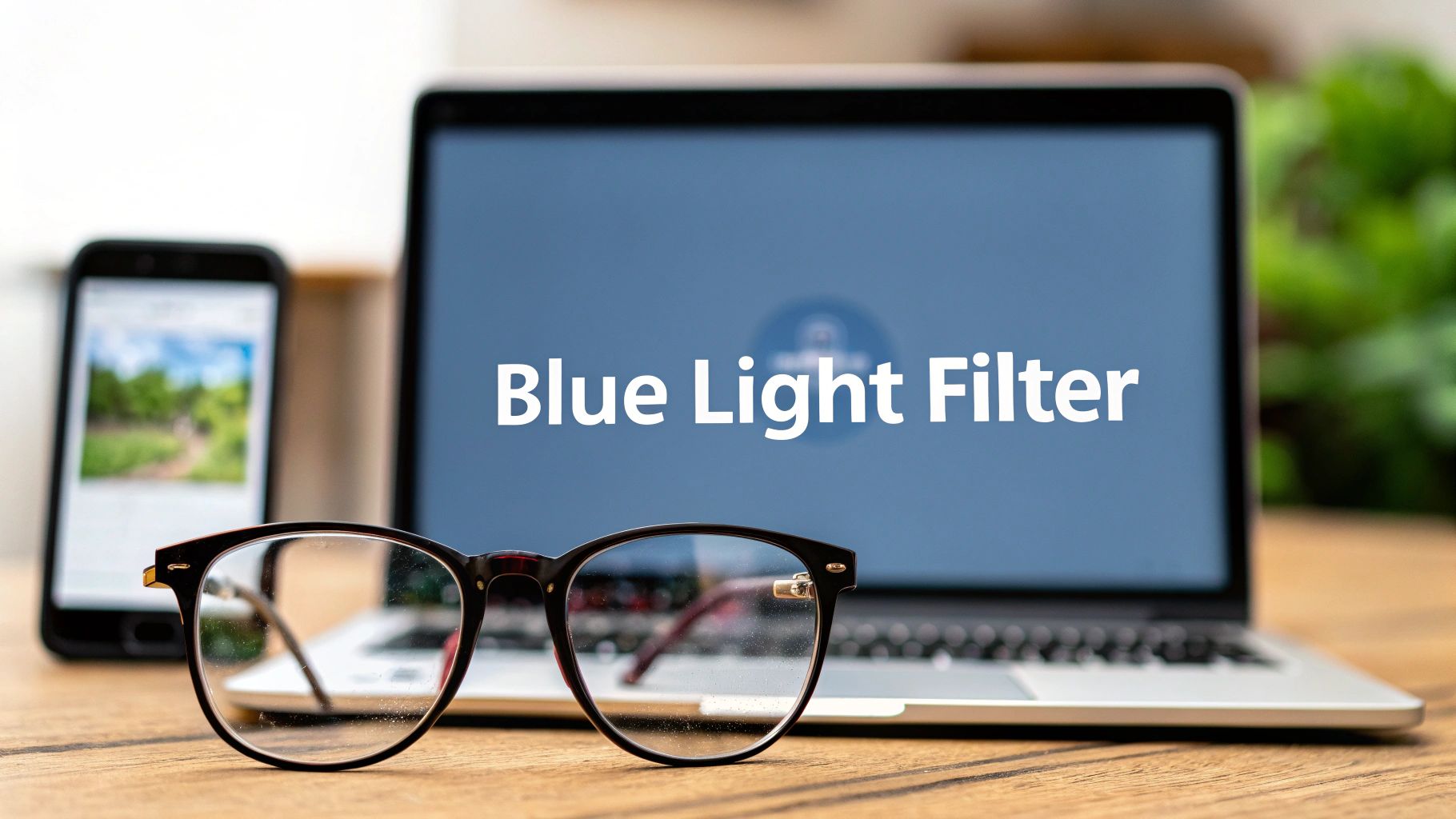
A blue light filter is essentially a tool that dials down the amount of intense, high-energy blue light coming from your digital screens. Think of it like putting a pair of digital sunglasses on your phone or laptop. It’s designed to selectively dim the part of the light spectrum that’s most known for messing with your sleep and making your eyes feel tired, both of which are critical for your overall health and well-being.
Picture the light from your screen as a full rainbow of colors. A blue light filter steps in and specifically targets the blue and violet parts of that rainbow, turning down their brightness.
This is a big deal because the artificial blue light from our devices is remarkably similar to the blue light in natural sunlight. During the day, that sunlight is great—it tells our brain to be awake, alert, and focused. But when we get that same signal from our screens late at night, our brain gets confused. It starts to think it’s still daytime, which can seriously disrupt your body’s natural wind-down process and sabotage the quality of your sleep.
To get a clearer picture of how this all fits together, here’s a quick summary of the core concepts.
| Aspect | Description |
|---|---|
| What is Blue Light? | A high-energy wavelength of light emitted by the sun and digital screens. It signals the brain to be awake and alert. |
| The Problem at Night | Exposure to blue light in the evening tricks the brain into thinking it's still daytime, suppressing sleep hormones essential for rest. |
| What a Filter Does | It reduces the amount of blue light coming from your screen, creating a warmer display that supports natural sleep patterns. |
| The Primary Goal | To protect your body's internal clock (circadian rhythm) and ensure you get the restorative sleep you need to function. |
This table lays out the basics, but the real benefit comes down to one thing: protecting your sleep.
The main job of a blue light filter is to defend your body’s natural sleep-wake cycle, also known as your circadian rhythm. Quality sleep is foundational to health, and a filter helps protect it in a few key ways:
At its core, a blue light filter is a wellness tool. It helps realign your modern digital habits with your body’s ancient need for a clear distinction between day and night, making quality sleep more achievable.
By simply dialing down the blue light, you’re doing more than just changing your screen’s color—you’re sending a clear "goodnight" signal to your brain. It’s a small adjustment that can be a powerful first step toward better sleep hygiene and improved daily performance.
For a deeper dive into how light impacts your nightly rest, feel free to explore our blue light blog. Understanding this connection is the key to finally reclaiming your nights.
Your body runs on a surprisingly smart internal clock called the circadian rhythm. Think of it as your body's 24-hour operating system, telling you when to feel awake and when it's time to power down for sleep. The most powerful cue for this entire system? Natural sunlight.
When your eyes see the bright, blue-heavy light of the morning sun, your brain gets a clear signal: "It's daytime! Get sharp and be productive." This is how it's supposed to work—it keeps you perfectly in sync with the world around you, ensuring you have energy during the day and can rest at night.
The problem starts when we stretch "daytime" long after the sun has gone down. Our phones, tablets, laptops, and TVs are all pumping out a concentrated stream of that same high-energy blue light. So when you're scrolling through your feed at 10 PM, you're sending your brain a very confusing signal: "The sun is still up!" This directly undermines your ability to get the essential sleep your body needs.
This false signal directly sabotages a critical sleep hormone called melatonin. Often called the "hormone of darkness," melatonin is what your brain releases to tell your body it's time to get sleepy and prepare for rest.
On a normal day, as the sun sets, your melatonin levels naturally start to climb. This gradual rise is what makes you feel drowsy, setting the stage for a great night of restorative sleep. But bombarding your eyes with blue light in the evening slams the brakes on that entire process.
When your brain is tricked into thinking it's still noon, it shuts down melatonin production. This is the number one reason so many of us struggle to fall asleep after late-night screen time. It completely undermines the very foundation of a good night's rest.
Without enough melatonin, your body’s "time for bed" signal gets lost in translation. This can kick off a whole host of sleep issues, making it harder to fall asleep and stay asleep.
The fallout from this cycle is much more than just feeling tired the next morning. Quality sleep isn't a luxury; it’s a non-negotiable biological need for your physical and mental health. When your circadian rhythm is constantly out of whack, you're robbing your body of its crucial repair time, which can lead to:
Just understanding this connection is the first step toward getting your nights back. If you're curious how tools like glasses can make a difference, you can learn more about how blue light glasses aid sleep and help support a healthier cycle. In the end, managing your evening blue light exposure is one of the most powerful things you can do to help your body get the deep, restorative sleep it needs to thrive.
So, how does a blue light filter actually stop those sleep-wrecking wavelengths from hitting your eyes? It’s not magic—it's just clever optical science that works in one of two main ways: absorption or reflection.
Once you get how these work, you'll understand exactly what’s happening when you flip on a software filter or slide on a pair of blue light glasses to protect your sleep.
The first method, absorption, is pretty much what it sounds like. Think of a sponge soaking up water. Filters using this tech have specific molecules or dyes baked into them that are engineered to capture and absorb high-energy blue light before it ever gets to your eyes.
This is the principle behind most physical filters.
For instance, those glasses with the noticeably yellow or amber lenses? That’s absorption in action. The pigments in the lenses literally trap blue light, which is why everything looks warmer and cozier when you wear them. It’s a simple but powerful way to protect your sleep cycle.
The other method is reflection. Imagine a bouncer at a club who only lets certain people in. Reflective filters use a special multi-layered coating that acts like a highly selective mirror, bouncing specific blue light wavelengths away from your eyes while letting all the other light pass through.
You'll see this technology most often in blue light glasses that look almost perfectly clear. They aren't as aggressive as the deep amber lenses, but their coatings can still reflect a huge chunk of the most problematic blue light that disrupts sleep. If you look closely, you might even notice a faint blue or purple shimmer on the lens surface.
The core idea behind filter technology is simple: selectively manage the light spectrum reaching your eyes. Whether by absorbing it like a sponge or reflecting it like a mirror, the goal is to reduce the "daytime" signals that can disrupt your natural sleep patterns.
This concept isn't exactly new, either. The roots of this tech actually trace back to early 20th-century photography, where photographers used yellow-dyed filters to absorb UV and blue light to get clearer images. So, the pioneering work done over a century ago laid the groundwork for the protective eyewear we use today to help us sleep better. You can check out the fascinating history of photographic filters to see how it all evolved.
You run into this technology in a few common forms, each designed to help you maintain a healthy sleep cycle in our screen-filled world.
Ultimately, understanding the mechanics of what is a blue light filter helps you pick the right tool for the job. It's all about giving your brain the clear signal it needs: when it's dark outside, it's time to wind down for sleep.
Using a blue light filter is about more than just tinting your screen a warm color. It's a simple change that delivers some surprisingly powerful health benefits, with the biggest one being a dramatic improvement in your sleep. When you consciously manage the light you’re exposed to, you’re helping your body’s internal clock stay on track, which is the foundation of good health.
Another huge win is the relief it brings from digital eye strain. By filtering out those harsh, high-energy blue wavelengths, a filter can make hours in front of a computer or phone feel far less punishing. This helps cut down on common issues like tired, gritty eyes and tension headaches that can interfere with your ability to relax and sleep well.
If there's one reason to use a blue light filter, it's to protect your sleep. When you stare at screens after dark, the intense blue light tricks your brain into thinking it's still daytime. This slams the brakes on melatonin production—the hormone that signals your body it's time to rest. This single disruption is a huge reason why so many of us struggle to fall asleep or have restless nights.
Think of a blue light filter as a shield. It blocks those confusing "daytime" signals from reaching your eyes, allowing your brain to start producing melatonin naturally as the evening goes on.
This helps you:
Ever finish a long day at the computer with dry, aching eyes, a nagging headache, and slightly blurry vision? That’s digital eye strain. While a few things can cause it, the high-energy nature of blue light is a major culprit. A blue light filter works by softening the harsh visual contrast, making the screen much gentler on your eyes.
This can bring a noticeable reduction in those all-too-common symptoms:
By dialing down the most intense part of the light spectrum, a blue light filter creates a more comfortable viewing experience. This makes it easier to work, study, or relax in front of a screen without the physical discomfort that can wreck your productivity and, most importantly, your ability to get a good night's sleep.
This problem really exploded in the 21st century as screens became a non-negotiable part of daily life. Today, with the average person clocking 8+ hours of daily screen time, the issue is more relevant than ever. Studies have confirmed that devices like smartphones and LED monitors blast out high levels of the exact blue wavelengths that throw our natural sleep cycles into chaos. In response, a multi-billion dollar industry for filters has grown, with some reports suggesting that consistent use can reduce eye strain symptoms by up to 65%. You can discover more insights about the history of blue light glasses and see how awareness has skyrocketed.
Ultimately, making a blue light filter part of your daily routine is a simple, powerful move for better sleep and more comfortable days. For more strategies to improve your nightly rest, check out the helpful articles in our online resources.
Okay, so you're sold on the idea of a blue light filter helping you sleep better. Awesome. The next step is figuring out which one actually fits into your daily routine.
This isn't a one-size-fits-all situation. The right choice really comes down to your devices, your habits, and just how serious you are about protecting your melatonin and prioritizing sleep. Your two main camps are software and hardware—let's break them down.
Software filters are, without a doubt, the easiest and most accessible option out there. They're already built right into the operating system of your phone, tablet, or computer, just waiting for you to flip a switch.
These filters work by adjusting your screen's color output, dialing down the harsh blue light in favor of a warmer, amber tone. The result is a display that’s much easier on your eyes and far less likely to mess with your sleep cycle.
Here’s how to find and activate them on the most common devices:
Settings > Display & Brightness > Night Shift. You can schedule it to turn on automatically from sunset to sunrise, which is a game-changer for protecting your melatonin in the evening.Settings > Display. It lets you customize the intensity and set a schedule, making it a seamless part of your wind-down routine for better sleep.Settings > System > Display > Night light settings. Here, you can tweak the color temperature and have it kick in automatically after dark to support your sleep.System Settings > Displays > Night Shift. Just like on the iPhone, you can set it to run on a custom schedule or simply from sunset to sunrise.The real power of software filters is automation. When you set it and forget it, you align your screen's light with the natural rhythm of the day. Every single evening, it sends a consistent signal to your brain: "Hey, it's time to start winding down for sleep."
While software is fantastic for its convenience, hardware filters offer a more comprehensive shield for your sleep. They work by physically blocking blue light before it can even hit your eyes.
This is a huge deal because hardware isn't limited to just one screen. It protects you from all artificial blue light sources—your phone, sure, but also the LED lights in your ceiling, your TV, and any other glowing gadget in the room that could be quietly disrupting your sleep.
This image gives you a good idea of how different hardware and software options stack up in terms of effectiveness.
As you can see, the amount of blue light reduction varies quite a bit. Software filters can be incredibly effective, especially when you crank the warmth setting all the way up.
The most popular hardware solutions are:
To help you decide, let's compare the two side-by-side.
| Feature | Software Filters (e.g., Night Shift) | Hardware Filters (e.g., Glasses, Screen Protectors) |
|---|---|---|
| Convenience | Excellent. Already built into most devices and can be automated. | Requires a purchase and remembering to use the item (glasses) or a one-time installation (protector). |
| Protection Scope | Only protects you from the screen of the specific device it's on. | Protects from all blue light sources in your environment, crucial for comprehensive sleep protection. |
| Cost | Free. | Varies. Screen protectors are affordable, while high-quality glasses are an investment in your sleep. |
| Best For | Casual evening screen use and automated, basic protection for sleep. | Serious sleep protection, people sensitive to light, and reducing daytime eye strain. |
| Customization | High. You can adjust the intensity and schedule it to the minute. | Low. The filtering level is fixed by the product's design. |
So, which one is best? Honestly, you don't have to choose just one.
The ultimate strategy is often a combination of both. Use an automated software filter on all your devices as your baseline, then throw on a pair of high-quality amber glasses in the hours before bed. This two-pronged approach gives your sleep the most robust protection possible.
As people start digging into blue light filters, a few questions always pop up. Getting those answered is key to using them right, especially when your sleep is on the line. Let's tackle the big ones.
Yes, they absolutely do—and the science is pretty simple. A blue light filter’s main job is to stop your screens from messing with melatonin, the hormone that signals your body to power down for the night.
By filtering out the specific blue light waves that look like daylight to your brain, you’re letting your body produce melatonin naturally as evening rolls in. This helps get your internal clock (your circadian rhythm) back on track, making it way easier to fall asleep and wake up feeling refreshed. It's not a placebo; you're fixing the biological short-circuit caused by late-night screen time that robs you of essential rest.
Nope, not at all. Blue light filters are designed purely for your comfort and to support better sleep. Whether it's software that adds a warm tint to your screen or a physical pair of glasses, these tools just change the light spectrum hitting your eyes. They don't alter your vision or cause any kind of strain.
Think of a blue light filter as a subtractive tool—it only removes a slice of the light. It adds nothing harmful and is completely safe for both short-term and long-term use. You're just creating a gentler, less jarring visual environment that is more conducive to sleep.
This really comes down to personal preference, but there's one non-negotiable window: the 2-3 hours before you go to bed. That’s when blue light exposure does the most damage to your sleep cycle by slamming the brakes on melatonin production. Protecting this window is critical for quality sleep.
During the daytime, the benefits are more about comfort. Keeping a filter on all day can be a game-changer for reducing digital eye strain—think tired, dry eyes and nagging headaches. If you spend your days staring at a computer, a subtle filter can make your workday feel a lot less grueling.
Here’s a simple way to think about it:
At the end of the day, using a blue light filter is about sending your body the right signals at the right time. By blocking blue light at night, you’re telling your brain it’s time to wind down, setting the stage for the kind of deep sleep your body and mind are craving.
Ready to give your sleep the ultimate protection? The amber lenses from Element Lux are engineered to block over 99% of disruptive blue light, helping you fall asleep faster and wake up refreshed. Shop our collection now and reclaim your nights.
