Running on fumes? We’ve all been there. But missing out on quality sleep has effects that go way beyond feeling a little groggy. It's a domino effect that can knock down everything from your immune system and heart health to your focus and emotional balance. When you consistently lack the restorative sleep that is so vital for your body, you're setting off a chain reaction of negative responses that can seriously chip away at your long-term well-being and open the door to chronic diseases.
We tend to treat sleep like it's optional—the first thing to go when a deadline is breathing down our neck or life just gets overwhelming. But thinking of sleep as just "downtime" is a huge mistake. It’s an active, biological necessity, just as critical to your health as what you eat or how often you move. Recognizing the profound importance of sleep and making consistent, high-quality rest a priority is one of the most powerful things you can do for your day-to-day performance and overall vitality.
Think of your body like a high-performance smartphone. Every night, you plug it in to recharge. A full charge gets the battery back to 100%, restores processing speed, and makes sure everything runs smoothly the next day. Now, what if you only ever charged it to 40%? Day after day, it would get slower, buggier, and just plain unreliable.
That’s exactly what happens to your brain and body when you're sleep-deprived. You’re starting every single day with a depleted battery, making it harder to concentrate, manage stress, or even fight off a common cold. Over time, the cumulative effects of sleep deprivation on your health wear down your resilience and tank your performance, underscoring why sufficient sleep is not a luxury, but a necessity.
This isn't just a personal struggle; it's a global one. Modern life, with its 24/7 connectivity and endless pressures, has created a full-blown sleep crisis. The blue light from our screens is a major culprit, messing with our natural sleep cycles—a topic we dive into deeper over on our blue light blog. The sheer scale of this problem is staggering.
A global survey found that, on average, people are losing nearly three full nights of restorative sleep every single week. The main drivers? Stress (57%), anxiety (46%), and financial worries (31%), pointing to a society running on empty.
The data couldn't be clearer: millions of us are stuck in a state of chronic exhaustion. Another survey of over 30,000 people revealed that about one-third struggle to sleep at least three times a week. You can get more insights into this global sleep crisis from the full research.
Recognizing these challenges is the first step toward valuing the importance of sleep. In this guide, we'll walk you through the specific ways a lack of sleep impacts your well-being, covering:
By the end, you'll see why protecting your sleep isn't just about feeling less tired—it’s about fundamentally protecting your health.
We've all felt the mental fog after a bad night's sleep, but the physical damage is far more serious and often goes unnoticed. The importance of sleep is crystal clear when you understand it's the time when your body's repair crew gets to work on intense physiological maintenance. When you cut that process short, you're essentially telling that crew to go on strike.
Think of it like a major city shutting down its maintenance operations for a night. Roads go unrepaired, trash piles up, and the power grid becomes unstable. That’s a pretty good picture of what happens inside your body without enough sleep. Critical jobs like cellular repair, hormone regulation, and immune system reinforcement just stop, leaving you vulnerable from the inside out.
Over time, this built-up neglect takes a real toll, chipping away at your physical resilience. This isn't just about feeling tired—it's about the fundamental systems that keep you healthy starting to break down.
Your immune system is one of the first things to suffer when you don't get enough sleep. During deep sleep, your body produces and releases proteins called cytokines, which are crucial for targeting infection and inflammation. This highlights the vital importance of sleep for a strong immune response; skimping on it means you're not making enough of these critical defenders.
This leaves you far more vulnerable to getting sick with common illnesses like the cold or flu. If you've ever noticed you catch everything going around when you're stressed and sleep-deprived, this is why. Your body just doesn't have enough soldiers to fight off invading pathogens.
It also means recovery takes longer. So, not only are you more likely to get sick, but you'll stay sick for longer, trapping you in a draining cycle of poor health and exhaustion.
This image captures that feeling of total exhaustion, which is really just the tip of the iceberg when it comes to the real health consequences.
The table below outlines just how serious the risks can become as sleep duration decreases.
| Nightly Sleep Duration | Increased Mortality Risk | Associated Physical Health Effects |
|---|---|---|
| Less than 6 hours | 10% higher | Weakened immunity, high blood pressure, increased risk of heart attack and stroke. |
| 6-7 hours | Moderate increase | Impaired insulin sensitivity, hormonal imbalances (ghrelin/leptin), inflammation. |
| 7-9 hours (Recommended) | Baseline | Optimal immune function, stable cardiovascular health, balanced metabolism. |
As the data shows, consistent, quality sleep isn't a luxury—it's a non-negotiable part of maintaining your long-term health.
The importance of sleep for heart health is rock-solid. Chronic sleep deprivation is closely tied to serious cardiovascular problems, including high blood pressure (hypertension), heart attack, and stroke. During a normal night's sleep, your blood pressure and heart rate naturally dip, giving your heart and blood vessels a much-needed rest.
When you don't get enough sleep, your blood pressure stays elevated for much longer. This puts constant strain on your entire circulatory system. It’s like running an engine at high RPMs for too long without a break—eventually, parts start to wear out. That sustained pressure leads to inflammation and can damage your arteries over time.
Sleep is also the master regulator of your body's hormones, which control everything from your appetite to your stress response. A lack of sleep throws this delicate system into total chaos, demonstrating just how crucial sleep is for metabolic balance. For example, it messes with ghrelin and leptin, the two key hormones that tell you when you're hungry and when you're full.
When you're sleep-deprived, ghrelin levels shoot up (making you feel hungrier) while leptin levels drop (making you feel less full). This is exactly why you might find yourself craving junk food—sugary, fatty, high-calorie snacks—after a rough night. It isn't a lack of willpower; it’s a direct physiological response to being exhausted. This is a big reason we explore whether our glasses can help with sleep, as they can help mitigate factors like blue light that disrupt these natural cycles.
The disruption doesn't stop there. Insufficient sleep also messes with your insulin sensitivity, making it harder for your cells to absorb sugar from your bloodstream. Over time, this dramatically increases your risk of developing type 2 diabetes. The end result is a metabolic system that's inefficient, sluggish, and prone to weight gain and chronic disease.
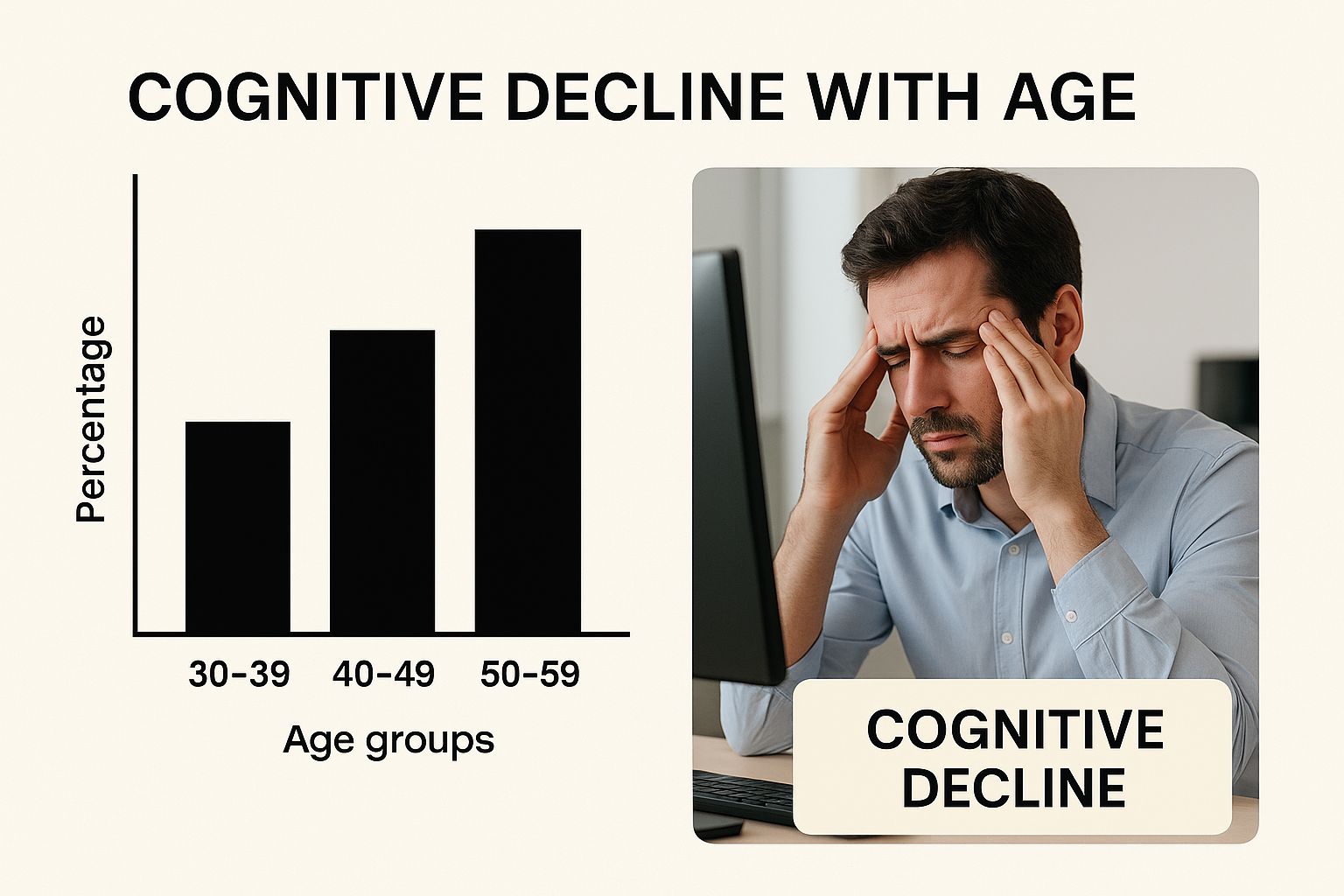
Beyond the physical strain, the damage sleep deprivation does to your brain is one of the most immediate and profound effects on your health. A sleep-deprived brain is like a computer trying to run complex software with barely any RAM. It sputters, freezes, and struggles with even the most basic tasks, making the importance of sleep for mental clarity undeniable.
Suddenly, remembering where you left your keys or making a critical decision at work becomes exponentially harder. This mental slowdown isn't just a feeling; it's a measurable decline in cognitive performance. The essential brain functions we rely on every second—sharp focus, problem-solving, and sound judgment—are directly compromised. The longer you go without rest, the deeper that cognitive debt becomes, making it impossible to operate at your best.
This exhaustion translates directly into poor performance, affecting everything from your career to your personal relationships. A mind clouded by fatigue just can’t process information clearly.
To really get why this happens, it helps to understand how different sleep stages actively restore your mind. Each phase of the sleep cycle has a specific job, proving how important every moment of sleep is. Think of it as an overnight cognitive maintenance crew, with each member handling a different task.
Deep Sleep (Non-REM Stage 3): This is your brain's filing clerk. During deep sleep, your brain consolidates memories, moving important information from short-term to long-term storage. Skimp on this, and you'll struggle with memory recall and learning new things.
REM (Rapid Eye Movement) Sleep: This is your brain's creative workshop. REM sleep is critical for processing emotions, cementing complex skills, and fostering creative problem-solving. A lack of REM can leave you feeling emotionally raw and mentally inflexible.
When you cut sleep short, you disrupt this vital workflow. The result is a brain that’s not just tired but also disorganized, emotionally volatile, and unprepared for the day.
A well-rested brain can easily filter out distractions and stay on task. A sleep-deprived one can’t. Your attention span shortens dramatically, and the ability to multitask effectively vanishes. You might find yourself reading the same sentence over and over or getting sidetracked by the smallest interruption.
This mental fog directly cripples your ability to make sound judgments. The prefrontal cortex, the part of your brain responsible for reasoning and impulse control, becomes sluggish and impaired. As a result, you're far more likely to be overly optimistic, take unnecessary risks, and make poor decisions you'll later regret. Your brain's natural checks and balances are offline.
When you miss a full night of sleep, the impairment to your cognitive function and reaction time can be equivalent to having a blood alcohol content of 0.10%, which is above the legal limit for driving in many places.
That's a staggering fact. It highlights just how severely a lack of sleep degrades your mental capabilities. It isn’t just about feeling tired; it’s about operating with a genuinely disabled brain.
One of the scariest consequences of severe sleep deprivation is the phenomenon of microsleeps. These are brief, involuntary episodes of sleep that can last from a fraction of a second to several seconds. You might not even realize they’re happening. Your eyes could stay open, but your brain has momentarily checked out.
While a microsleep might seem harmless if you're on the couch, it can be catastrophic if you're behind the wheel of a car or operating heavy machinery. At 55 miles per hour, a car travels the length of a football field in just a few seconds. A single microsleep is all it takes for a devastating accident to happen.
These episodes are your brain's desperate, last-ditch effort to get the rest it needs, overriding your conscious attempts to stay awake. They're a final, undeniable warning sign that you've pushed your body far past its safe limits.
Beyond just clouding your thoughts and weakening your body, a lack of sleep wages a direct assault on your emotional stability. Ever found yourself snapping over something tiny after a restless night? You’ve experienced this firsthand. That heightened irritability isn't a character flaw; it’s a completely predictable, physiological response to being exhausted.
The importance of sleep for emotional regulation is huge. When you’re well-rested, your brain can process emotions, manage stress, and respond to situations with a sense of balance. Without that nightly reset, your emotional controls go haywire. Minor frustrations can suddenly feel like monumental crises.

This feeling of being emotionally overwhelmed isn't just in your head—it's the direct result of specific changes happening inside your sleep-deprived brain.
To really get why you feel so emotionally volatile, we need to look at two key parts of your brain: the amygdala and the prefrontal cortex.
Think of the amygdala as your brain’s emotional gas pedal. It’s the primitive, reactive part that triggers immediate feelings like fear, anger, and anxiety. Normally, it responds appropriately to different situations.
But after just one night of poor sleep, the amygdala can become over 60% more reactive. This is why a small annoyance, like someone cutting you off in traffic, can provoke an outsized, furious reaction when you're tired. Your emotional accelerator is basically stuck to the floor.
At the same time, the prefrontal cortex—your brain's rational decision-maker and impulse controller—becomes sluggish. This is the part of your brain that acts as the brakes, telling the amygdala, "Hey, calm down, this isn't a big deal."
So, a lack of sleep gives you an overly sensitive gas pedal and weak, unresponsive brakes. This neurobiological imbalance is the core reason why sleep deprivation effects on health manifest as mood swings and an inability to cope with everyday stress. Your brain is physically rewired for overreaction.
This connection between rest and emotional wellness is backed by some serious data. A poll by the National Sleep Foundation found that American adults who consistently get enough sleep are far more likely to be flourishing. Specifically, 72% of well-rested people reported a high level of well-being, compared to just 46% of those with poor sleep—a 57% increase. You can read more about the connection between sleep and human flourishing in their report.
This highlights a critical truth: getting enough sleep doesn't just prevent negative emotional states; it actively promotes positive ones. The importance of sleep extends beyond avoiding problems; it’s about enabling a vibrant, fulfilling life.
While occasional irritability is one thing, chronic sleep deprivation creates a much more serious risk. The persistent emotional dysregulation can pave the way for long-term mood disorders.
The relationship between sleep and mood is a two-way street. Not only does sleep deprivation amplify negative emotions, but many mood disorders, like depression and anxiety, often cause severe sleep problems. This can create a draining, self-perpetuating cycle that is incredibly difficult to break.
Here's how this vicious cycle works:
Ultimately, protecting your sleep is a fundamental act of protecting your mental and emotional health. It provides the foundation upon which a stable, resilient, and positive mindset is built.
Knowing how badly sleep deprivation wrecks your health is one thing; doing something about it is another. Reclaiming your rest isn't about finding some magic pill. It’s about building a solid framework of healthy habits that stick. By putting a few practical, science-backed strategies into play, you can get your body’s natural rhythm back on track and finally get the deep, restorative sleep you’ve been missing.
So, let's shift from the problem to the solution. The good news is you have a ton of control over the things that dictate your sleep quality. It all starts with creating an environment and a routine that sends a clear signal to your brain: it’s time to wind down.
Your bedroom should be a sanctuary for rest, not a command center for work, entertainment, and late-night scrolling. The goal is simple: create an environment that kills disruptions and promotes total relaxation. That means making it dark, quiet, and cool.
Think of your brain as being incredibly sensitive to cues from your surroundings. A bright, noisy, or warm room screams, "Stay awake! Be alert!" But a cool, dark, and quiet space tells your brain it's safe to power down for the night.
Here are a few powerful, no-nonsense adjustments:
Honestly, one of the most effective things you can do for your sleep is to lock in a consistent sleep-wake schedule—and yes, that includes weekends. Going to bed and waking up around the same time every day is the key to regulating your body's internal clock, also known as your circadian rhythm.
When your circadian rhythm is stable, your body starts to anticipate when it's time to sleep and when it's time to wake up. It becomes way easier to fall asleep at night and wake up feeling genuinely refreshed. It’s like setting a biological alarm clock that just works.
Sticking to a schedule reinforces your body’s natural sleep-wake cycle. This simple act of consistency can be more powerful than any sleep aid, training your brain to recognize when it’s time for rest and when it’s time for activity.
This doesn't mean you can never stay up late again. But the more consistent you are, the stronger your sleep cycle becomes, making it better at bouncing back from the occasional late night.
In our screen-filled world, the biggest sleep disruptor is the artificial blue light blasting from our phones, tablets, computers, and TVs. This specific wavelength is a master at suppressing melatonin, the hormone that tells your body it’s time to get sleepy.
When you're scrolling through your phone in bed, you're basically telling your brain it's high noon. This pushes back your natural sleep onset and tanks the quality of your rest. This is where blue-light-blocking glasses become an incredibly simple and effective tool. Just wearing them for 1-2 hours before you plan to sleep filters out that disruptive light, letting your body produce melatonin the way it's supposed to.
This one habit lets you wind down with a show or an e-book without completely sabotaging your night. If you're looking to dive deeper into building a rock-solid sleep routine, check out our collection of helpful sleep resources for more tips.
Your body can't just flip a switch from "go-go-go" to "sleep." It needs a transition period. A relaxing pre-bedtime routine is a powerful signal to your brain that the day is over and it's time to prepare for rest. The key is to create a consistent set of calming activities you do every night.
A great routine could look something like this:
To help you get started, here's a quick summary of actionable changes you can make to improve your sleep hygiene.
| Strategy | Primary Impact | Implementation Tip |
|---|---|---|
| Consistent Sleep Schedule | Regulates your circadian rhythm for easier sleep. | Set a daily alarm for both waking up and going to bed. Try to stick to it within a 30-minute window on weekends. |
| Optimize Your Bedroom | Creates an environment conducive to deep rest. | Invest in blackout curtains and use a white noise machine. Set your thermostat to a cool 65°F (18°C). |
| Wear Blue Light Glasses | Prevents melatonin suppression from screens. | Put them on 1-2 hours before bed. Keep a pair right by your couch or wherever you unwind at night. |
| Create a Wind-Down Routine | Signals to your brain that it's time for sleep. | Choose 2-3 relaxing activities (like reading or stretching) and do them in the same order every night for 30 minutes. |
| Avoid Late-Night Stimulants | Reduces interference with natural sleep processes. | Cut off caffeine at least 8 hours before bed and avoid heavy meals or alcohol in the final 2-3 hours of your day. |
By making these practical habits a part of your daily life, you can build a strong foundation for truly restful nights. You’ll be reclaiming your health from the clutches of sleep deprivation and waking up ready to take on the day.
https://www.youtube.com/embed/1U2qMRGihGg
When you start digging into sleep health, a lot of questions pop up. Now that we’ve gone deep on the effects of sleep deprivation on your health, let's tackle some of the most common ones. My goal is to give you clear, science-backed answers so you can feel more confident on your path to better rest.
It’s a tempting idea, right? Treat sleep like a bank account, go into debt during the week, and make a massive deposit on Saturday. While sleeping in can definitely take the edge off and make you feel less tired, it's not a real solution for chronic sleep debt.
Think of it this way: if you ate nothing but junk food Monday through Friday and then switched to salads all weekend, you wouldn't completely undo the damage. It’s the same with sleep. A couple of long nights don't fully reverse the cognitive and metabolic harm that’s been building up all week. Critical functions like your reaction time and attention span often don't bounce back completely.
The best strategy isn't trying to catch up—it's aiming for consistency. A regular sleep schedule, even on weekends, is the gold standard for keeping your body’s natural rhythm in sync and getting truly restorative rest. The importance of sleep lies in its regularity.
The link between poor sleep and weight gain is surprisingly direct and powerful. When you don't get enough sleep, it throws the two hormones that manage your appetite completely out of whack.
Your body ends up producing more ghrelin, the hormone that screams, "I'm hungry!" At the same time, it lowers your levels of leptin, the hormone that signals, "I'm full."
This hormonal mess is a recipe for intense cravings, especially for high-calorie, sugary, and fatty foods. It’s not about weak willpower; it’s a physiological response your body has to being exhausted.
On top of that, sleep deprivation messes with your body's insulin sensitivity, making it harder for your cells to use sugar for energy. Over time, this can lead to weight gain and even increase your risk of developing type 2 diabetes. It makes managing your weight a much tougher fight.
Yes, they’re a genuinely useful tool for our modern, screen-filled lives. All our devices—phones, tablets, laptops—emit a specific type of blue light that messes with our sleep. It essentially tricks your brain into thinking it's still daytime.
This suppresses the production of melatonin, the crucial hormone that tells your body it's time to wind down and get ready for bed.
Popping on a pair of blue light blocking glasses for an hour or two before you go to sleep acts like a shield, filtering out this disruptive light. It’s a simple move that lets your body produce melatonin on its natural schedule, keeping your internal clock running smoothly. They're a practical fix for anyone who can't avoid screens in the evening.
This is a really important distinction.
Tiredness is that temporary feeling of wanting to rest. You had a long day, and a good night's sleep or even a quick nap will usually fix it. It’s a normal, everyday feeling.
Sleep deprivation, on the other hand, is a chronic state. It's what happens when you consistently don't get enough sleep, and that sleep debt just keeps piling up. This leads to much more serious, long-term symptoms like constant brain fog, poor judgment, mood swings, and a much higher risk for serious health problems.
Basically, tiredness is a symptom. Sleep deprivation is the underlying problem, which is why recognizing the importance of consistent sleep is so critical.
Prioritizing your sleep is one of the most powerful things you can do for your overall health. To help you get there, Element Lux offers high-quality blue light blocking glasses designed to protect your sleep from the glare of modern screens.
Explore our collection and take the first step toward more restful nights and energized days by visiting Element Lux.
