If you're finding it harder than ever to get a truly good night's sleep, you're not just imagining it. Our modern lives are practically designed to work against our body's natural sleep rhythms, and the biggest culprit is staring us right in the face: our screens.
Think about it. From firing off late-night work emails to one last scroll through social media, we're soaking in artificial light long after the sun has set. This isn't just a minor habit; it's sending a powerful—and very confusing—signal straight to our brains.
Your body runs on an internal clock called the circadian rhythm, which manages your sleep-wake cycle. A key player in this system is melatonin, often called the "hormone of darkness." As evening rolls in and the world gets darker, your brain starts releasing melatonin, making you feel drowsy and priming your body for rest.
But the bright, blue-toned light from our phones, tablets, and computers is a dead ringer for daylight. When your eyes take in that light at night, your brain gets tricked. It thinks it's still daytime and slams the brakes on melatonin production. This leaves you in that frustrating "wired but tired" state, where you know you need to sleep, but your mind is still buzzing.
This constant disruption is a primary reason why so many people struggle to fall asleep, stay asleep, and wake up feeling refreshed. Managing your light environment is the foundational step in learning how to improve sleep quality naturally.
This struggle is a worldwide issue. According to data from Sleep Cycle, which tracked over 105 million nights of sleep, the global average sleep quality actually dipped from 74.26% in 2023 to 73.92% in 2024.
This small but significant drop shows how modern pressures and habits—especially our evening screen time—are slowly chipping away at our collective ability to rest.
The connection is crystal clear: what we do in the evening directly sabotages our ability to sleep well. To start reclaiming your rest, you have to get a handle on the light in your environment. For a deeper dive into how different types of light mess with your biology, you can explore our comprehensive blue light blog. Once you understand the why, making small but powerful changes becomes a whole lot easier.
We live our lives in front of screens, but our biology just hasn't kept up. That constant stream of blue light from our phones, laptops, and TVs directly messes with our ability to get deep, restorative sleep. The good news? Taking back control of your natural sleep cycle is simpler than you might think, and it all starts with managing light in the evening.
Think of blue light blocking glasses as a shield. They filter out the specific wavelengths of light that tell your brain to stop making melatonin, the hormone that signals it's time for bed. Even if you're still finishing up work or watching a movie, slipping on a pair of these glasses helps your body start its natural transition toward rest.
Ever finish a late-night work session with tired, dry, or aching eyes? That’s digital eye strain, and it’s no joke. The high-energy visible (HEV) blue light from screens is harsh, causing a physical discomfort that makes it tough to truly relax.
This is where orange-colored blue light glasses really shine. By filtering out a huge chunk of the blue spectrum, they cut down on the visual "noise" that's constantly bombarding your eyes. Your eye muscles can finally relax, giving you immediate relief from strain and helping you properly wind down after a long day of screen time.
Not all blue light glasses are the same, especially when getting better sleep is your main goal. The color of the lens tells you exactly how much of that sleep-disrupting light it’s blocking.
This infographic breaks down some of the other core pieces of a solid bedtime routine.
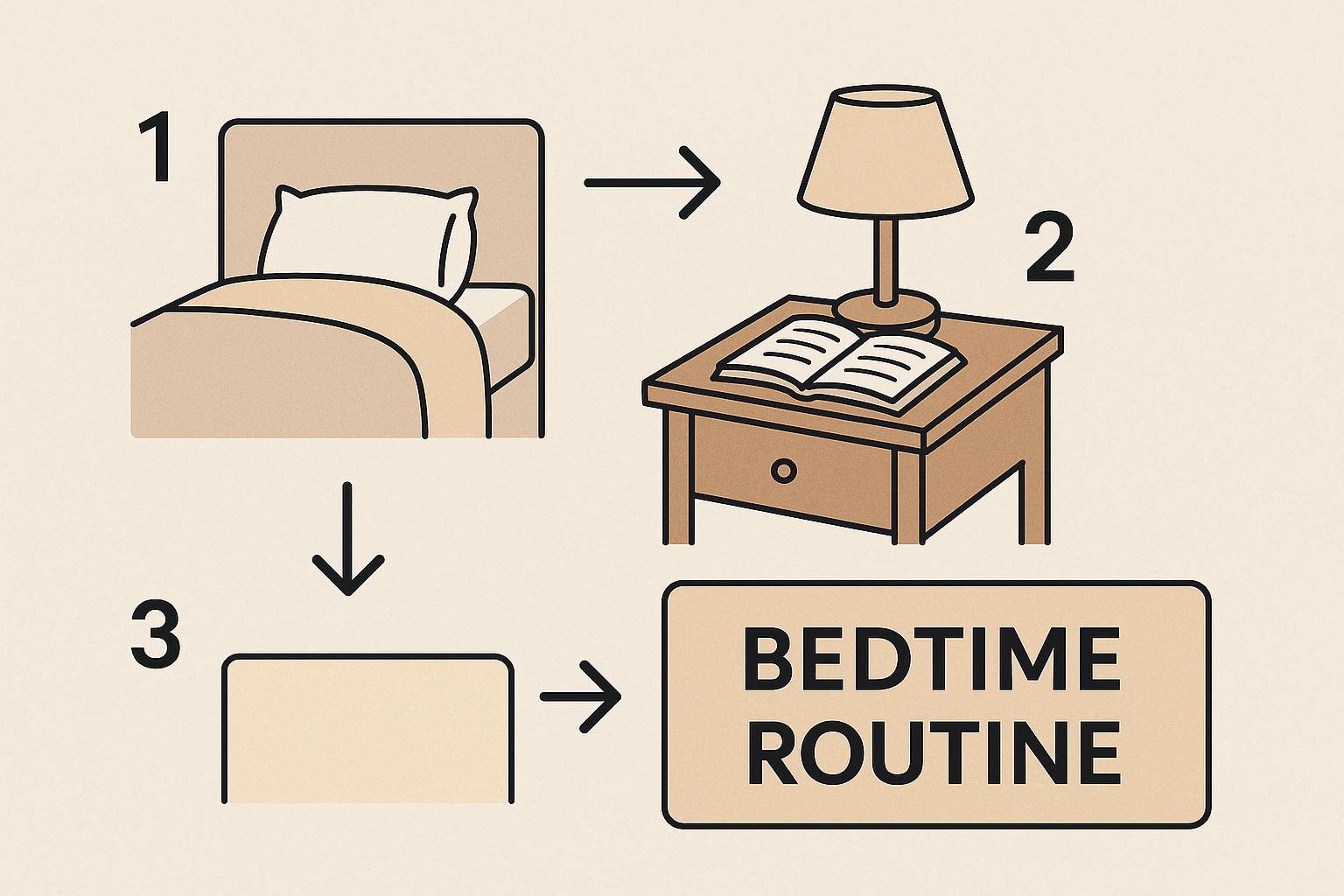
As you can see, creating a calm environment is foundational, and managing your light exposure with tools like blue light glasses is a huge part of that.
Honestly, the most effective way to improve your sleep is to build a consistent routine. When you combine a few proven strategies, you create a powerful system that gets your body’s internal clock back on track.
A racing mind is probably the biggest hurdle to falling asleep. Here are four practical things you can do to calm your nervous system, with your blue light blocking glasses playing a key supportive role.
If you want to dive deeper into the science behind this, you can learn more about how our glasses help with sleep and see the direct impact they have on melatonin production.
A solid pre-sleep ritual is your secret weapon for learning how to improve sleep quality naturally. And forget the generic advice—the key is to build a personalized routine you actually look forward to. For me, and countless others, the cornerstone of this ritual is making blue light blocking glasses a non-negotiable part of the last 90 minutes of my day. It's a small habit that powerfully trains your brain to associate them with shutting down for the night.
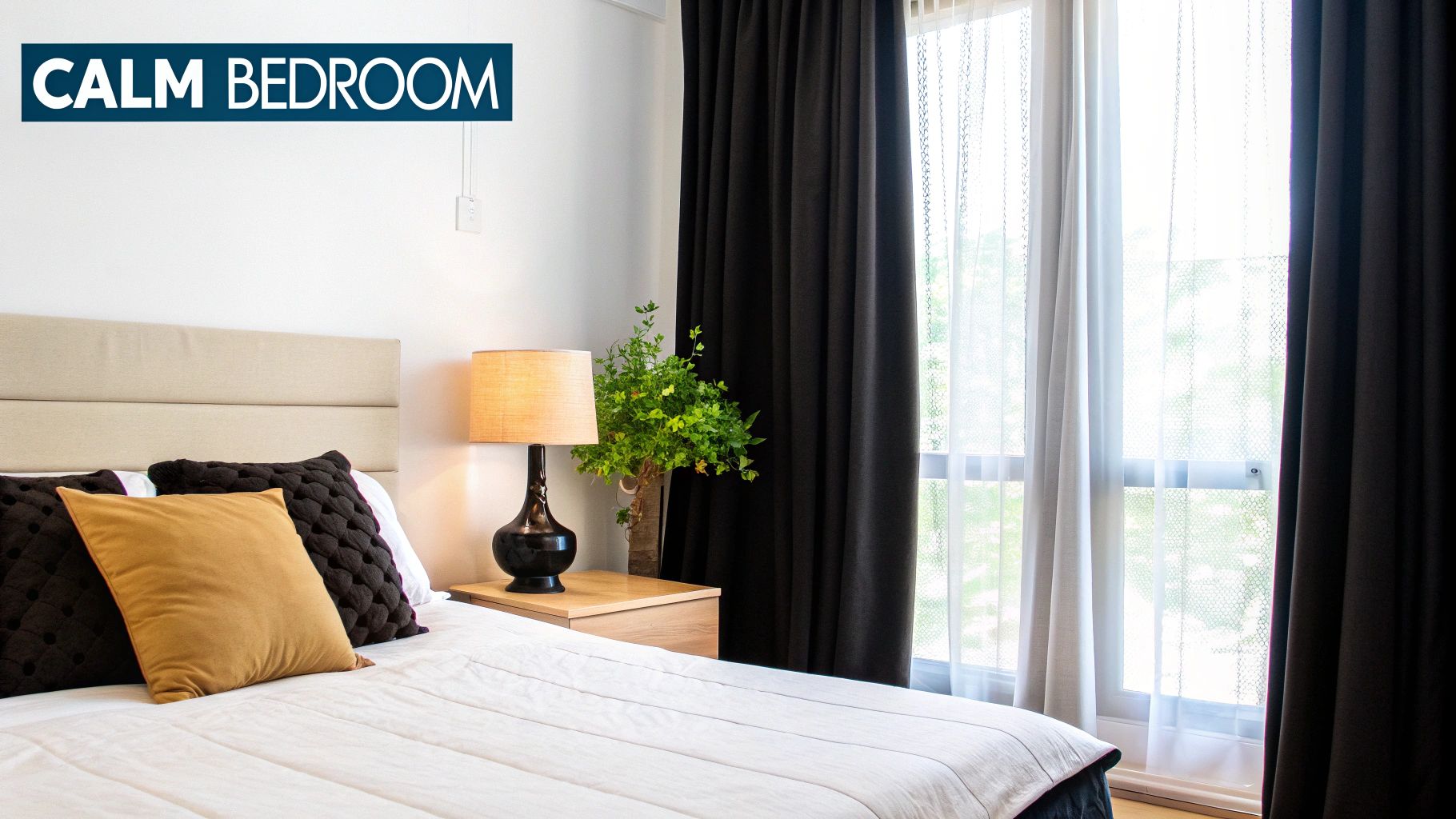
Let's face it, after a full day staring at screens, your eyes are just plain tired. The constant glare and high-energy light create a physical tension that makes it tough to shift into a relaxed state.
This is where you'll feel the immediate relief of amber-lensed glasses. They filter out that aggressive, harsh light, finally allowing your eye muscles to unclench and relax. This physical comfort is the first step toward mental calm. By dialing down that constant, low-level stimulation, you’re sending a clear signal to your nervous system that the day is over and it's safe to wind down.
Think of your amber blue light glasses as creating a warm, cozy visual environment, almost like candlelight or a sunset. This gentle filter helps you settle in, whether you're reading a book, watching a bit of TV, or just chilling on the couch.
They take the sharp, stimulating edge off of all the artificial lighting in your home, making it much easier to transition from the busyness of the day into a peaceful, pre-sleep mindset. Amber blue light glasses let you relax and wind down effectively.
A consistent pre-sleep ritual doesn't just happen; it's built. The goal is to create a sequence of calming activities that signals to your body and mind that sleep is coming. Wearing blue light glasses is a powerful first step in that sequence.
Building an effective sleep routine is all about layering a few proven habits. When you combine them, the effect is far greater than any single action on its own.
A busy mind is one of the biggest roadblocks to a good night's sleep. Here are four strategies to help you find some tranquility.
Even if you’ve nailed the perfect pre-sleep ritual, a racing mind can still be the single biggest obstacle to deep, restorative rest. When stress and anxiety kick in, your body stays on high alert, making it nearly impossible to drift off.
If this sounds familiar, you’re not alone. A global sleep survey from ResMed found that 57% of people blame stress for their sleep problems, with another 46% pointing to anxiety. The study, which covered over 30,000 adults, revealed that most people lose nearly three nights of good sleep every single week.
Tackling that mental chatter is a non-negotiable part of getting better sleep. Here’s how to start.
One of the fastest ways to tell your nervous system it's safe to power down is by controlling your breath. The 4-7-8 breathing technique is a deceptively simple tool that does just that.
Here’s the rundown:
Just repeat this cycle three or four times. This rhythmic pattern physically lowers your heart rate and signals to your brain that the day's threats are over. It's time to rest.
Trying to hold onto every to-do, worry, and random thought is a recipe for a sleepless night. The solution is a "brain dump"—the simple act of getting all that noise out of your head and onto paper.
Before you get into bed, grab a notebook. Spend just five minutes writing down everything that’s on your mind. Don’t worry about grammar or making it neat; just let it flow. This act of externalizing your thoughts helps you let them go, clearing up the mental space you need for rest.
By physically writing down your concerns, you give your brain permission to stop rehearsing them. It's a surprisingly effective way to quiet the internal noise that keeps you awake.
You don’t need a meditation cushion or a quiet room to be mindful. You can do it right in bed. Try a simple body scan once you’re under the covers.
Start by bringing your attention to your toes. Just notice any sensations—warmth, coolness, the pressure from the blankets—without judgment. Then, slowly move your awareness up through your feet, ankles, legs, and the rest of your body. This exercise grounds you in the present moment, pulling your focus away from anxious, looping thoughts.
Finally, don't forget how much your physical environment impacts your mental state. The harsh, stimulating light from screens contributes to both eye strain and mental alertness, which can easily fuel anxiety.
This is where slipping on a pair of orange colored blue light blocking glasses can make a huge difference. The soft, warm tint of the lenses from a brand like Element Lux physically calms your sensory system by reducing the jarring visual input that keeps your brain buzzing.
When you cut down on that digital stimulation, it becomes far easier for your mind to follow suit, relax, and finally wind down for a peaceful night’s sleep.
Great sleep doesn't come from a single magic bullet. It’s built on a foundation of solid, healthy habits. While managing your light exposure with the right glasses is a huge leap forward, mastering the fundamentals of sleep hygiene is what ties it all together for consistent, restorative rest.
Think of these habits as the non-negotiables. They’re what set the stage for your body to do what it’s naturally meant to do every night.
The single most powerful habit you can adopt? Consistency. Seriously. Try to go to bed and wake up at roughly the same time each day—and yes, that includes weekends. This simple act is like setting a reliable schedule for your body’s internal clock, also known as your circadian rhythm. When your body knows what to expect, it becomes so much easier to fall asleep and wake up feeling refreshed instead of groggy.
It’s easy to forget, but what you consume and how you move your body during the day have a direct line to how well you rest at night. A heavy meal or a high-intensity workout too close to bedtime can completely backfire, leaving you feeling wired and uncomfortable just when you should be winding down.
A good rule of thumb is to finish your last meal at least two to three hours before you plan to hit the hay. Similarly, get your more vigorous exercise in earlier in the day. In the evenings, switch to gentle, relaxing activities like light stretching or a casual walk.
Small, consistent daily actions are the key to long-term, restorative sleep. It's not about being perfect every night but about building a supportive routine that works for you.
Your bedroom environment sends powerful signals to your brain. To make sure it’s sending the right ones, focus on three things: making it cool, dark, and quiet.
Use blackout curtains to get rid of every last bit of light. If you live in a noisy area, a white noise machine can be a game-changer. And don't forget the thermostat—a comfortably cool temperature is best for sleep.
This is where the environment you create works hand-in-hand with your orange colored blue light glasses. By filtering out the harsh, stimulating artificial light from screens and bulbs, they help shield your eyes from digital strain and, more importantly, give your brain the "all clear" to start producing melatonin—the hormone that makes you feel sleepy. The physical relief from eye strain alone helps your whole body begin to relax.
Combining a pitch-dark room with the filtered, gentle light from glasses like the ones from Element Lux creates the ideal one-two punch to help you fall asleep faster.
Ultimately, learning how to improve sleep quality naturally is all about layering these simple but powerful strategies. Together, they create a routine that prepares your body and mind for the deep rest you need.
It's one thing to read about sleep strategies, but it's another to feel confident putting them into practice. Let's clear up a few of the most common questions I hear about how this all works in the real world.
I get this one a lot. It's simple, really. Orange-lensed glasses do two key things to fight back against the biggest sleep disruptors of our modern world: digital eye strain and melatonin suppression.
First, think about how your eyes feel after staring at a screen for hours. That harsh, focused glare makes your eye muscles clench up, leading to fatigue and tension headaches. The glasses soften that light, giving your eyes an immediate sense of relief. It’s a physical relaxation that helps the rest of your body follow suit. This is how orange colored blue light glasses help with eye strain.
But the real magic is in how the orange tint filters out specific wavelengths of blue and green light. These are the exact frequencies that scream "it's daytime!" to your brain. By blocking that signal, you allow your body to get on with its natural job of producing melatonin, the hormone that makes you feel sleepy. This is how orange colored blue light glasses help with sleep.
Think of it as creating a "virtual sunset" for your brain. While amber lenses are a great starting point for easing into the evening, the deeper orange lenses give you the serious protection you need in those final hours before bed to truly safeguard your sleep cycle.
Honestly, the secret isn't some magic pill—it's building a solid, consistent routine. Small actions, repeated night after night, build powerful momentum for better rest.
A racing mind is often the last hurdle to a good night's sleep. There's even a growing phenomenon called "sleep anxiety," with research showing nearly 40% of young adults experience it multiple times a week, largely thanks to digital overload and modern stress.
Here are four simple but effective ways to quiet your mind:
Ready to take back control of your sleep? The science is crystal clear—managing your light environment is the most powerful first step you can take. Element Lux glasses are specifically engineered to filter the most disruptive wavelengths, helping you wind down naturally and wake up feeling truly refreshed.
Shop the collection now and start your journey to better sleep tonight.
Tackling shift work sleep disorder starts with getting to the heart of the problem: your work schedule is in a head-to-head battle with your body’s internal 24-hour clock. The entire goal of any treatment plan is to get that clock back on your side using practical, proven strategies.
This isn't just about willpower. It’s about creating the perfect sleep environment, knowing exactly when and how to use tools like blue light blocking glasses, and manipulating light exposure to wrestle back control over your sleep.
Working nights, early mornings, or rotating shifts is like putting your body through a constant state of jet lag. You're fighting to stay alert when your internal clock—your circadian rhythm—is screaming at you to go to bed. Then, when your shift ends, you’re trying to force sleep when your body is biologically programmed to be wide awake, often with daylight and daytime noise as unwelcome intruders.
This chronic mismatch is the very definition of Shift Work Sleep Disorder (SWSD). It's more than just feeling tired; it’s a recognized medical condition that brings on debilitating fatigue, insomnia, and a brain fog that’s hard to shake.
Your body's production of melatonin, the hormone that tells your brain it's time to sleep, gets thrown into total chaos. Instead of rising naturally in the evening, its release is crushed by the bright artificial lights at your workplace or the morning sun hitting your windshield on the drive home.

If you're going through this, you are far from alone. Around 20% of the global workforce are shift workers. Of that group, studies estimate that SWSD affects a staggering 20% to 30% of them. That's millions of people stuck in the same exhausting cycle you are.
The fallout from SWSD goes way beyond the bedroom. When your circadian rhythm is constantly out of whack, the effects bleed into every part of your life. It’s that desperate struggle to stay sharp during a critical task at 3 AM. It’s the utter frustration of lying in bed at 9 AM, bone-tired but unable to drift off.
You might be experiencing:
Key Takeaway: Shift Work Sleep Disorder isn't a character flaw or a lack of discipline. It is a completely natural biological response to an unnatural schedule. Understanding and accepting this is the first real step toward managing it.
The good news is that there are very real, tangible steps you can take to manage SWSD. This guide is your complete toolkit, filled with practical strategies to help you reclaim your sleep, your energy, and your life.
Before we dive into the details, here’s a quick overview of the key strategies we'll be covering. Think of this as your roadmap for the journey ahead.
| Treatment Strategy | Primary Goal | Best For |
|---|---|---|
| Sleep Hygiene | Create a pro-sleep environment. | All shift workers, as a foundational practice. |
| Light Therapy | Reset the body clock with bright light. | Workers on stable night or early morning shifts. |
| Melatonin | Signal sleep time to the brain. | Night shift workers trying to sleep during the day. |
| Blue-Light Blockers | Prevent light from suppressing melatonin. | Night shift workers during the commute home. |
| Scheduling | Minimize circadian disruption. | Workers with some control over their shift patterns. |
Each of these elements plays a crucial role, and we'll break down exactly how to implement them.
We're going to cover everything from turning your bedroom into the ultimate sleep sanctuary to using powerful tools like blue light blocking glasses and targeted light therapy. You can find more in-depth articles and supporting materials at https://element-lux.com/resources/. My goal is to give you a clear, actionable path forward so you can start working with your body instead of constantly fighting against it.
Your bedroom needs to be your sanctuary, a place dedicated solely to rest. But for a shift worker, it often feels more like a battleground against daylight and daytime noise. The very first step in any effective shift work sleep disorder treatment is to transform this space. You're essentially building a sleep cave—an environment so perfectly optimized for rest that it tells your body it's time to shut down, even when the sun is high in the sky.
This isn't just about being comfortable; it's about seizing control of your environment to support your body's need for sleep. And the challenge is huge. Research shows that about 50% of night workers scrape by on six hours of sleep or less, a massive jump from the 26% of their daytime counterparts. Even more telling, a staggering 51% of night shift workers screen positive for at least one sleep disorder. You can dig deeper into these findings on sleep disruption in shift workers.
Your first mission, should you choose to accept it, is to wage war on light and sound. These are the primary enemies of daytime sleep. Your brain is hardwired to associate light with being awake, so creating total darkness is non-negotiable.
This one-two punch creates a powerful sensory deprivation chamber, signaling to your brain that it's nighttime and safe to rest, no matter what the clock says. This step alone can make a world of difference.

Consistency is your most powerful weapon. A structured wind-down routine, performed before every single sleep period—whether that’s at 9 AM or 9 PM—is how you train your body to anticipate rest. Think of it as a sacred, non-negotiable part of your day.
This is where blue light blocking glasses become your secret weapon. As you start to wind down, the artificial light from lamps and screens is screaming "wake up!" to your brain. Amber blue light glasses are perfect for this phase. Wear them while you read, watch a little TV, or just tidy up. They filter out just enough of that stimulating blue light to help your mind and body start to relax and wind down.
Then, for that final hour before you hit the pillow, switch to orange colored blue light glasses. These are the heavy hitters, blocking a much wider spectrum of the light that sabotages melatonin production. This does more than just ease eye strain from your phone; it gives your brain the all-clear to ramp up melatonin, paving the way for deep, restorative sleep.
Creating the perfect environment and routine is the foundation. Here's a quick rundown of the essentials for high-quality sleep:
By making your bedroom a no-work, no-stress zone, you reinforce the mental association between that room and sleep. This psychological cue is a powerful part of managing SWSD.
It's nearly impossible to switch off your mind when the stress from a demanding shift follows you home. That’s why integrating relaxation techniques into your pre-sleep ritual is absolutely critical.
Here are four simple but powerful ways to de-stress and quiet your mind:
Getting your bedroom pitch-dark is a great first step, but the real battle against SWSD is won by managing your light exposure before you even hit the pillow. This is where blue light blocking glasses become your secret weapon. Think of them as a personal bodyguard for your melatonin, the crucial sleep hormone that gets absolutely decimated by artificial light.
For anyone working the night shift, the most destructive part of your "day" isn't the noisy afternoon—it's the commute home. That morning sun, even on an overcast day, is a firehose of high-energy blue light that screams "WAKE UP!" to your brain. Just that one drive can slam the brakes on melatonin production, making it almost impossible to fall asleep once you're finally in bed.
When you need serious, heavy-duty sleep defense, you grab the orange colored blue light glasses. These are specifically engineered to block a massive amount of blue light and even some of the neighboring green light spectrum, both of which are notorious for throwing your circadian rhythm into chaos.
After a long shift under harsh fluorescent lights or staring at computer screens, your eyes are fried. Popping on a pair of orange glasses brings instant relief. It’s like turning down the visual volume on the world, easing that overstimulated feeling and helping with eye strain, which gives your eyes a much-needed break.
Here's a look at the ELEMENT LUX glasses, designed to do just that.

The wrap-around design offers full coverage, blocking disruptive light from all angles—a critical feature for preserving your sleep hormones after a night shift.
More importantly, these glasses create a biological bubble around you. By wearing them on your commute home and for the last hour or so before you plan to sleep, you're essentially telling your brain it's already dark out. This helps with sleep by allowing your melatonin levels to rise naturally, prepping you for deep, restorative rest.
While orange lenses are for that critical final stretch before bed, amber blue light glasses are perfect for the longer "wind-down" period. They block a good amount of blue light but are less intense, casting the world in a warm, calming glow instead of a deep orange.
This makes them ideal for wearing in the first few hours after your shift as you decompress. You can wear your amber glasses while making a meal, watching a bit of TV, or reading. They take the sharp, stimulating "edge" off of artificial lighting, helping you transition from a state of high alert to one of relaxation. This gentle reduction in stimulating light allows your nervous system to calm down, making it much easier to relax and wind down when bedtime rolls around.
Want to dive deeper? You can explore our detailed guide on how our glasses help with sleep.
Knowing when to use each pair is what unlocks their full power. Here’s a simple, real-world plan for a typical night shift worker:
My Pro Tip: Treat your blue light glasses like any other essential part of your sleep routine. I always tell people to keep a pair in their car or work bag so they're never caught without them. It's the consistency that really trains your body to respond to this powerful new sleep cue.
Stress and sleep are terrible bedfellows. A racing mind can ruin even the most perfectly prepared sleep environment. Integrating your glasses into a broader relaxation routine can make a world of difference.
Perfecting your sleep sanctuary is a great first step, but to really get a handle on shift work sleep disorder, you need to get a little more hands-on. This means actively resetting your body’s master clock. Think of it like manually overriding your internal programming to fit your work schedule.
The whole concept boils down to this: your brain is hardwired to associate bright light with “wake up time” and darkness with “sleep time.” By strategically controlling when you see light and when you don’t, you can trick your body into feeling alert or sleepy on command—even when that command is the total opposite of a normal day.
One of the most powerful things you can do to kickstart your alertness at the beginning of a night shift is to give yourself a dose of bright light. A light therapy box, which blasts out a very bright, full-spectrum light (around 10,000 lux), is perfect for this.
Sitting in front of one for just 20-30 minutes signals to your brain that it’s morning. This stops the production of any lingering melatonin that’s making you feel groggy and gives you a clean burst of energy to start your shift, no caffeine required. Timing is everything, though. Use the light box early in your shift, never towards the end, or you’ll find it impossible to wind down later.
Of course, what you do after your shift is just as important—maybe even more so.
Once you clock out, light is the enemy. Your mission is to avoid bright light, especially the morning sun, on your way home. This is where your blue light blocking glasses become your most essential piece of gear.
Melatonin can be an incredible ally, but most people use it wrong. It’s not a sleeping pill that just knocks you out. It’s what’s known as a chronobiotic, meaning it helps shift the timing of your internal clock. For a night worker, taking it at the right time is like telling your brain, “Okay, nighttime starts now.”
A small dose—typically 0.5 to 3 mg—taken about 30-60 minutes before you plan to go to bed can help you fall asleep much faster and stay asleep longer. But again, the timing has to be precise. Taking it too early or too late can mess up your rhythm even more.
For more deep dives into how light impacts sleep and overall wellness, the articles on the Element Lux blue light blog are a fantastic resource.
It’s always a good idea to chat with a doctor before starting melatonin. They can help you figure out the exact dose and timing that works for your unique schedule and make sure there isn’t another sleep issue at play.
This infographic breaks down what getting professional help for SWSD typically looks like.
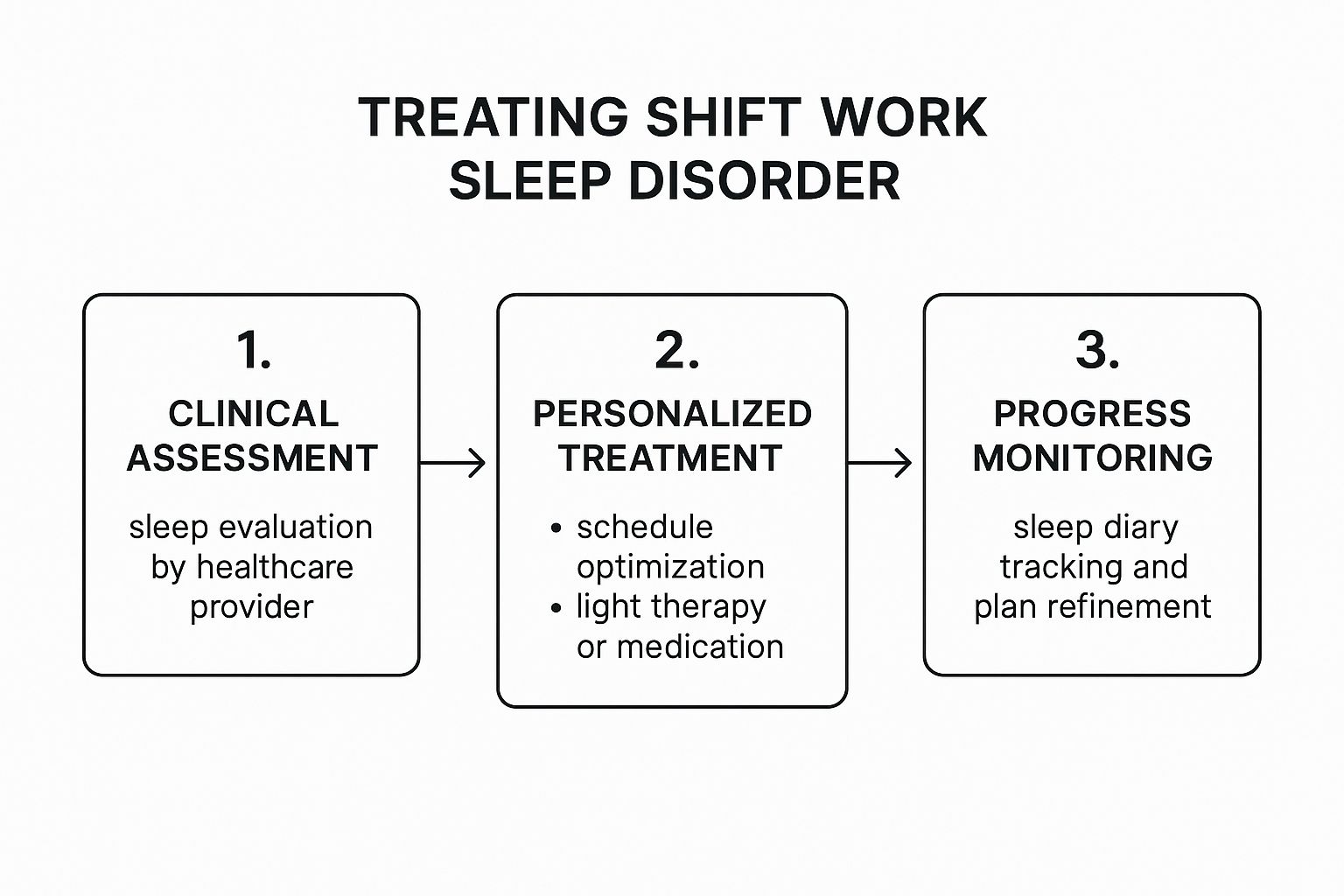
From the initial assessment to a personalized treatment plan and regular check-ins, you can see that managing SWSD is a deliberate, structured process—not just a guessing game. And powerful tools like light therapy and melatonin are key parts of that personalized plan.
Shift work is stressful. There's no getting around it. After a long, demanding shift, your mind is often still racing, making it nearly impossible for your body to switch off and get the restorative sleep it desperately needs. This isn't just a minor annoyance; it's a huge hurdle for the more than one in four shift workers who may be struggling with this condition.
In fact, a massive meta-analysis of 29 different studies found the prevalence of shift work disorder to be around 26.5%. That’s a staggering number of people whose health is at risk. If you want to dive deeper, you can read the full research on the global health burden of shift work.
So, how do you combat this? Managing stress isn't just a nice-to-have; it's a non-negotiable part of any effective shift work sleep disorder treatment plan. Let's walk through some practical, real-world strategies to quiet your mind and set the stage for deep, quality sleep.
Your brain thrives on routine. A consistent wind-down ritual is one of the most powerful signals you can send it, telling it that the day is over and it’s time to prepare for sleep—no matter what the clock on the wall says. Think of this as a mandatory buffer zone between the chaos of your job and the calm of your bedroom.
This is where you bring in your secret weapon: blue light blocking glasses. As soon as you begin your wind-down period, put on a pair of amber blue light glasses. The warm tint instantly softens the harsh glare of artificial lighting, helping you de-stress. They work by gently dialing down the mental stimulation from screens and overhead lights, allowing your brain to shift gears from high alert to a state of calm.
These glasses do more than just protect your melatonin production; they actively help your body and mind relax. Specifically, orange colored blue light glasses are your best friend when fighting the mental and physical fatigue that builds up over a long shift.
Think about it: after hours under intense workplace lighting or staring at monitors, your eyes feel strained and fried. Slipping on a pair of orange lenses provides immediate visual relief. It cuts through that feeling of overstimulation that keeps your mind buzzing long after you've clocked out. This physical comfort is a direct signal to your nervous system that it's okay to power down.
This reduction in eye strain is a direct pathway to better sleep. When your eyes can finally relax, the rest of your body tends to follow. The deep orange tint creates a kind of "digital sunset," a calming visual cue that primes your brain for rest, making it much easier to fall asleep faster and sink into those deeper, more restorative sleep cycles.
By making blue light blocking glasses part of your evening, you're not just blocking light—you're creating a powerful ritual. The simple act of putting them on can become a psychological trigger, signaling that the workday is officially done and your relaxation time has begun.
A great wind-down routine is only as good as the sleep hygiene it's built on. Here are some of the most impactful habits you can adopt to ensure you're getting the highest quality sleep possible.
You can't be anxious and relaxed at the same time. To truly unwind, you need to actively push stress out of the picture. Here are four simple but effective ways to do just that.
Starting a treatment plan for shift work sleep disorder always brings up a lot of questions. It's completely normal to wonder what to expect as you start making these changes. Let's tackle some of the most common questions I hear from people who are new to managing SWSD.
Honestly, it varies for everyone, but you can feel some immediate wins. Simple changes to your sleep hygiene—like making your room pitch black with blackout curtains—can make a difference in your very first week. You might notice you're falling asleep a little faster or feeling a bit more rested.
The bigger changes, like fully resetting your internal clock using light therapy, take more time and patience. We're talking several weeks of consistent, dedicated effort. The key is to not give up. For instance, putting on a pair of orange colored blue light glasses after your shift might immediately make your eyes feel less strained, but their real power to improve your sleep quality builds up over many nights. Stick with it.
As long as you’re working shifts, a permanent "cure" isn't really the right way to think about it. The disorder is a direct result of the conflict between your work schedule and your body's natural rhythm. The real goal is to manage it so effectively that it no longer runs your life.
By combining the right strategies—carefully timed light exposure, rock-solid sleep habits, and tools like blue light blocking glasses—you can seriously improve how you feel, both when you're sleeping and when you're awake. Think of it less as a cure and more as a successful long-term management plan that puts you back in control.
This is a great question. Both are effective, but they play slightly different roles in helping you wind down.
A fantastic strategy many shift workers use is to wear amber blue light glasses for a couple of hours post-shift to ease into relaxation, then switch to the stronger orange colored blue light glasses for that last 30-60 minutes before hitting the pillow. This two-step approach can work wonders.
If you’ve been trying these strategies consistently and you're still struggling, it's time to bring in a professional. Don't wait.
See a doctor if you're experiencing any of these:
A doctor can make sure there isn’t another underlying issue, like sleep apnea, contributing to your problem. They can also discuss prescription options or help create a more personalized plan based on your specific health and work schedule. It's the right move for your long-term health.
Ready to get a handle on your light exposure? The team at Element Lux has created blue light blocking glasses specifically for the challenges shift workers face.
Explore our collection and find the perfect pair for your wind-down routine.
Ever feel like your body is on a completely different time zone than the rest of the world? That frustrating, out-of-sync feeling is at the heart of what’s known as a circadian rhythm disorder.
The most obvious signs are trouble falling asleep at a "normal" time, waking up way too early, or fighting a deep, persistent fatigue during the day that’s far more than just being tired.
Think of your body as having an internal master clock. This clock, your circadian rhythm, is like a conductor for an orchestra, making sure everything from your sleep-wake cycle to your hormones and digestion runs on a synchronized schedule. It’s what makes you feel naturally alert in the morning and sleepy at night.
A circadian rhythm disorder happens when that internal conductor loses the beat. Suddenly, your body’s clock is in direct conflict with the 24-hour day everyone else is living on. This isn't just a few rough nights of sleep; it's a constant, disruptive pattern that can seriously get in the way of your life.
This isn't a rare problem, either. Circadian rhythm sleep disorders (CRSD) are surprisingly common. In the United States, for instance, delayed sleep phase disorder—just one type of CRSD—affects anywhere from 7% to 16% of adolescents. As chronic health issues and our population's average age increase, experts expect to see these numbers climb. You can explore more data on sleep disorder trends to see the bigger picture.
So, how do you know if you're dealing with a bad week of sleep or something more? A few nights of tossing and turning due to stress is one thing. But a consistent inability to line up your sleep schedule with your daily responsibilities usually points to a deeper issue.
Here’s a quick rundown of what a true circadian rhythm disorder looks like:
This is why daytime fatigue is one of the biggest complaints. It’s a classic sign that something is fundamentally off with your internal clock.
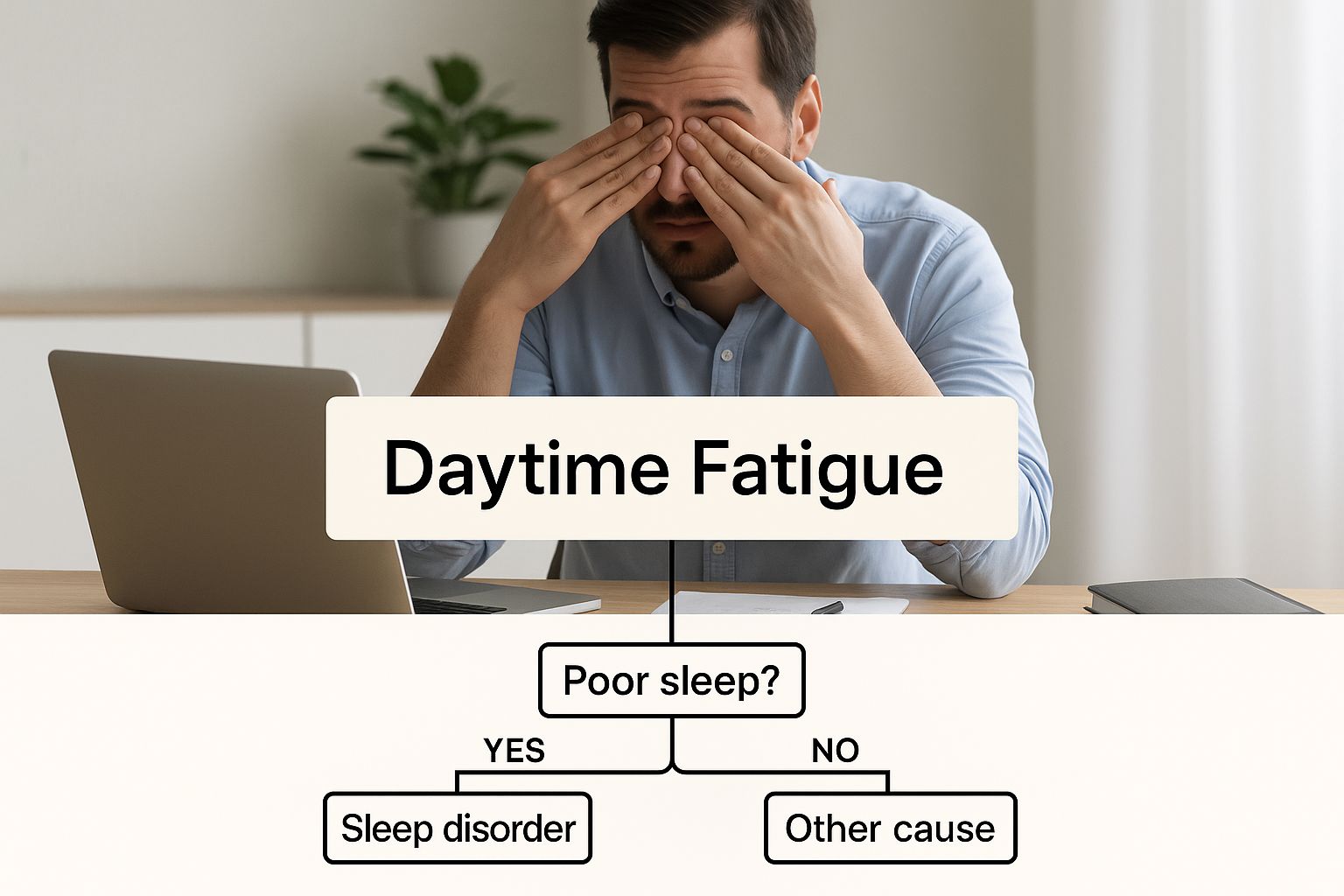
As the image shows, the struggle doesn't end when the sun comes up. A misaligned body clock turns a nightly problem into a daily battle against exhaustion.
To help clarify, here’s a simple breakdown of how to tell the difference between a normal sleep problem and a potential disorder.
| Symptom | Typical Bad Night's Sleep | Potential Circadian Rhythm Disorder |
|---|---|---|
| Trouble Falling Asleep | Occasional difficulty due to stress, caffeine, or a late movie. | A consistent pattern of not feeling tired until hours after your desired bedtime (e.g., 2 AM or later). |
| Waking Up Too Early | Waking up early once in a while, often able to go back to sleep. | Regularly waking up much earlier than planned (e.g., 4 AM) and being unable to fall back asleep. |
| Daytime Fatigue | Feeling tired the next day but recovering after a good night's rest. | Chronic, heavy exhaustion and brain fog that persist daily, even if you technically got enough hours of sleep. |
| Schedule Impact | You can adjust your sleep schedule back to normal within a day or two. | You feel a constant, biological pull to sleep and wake at "off" hours, regardless of your schedule. |
Spotting these persistent patterns is the first step. While a bad week of sleep is frustrating, recognizing the signs of a true disorder means you can start looking for real, effective solutions.
Knowing the symptoms of a circadian rhythm disorder is the first step, but understanding what’s causing them is where the real solution lies. More often than not, the culprits are hiding in plain sight, woven into our daily routines. Modern life, with its constant demands and glowing screens, has a knack for putting us at odds with our own internal clocks.
One of the biggest disruptors? Artificial blue light. When you’re staring at your phone, tablet, or computer late into the evening, that bright, blue-toned light is sending a powerful message to your brain: "It's still daytime!" This sneaky signal suppresses the production of melatonin—the hormone that tells your body it's time to sleep—making it incredibly difficult to wind down.
While late-night screen time is a major offender, it’s certainly not the only thing that can throw your internal clock for a loop. Several other lifestyle and environmental factors can lead to those persistent circadian rhythm disorder symptoms.
At the end of the day, all these factors create a mismatch between our biology and our environment. Getting a handle on how they work—especially the pervasive issue of blue light—is essential. If you want to dive deeper, feel free to explore our blue light blog for more insights.
By pinpointing the specific culprits in your own life, you can start taking targeted steps to get your sleep cycle back on track.
When your internal clock is off-kilter, the fallout goes way beyond just feeling sleepy. Think of a chaotic sleep schedule as a stress multiplier—it directly messes with your mental and emotional stability. This kicks off a nasty cycle: poor sleep tanks your mood, and a low mood makes getting good sleep feel impossible.
This link between your body clock and your mental health isn't just in your head; it's deeply biological. The brain chemicals that keep your mood steady, like serotonin, are produced on a strict daily schedule. When that rhythm gets thrown off, your brain’s entire chemical balance can go haywire, leaving you irritable, emotionally fragile, and struggling to cope with everyday stress.
This connection is so strong that researchers now see circadian rhythm disruption as a major contributor to mental health conditions like major depressive disorder (MDD). It's a huge issue, with estimates suggesting that about 20% of people worldwide deal with mood or anxiety disorders tied to the circadian disruptions of modern life. In fact, recent studies are showing that a wonky internal clock can even be used as a reliable digital marker to flag when someone might need psychiatric help. You can read the full research on circadian disruption and mood to see how deep this connection goes.
So, what does this all mean? It means your emotional struggles aren't happening in a vacuum. They are fundamentally intertwined with your body's most basic internal rhythms.
Understanding and accepting this connection is the first real step toward finding solutions that tackle both your sleep and your mental health at the same time. You’re not just tired—your entire system is sending a clear signal that it needs to get back in sync.
One of the most powerful ways to manage your circadian rhythm is to control your light exposure, especially after the sun goes down. This is where specialized, light-filtering lenses come into play. Think of them as creating a personal sunset, sending a clear signal to your brain that it’s time to wind down—even when you’re surrounded by bright artificial lights from screens and bulbs.
By strategically blocking specific wavelengths of light, these glasses protect your body's natural production of melatonin. That’s the crucial hormone that tells your body it's time to sleep. It’s like putting up a shield against the very light that keeps you feeling wired and awake long after you should be resting.
When you need serious help getting your sleep cycle back on track, orange-colored lenses are the heavy hitters. They’re designed to filter out the most disruptive, high-energy blue and green light wavelengths that wreak havoc on your internal clock. By blocking this harsh light, they combat digital eye strain, reducing the gritty, tired feeling and headaches associated with screen time. The moment you put them on, you’re essentially telling your brain the day is over. This allows your melatonin levels to rise naturally, making it much easier to fall asleep and achieve deep, restorative rest.
Here's an example of our Element Lux orange glasses, designed for maximum light filtering.
As you can see, that distinct orange tint is what does the hard work, transforming a bright, stimulating screen into a warm, sleep-friendly light source.
While orange lenses are your go-to for serious sleep preparation, amber-colored blue light glasses offer a gentler approach, letting you relax and wind down. They're perfect for those earlier evening hours when you want to de-stress. These lenses filter a smaller portion of blue light, creating a warm, cozy light environment that takes the edge off stimulating artificial lights. Popping on a pair of amber glasses after work can make the transition from a busy, high-alert day to a calm, restful evening feel much smoother, allowing both your mind and body to begin relaxing.
You can learn more about how our glasses help with sleep and figure out which lens is the right fit for your nightly routine.
By blocking the specific light frequencies that suppress melatonin, blue light blocking glasses can be a simple yet effective way to realign your sleep cycle with your desired schedule, directly combating common circadian rhythm disorder symptoms.
Not sure whether to go with orange or amber? It really comes down to what you're doing in the evening and how sensitive you are to light. This table breaks it down to help you decide.
| Lens Color | Primary Benefit | Best For |
|---|---|---|
| Orange | Maximum Melatonin Protection & Sleep Induction | Wearing 1-2 hours before bed, especially if you have significant sleep issues or are using screens late at night. |
| Amber | Relaxation & Reduced Eye Strain | Winding down after work, reading, or watching TV in the early evening to create a calm, stress-free environment. |
Ultimately, many people find having both pairs useful—amber for general evening relaxation and orange for the final pre-sleep stretch.
Alright, you understand the symptoms and what might be causing your internal clock to go haywire. That's the first big step. Now, let's talk about how to actually reclaim your nights and feel human again during the day.
This isn't about some massive life overhaul. It's about making small, smart changes to your routines—for both your mind and your body—that add up to a huge difference. Think of it as actively steering your internal clock back on track.
The right tools can make this whole process much easier. One of the single most powerful things you can do is manage the light you see in the evening. This is where specialized blue light blocking glasses come in. They send the right signals to your brain, prepping it for sleep long before your head hits the pillow.
A great pair of glasses is even more effective when you pair them with solid, healthy habits. Here are the top ways to improve your sleep quality and get your internal clock back in sync:
Here’s an example of our Element Lux amber glasses, which are designed to create that calming visual environment.
The warm tint of these lenses cuts the harsh glare from artificial lights, helping to ease that feeling of being "on edge" and preparing your mind for a peaceful night.
By creating a shield against disruptive artificial light, blue light blocking glasses become a key part of a holistic strategy to manage circadian rhythm disorder symptoms and improve overall well-being.
Stress and anxiety are absolute sleep-killers. If you can quiet your racing mind in the evening, you’ll find it so much easier to fall asleep.
When you start digging into the world of circadian rhythm disorders, a lot of practical questions pop up. Let's tackle some of the most common ones to give you a clear path forward for feeling and sleeping better.
If you've ever felt that gritty, headache-inducing eye strain after a long day in front of a computer, you know the feeling. Orange-colored blue light glasses are fantastic for combating exactly that. They work by filtering out the specific, high-energy blue light wavelengths that blast out of our screens.
This intense light is a major culprit behind visual fatigue, dryness, and tension headaches. By blocking a huge chunk of it, orange lenses create a much softer, warmer visual experience. It instantly makes evening screen time more comfortable and puts way less stress on your eyes.
Beyond just eye comfort, orange-colored blue light glasses are a game-changer for your sleep. When your eyes take in blue light at night, it essentially tricks your brain into thinking it's still high noon. This confusion shuts down your body's production of melatonin—the critical hormone that tells you it's time to sleep.
Orange lenses act like a shield, blocking those disruptive signals. This allows your melatonin levels to rise naturally as the evening goes on, just as they should. Try wearing them for 90 minutes to two hours before bed. You’ll be amazed at how it can help you fall asleep faster and get the kind of deep, restorative rest your body is craving.
Think of amber blue light glasses as your "winding down" tool. They let you relax and unwind by filtering a good amount of blue light, making them less intense than orange lenses. This makes them perfect for easing into a calm, relaxed state in the early evening.
The warm, gentle light they create helps your nervous system shift gears from a state of high alert to one of tranquility. Pop on a pair of amber lenses to help you transition from a hectic day to a peaceful night, letting you de-stress and prepare your mind for sleep.
The bottom line is this: managing your light exposure in the evening is one of the most powerful things you can do to support a healthy circadian rhythm. When you use the right tools, you can give your brain the clear signal it needs to rest.
Great sleep isn't about one magic bullet; it's about building a consistent, supportive routine. And if you want to dive deeper, you can always explore the topics in our Element Lux resources library.
Here are the essentials:
Yes, there's a definite link between blue light and headaches, and it almost always comes down to digital eye strain. When you stare at a screen for hours, the high-energy visible (HEV) light forces your eyes to work overtime, leading to fatigue, tension, and that all-too-familiar head pain.
Ever wrapped up a long day at the computer with a throbbing headache? You’re not alone. The digital devices we depend on are often the direct cause of that discomfort, and the real culprit is the specific kind of light they pump out.
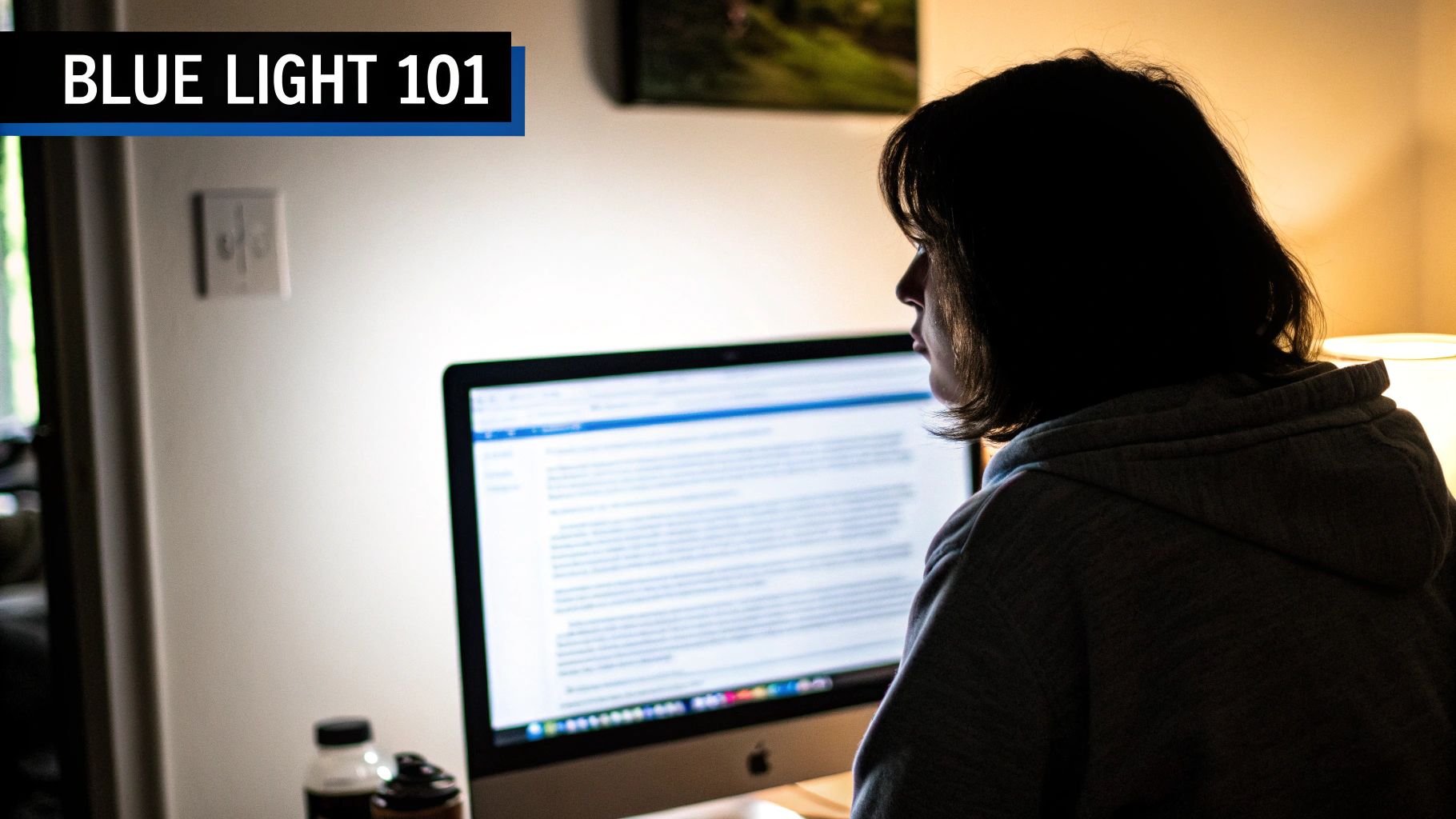
This high-energy light, what we call blue light, acts like a constant, low-level stressor on your eyes. Imagine a persistent, quiet hum in the background—you might be able to ignore it for a bit, but eventually, its non-stop presence starts to cause real irritation and fatigue.
After hours of exposure, this relentless stimulation triggers a condition known as digital eye strain. This isn't just about feeling tired; it’s a cluster of physical symptoms that are a direct pipeline to head pain.
The connection between screen time and head pain isn't just a hunch—it's well-documented. One study looking into our screen habits found a powerful link between long-term blue light exposure and how often people get headaches.
A huge number of participants, many of whom were clocking 7–9 hours on screens every day, reported a significant increase in both tension-type and migraine headaches. It's a clear reminder of how our daily digital routines can directly mess with our physical well-being. You can learn more about the study's findings on blue light and headaches to see the data for yourself.
But this constant exposure does more than just wear out your eyes. It also keeps your brain on high alert. The intensity of blue light is a powerful signal to your mind that it’s daytime, which makes it incredibly difficult to relax and properly wind down, even long after you’ve shut off your devices.
So, how do you know if your headaches are the direct result of too much screen time? The signs of digital eye strain tend to build up slowly over the day. If you notice a pattern, blue light is likely the cause.
Here are the most common signs that your headaches are tied to screen use.
| Symptom | Description |
|---|---|
| Dull Ache Behind the Eyes | A nagging, persistent pressure that feels like it’s building up right behind your eye sockets. |
| Sensitivity to Light | You might find that normal indoor lighting suddenly feels overwhelmingly bright or harsh after hours on a screen. |
| Blurred Vision | Your focus gets fuzzy, especially when you try to look away from your screen at objects in the distance. |
| Tension Headaches | This classic symptom feels like a tight band is being squeezed around your forehead, a direct result of strained eye and facial muscles. |
Recognizing these symptoms is the crucial first step. Once you identify blue light as the trigger, you can start looking for real solutions—like blue light blocking glasses, which are specifically designed to filter out this aggressive light and bring some much-needed relief.
To really get why blue light and headaches are so connected, we have to look at how our eyes and brain uniquely process this one part of the light spectrum. Unlike other colors, blue light has a shorter wavelength and packs more energy, which is particularly harsh for the sensitive network of nerves in our eyes.
Think of it like a sound that's just a bit too high-pitched. You can hear other noises just fine, but that one specific frequency is grating and can even become painful after a while. Blue light works the same way on a special set of light-sensitive cells in our retinas.
These cells are called intrinsically photosensitive retinal ganglion cells (ipRGCs). Their main job isn't to help you see, but to talk directly to the parts of your brain that manage pain and emotion. When these cells get blasted with high-energy blue light from our screens, they go into overdrive.
This overstimulation kicks off a cascade of distress signals that travel from your eyes straight to your brain. These signals race along the trigeminal nerve, a major neural highway that’s famous for its role in triggering migraine pain.
When this nerve gets agitated by the constant stream of blue light signals, it can lead to that awful throbbing pain and intense pressure we know as a severe headache or migraine.
This direct line of communication is also why so many of us experience photophobia, or extreme light sensitivity, during a headache. Your brain is already on high alert, and any more light—especially blue light—just cranks up the volume on those pain signals, making everything feel so much worse.
This diagram shows just how simple but powerful that connection is.
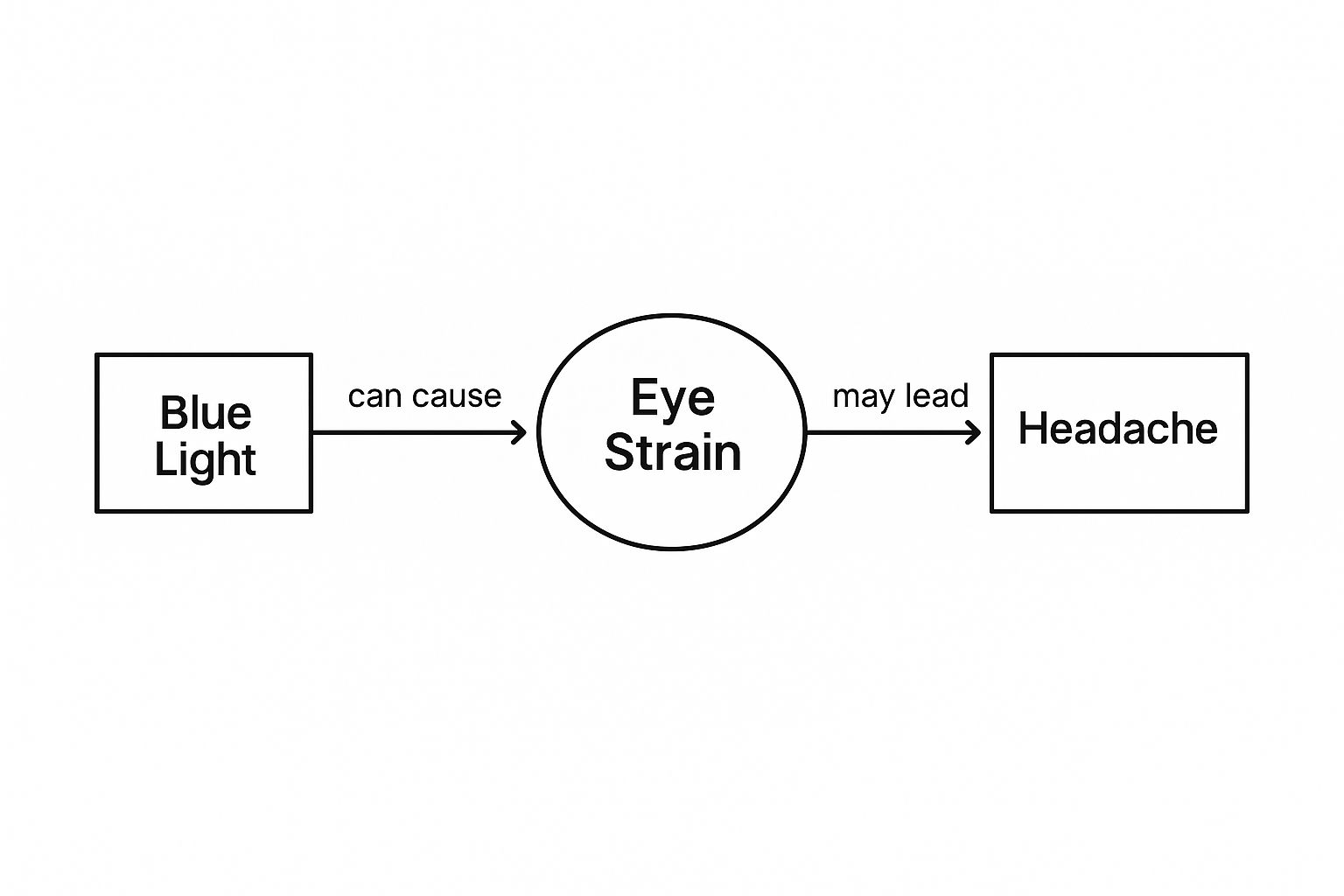
As you can see, the path is pretty direct: persistent blue light exposure causes eye strain, which then acts as a direct trigger for headaches.
If you suffer from migraines, this whole process is dialed up to eleven. Research has shown that the brains of migraineurs are uniquely hypersensitive to blue light.
It’s a huge issue, considering migraines affect nearly 15% of the population worldwide, and over 80% of attacks come with severe light sensitivity. Groundbreaking studies from Harvard Medical School found that blue light consistently makes headache pain worse for migraine sufferers. This response is so deeply ingrained that it even happens in blind patients who can’t consciously "see" the light but whose neural pathways still react to it. It just goes to show how hardwired this trigger is in our nervous system.
Key Takeaway: Blue light doesn't just make your eyes feel tired; it actively fires up pain-sensitive nerve cells in your brain. That’s why managing your exposure isn’t just about comfort—it's a critical strategy for preventing headaches.
Cutting down your exposure to these specific wavelengths can help calm this overactive pathway. You can learn more about managing your screen time and its effects by exploring our comprehensive blue light blog. By filtering out the most aggressive light, you give your brain and your nerves a much-needed break, which can dramatically reduce how often and how intensely you experience screen-related headaches.
Ever get that feeling after a long day of screen time? Your mind is buzzing, you feel wired but tired, and actually winding down seems impossible. This is where amber and orange-lensed blue light glasses come into play. They aren't just for daytime use; they're a powerful tool for tackling digital fatigue and stress.
Think of them as creating an "artificial sunset" for your brain. Unlike the clear lenses you might wear during the day, these darker, warmer tints are specifically designed to filter out the most disruptive wavelengths of blue light. Putting on a pair sends a clear signal to your body: the day is ending, and it's time to calm down.
Staring at bright screens forces the tiny muscles in your eyes to work overtime, leading to that all-too-familiar feeling of fatigue, tension, and even headaches. Orange-colored glasses drastically reduce this workload.
By cutting out the harsh, high-energy blue light, they let your eye muscles relax and soften the digital glare. This physical relief sends a ripple effect to your brain. When your eyes aren't constantly sending stress signals, the mental fatigue that builds up from hours of focused screen time starts to melt away.
By blocking the most aggressive light, orange-lensed glasses help your mind transition from a state of high alert to one of calm. This makes it easier to de-stress and prepare for restorative rest, which is crucial for preventing blue light and headaches.
This is where amber and orange lenses really shine, especially in the evening. They are specifically designed to block the exact wavelengths of blue light known to suppress melatonin—the hormone that makes you feel sleepy. The warm tint of amber lenses helps create a calming visual environment, letting you relax and wind down naturally after a long day.
When you wear them for an hour or two before bed, you're essentially protecting your body's natural sleep cycle from your devices. Your brain can start producing melatonin on schedule, helping you not only fall asleep faster but also achieve a deeper, more restorative sleep. And when you sleep well, your brain has the time it needs to recover, making it far less likely you'll wake up with a headache.
If you're looking for glasses designed for this purpose, you can explore the options at Element Lux.
Pairing your blue light glasses with a solid evening routine is the best way to set yourself up for success. Think of it as creating a complete "wind-down" ritual.
Top Ways to Get Good Sleep:
Top 4 Ways to Reduce Stress or Anxiety and Relax:
Ever wondered why a late night doomscrolling often leads to a pounding headache the next morning? It’s not your imagination. The connection starts with how the blue light from our screens throws your body's internal clock, or circadian rhythm, completely out of whack.
Think of your body's rhythm like a well-rehearsed orchestra. Blue light is the one loud, off-key instrument that ruins the whole performance.

When you’re staring at a screen after dark, that blast of high-energy light tells your brain it's still daytime. This mix-up causes it to hit the brakes on producing melatonin, the crucial hormone that signals it's time to wind down. Without that "go to sleep" message, you're left tossing and turning, and any sleep you do manage is often shallow and unsatisfying.
This is where the blue light and headaches link becomes crystal clear. Poor sleep makes you far more sensitive to pain, leaving you vulnerable to tension headaches and even triggering migraines the following day. It's a vicious cycle: you get bad sleep, which makes the effects of blue light feel even worse.
This is where a good pair of orange-colored blue light glasses, like ours at Element Lux, can be a game-changer. They act as a shield, specifically filtering out the exact blue and green light wavelengths that stop your body from making melatonin. Orange colored blue light glasses help with sleep by protecting your natural melatonin production, allowing you to fall asleep faster and achieve deeper, more restorative rest.
Slipping them on in the evening is like drawing the curtains on the digital world. It allows your brain to finally get the message that the day is over and start preparing for rest.
Artificial light, especially the intense blue light in the 380-500 nm range pouring from our screens, is a known migraine trigger. Its high energy doesn't just mess with your sleep; it can directly activate the neural pathways that cause headache pain. When your sleep-wake cycle is already disrupted, you're that much more susceptible.
By blocking these disruptive wavelengths, orange-lensed glasses allow your body to produce melatonin naturally and on schedule. The result? You don't just fall asleep faster—the quality and depth of your sleep improve dramatically. To see the science in action, you can learn more about how our glasses help with sleep right here.
Making orange-lensed glasses part of a solid evening routine can completely transform your nights. Here are a few simple but powerful habits to reclaim your rest.
Top Ways to Get Good Sleep:
Top 4 Ways to Reduce Stress or Anxiety and Relax:
Knowing the "why" behind blue light and headaches is half the battle. Now, let’s get to the "how"—the practical steps you can take to fight back. By combining the right gear with a few smart habits, you can dramatically improve your sleep, lower your stress, and keep those nagging digital headaches from ever starting. It all begins with taking control of your light environment.

The single most powerful tool in your evening arsenal is a quality pair of amber or orange-tinted blue light glasses. These lenses are engineered to specifically filter out the intense, melatonin-killing light from our screens. When you pop them on for an hour or two before hitting the pillow, you're essentially creating a protective bubble for your brain, allowing your natural sleep cycle to kick in right on schedule.
Think of your glasses as the main event and your other habits as the supporting cast. Together, they create a powerful synergy that leads to better rest and fewer headaches. When your body finally gets the deep, restorative sleep it's been craving, it becomes far more resilient to daily stressors that might otherwise trigger pain.
Top Ways to Get Good Sleep:
Better sleep quality is a direct route to fewer headaches. And beyond just sleep, those orange lenses play a huge role in helping you de-stress after a long, screen-filled day.
The warm, gentle tint of amber and orange glasses is more than just functional—it's calming. It provides a visual cue that helps shift your overstimulated nervous system from "go" mode to "wind-down" mode. This is absolutely critical for managing stress, which is one of the biggest headache triggers out there.
Here are four simple ways to relax in the evening:
If you've ever dealt with tension headaches or migraines, you know that chronic stress is often public enemy number one. Modern life has us all constantly "on," and the physiological stress from staring at bright screens all day just pours fuel on the fire. Getting a handle on this daily strain is absolutely essential if you want to find real relief from persistent head pain.
The simplest, and honestly one of the most effective, techniques starts when the sun goes down.
By slipping on a pair of amber or orange-tinted blue light glasses, like the ones from Element Lux, you immediately start to dial back the stimulating effects of your screens. It’s a simple act, but it tells your mind and body to begin winding down naturally, easing you into a relaxed state and signaling that the day's chaos is officially over.
This one little habit can make a massive difference in your battle against both blue light and headaches.
While glasses are an incredible tool, they work even better when you pair them with other relaxation techniques. Think of it as building a comprehensive defense system against stress-induced head pain. Each strategy supports the others, helping to quiet your nervous system and release physical tension at the same time.
When you actively manage your body's stress response, you become far more resilient to your headache triggers. The goal is to lower your baseline stress level so that daily hiccups don't automatically escalate into pain.
Here are four of my go-to methods for reducing stress and finding a sense of calm, especially after a long day glued to a screen.
Make Blue Light Blocking Glasses Your Evening Ritual. Seriously, make this a non-negotiable part of your nightly routine. The warm tint of the lenses acts as a powerful cue to your brain, telling it to shift gears from high-alert mode to rest-and-relax mode. You'll feel the mental fatigue from your screens start to melt away.
Practice Mindful Breathing. You don't need an hour-long meditation session. Just five minutes of slow, deep, intentional breathing can lower your heart rate and soothe your entire nervous system. It's the perfect antidote to the physiological "fight or flight" response that both stress and blue light can trigger.
Get Moving, Gently. Stress has a nasty habit of showing up as physical tension, especially in the neck and shoulders—a classic cause of tension headaches. A few gentle stretches or even a short, leisurely walk can release that tightness and get your blood flowing properly again.
Carve Out Time for a Screen-Free Hobby. Give your eyes and your brain a real, honest-to-goodness break from digital stimulation. Pick up a physical book, put on some music, or work on a craft. This allows your visual and nervous systems to fully decompress and recover from the day.
So, how do these orange-lensed glasses actually pull off the magic trick of reducing eye strain? It's all about filtering. Orange colored blue light glasses help with eye strain by blocking the harshest, highest-energy wavelengths of blue light pouring out of our digital screens.
Think of it this way: your eye muscles are constantly working to focus on that bright, intense light. By filtering it, the glasses essentially turn down the volume, giving those muscles a much-needed break. This is what helps stop that physical tension and fatigue that builds into a nasty headache after a long day in front of the computer.
But what about sleep? That's where they really shine. Orange colored blue light glasses help with sleep by specifically blocking the blue light that messes with melatonin—the hormone that tells your brain it's time to sleep. By stopping that signal, the glasses help your body stick to its natural circadian rhythm.
Putting them on in the evening is like sending a clear message to your brain: "Hey, it's nighttime now. Time to wind down." This helps you fall asleep faster and get the kind of deep, restorative rest your body is craving.
Similarly, how amber blue light glasses let you relax and wind down is by creating a calming visual environment. It's a subtle cue to your nervous system to shift gears from high-alert daytime mode to a more relaxed state. That mental transition is absolutely key for dialing down stress and anxiety before you hit the pillow.
Of course, glasses work best when you pair them with other healthy habits.
Top Ways to Get Good Sleep:
Top 4 Ways to Reduce Stress or Anxiety and Relax:
Ready to take back your evenings and say goodbye to screen-related headaches for good? It's amazing what the right pair of glasses can do. Explore the collection at Element Lux and find the perfect fit for your routine today at https://element-lux.com/shop-now.
When you wear a pair of blue light glasses, you're doing two key things for your body: improving your sleep quality and cutting down on digital eye strain. These glasses are designed with special lenses that filter out the high-energy blue light blasting from our screens, which can mess with our natural sleep cycle and make our eyes feel tired and achy.
Think of blue light as your brain's morning shot of espresso. It's fantastic for waking you up and making you feel alert, but it's the last thing you want when you're trying to wind down for bed.
Light is made up of a whole spectrum of colors, and blue light just happens to have one of the shortest, most powerful wavelengths. Its main source is the sun, which our bodies have used for millennia to set our internal clock, also known as our circadian rhythm. When sunlight hits our eyes, it sends a clear signal to our brain: "Time to be awake!"
The problem is, we're no longer just getting that signal from the sun. We're getting it all day—and all night—from our digital screens. Every time you glance at your phone, work on your laptop, or watch TV, you're sending that same "wake-up" call to your brain.
This constant stimulation, especially in the evening, creates a huge disconnect. Your body might feel exhausted, but your brain is getting signals that it's the middle of the afternoon. This mix-up can lead to a few major issues:
As more people have become aware of these effects, the demand for protective eyewear has skyrocketed. The global market for anti-blue light glasses is booming, a clear sign that consumers are getting serious about protecting their eye health and sleep.
Getting a handle on our blue light exposure is becoming essential for modern well-being. Understanding how it all works is the first step toward getting your natural rhythm back on track.
If you want to dive deeper into this topic, we have plenty of other articles on our blue light blog.
If you’ve ever ended a long day staring at a screen with tired, achy eyes and a nagging headache, you know exactly what digital eye strain feels like. It’s a super common problem these days, but understanding the why behind it is the key to finding some real relief. And the answer is all about the unique way blue light from our devices behaves.
High-energy blue light has a short wavelength, which means it scatters more easily than other colors in the light spectrum. Think of it like trying to focus on a slightly fuzzy image—your eyes are constantly making tiny, non-stop adjustments to try and get a sharp picture. That sustained effort is what leads to muscle fatigue, dryness, and the all-around discomfort we call eye strain.
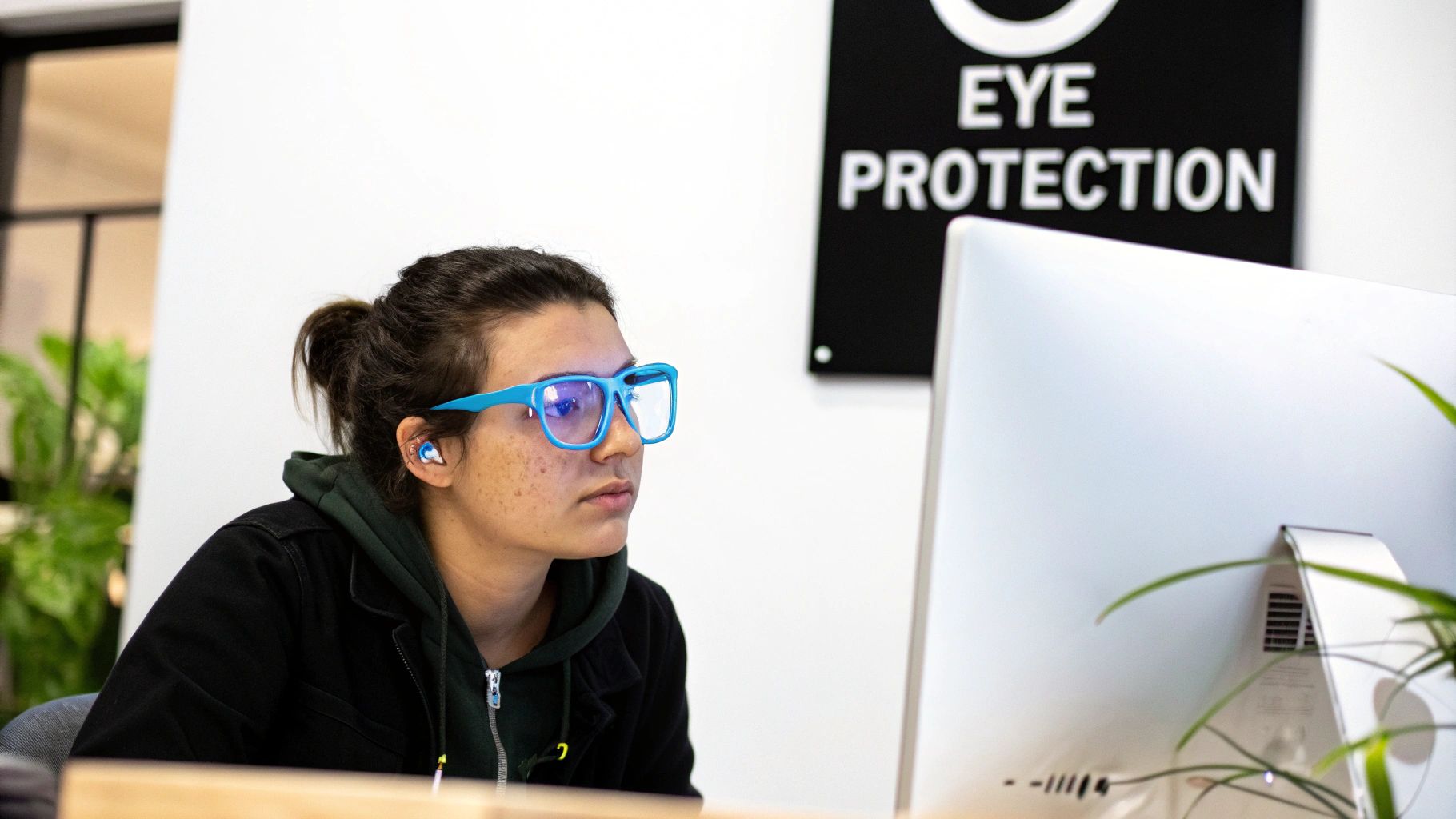
This is where a pair of orange colored blue light glasses really makes a difference. Unlike clear or lightly tinted lenses, orange lenses are specifically designed to filter out the most aggressive part of the blue light spectrum. They target those high-energy wavelengths that cause the most scattering and visual "noise."
By blocking this harsh light before it even hits your eyes, the glasses completely change the way you see your screen. Suddenly, glare is softened and contrast is sharpened, making text pop. This lets your eye muscles finally relax because they no longer have to fight to hold focus. The benefits of wearing blue light glasses with orange lenses are often felt almost immediately, making for a much more comfortable screen experience.
Wearing orange-lensed glasses is like putting a calming filter over the digital world. By removing the most jarring light, you reduce the workload on your eyes, which can alleviate headaches and soreness linked to screen use.
That shift from straining to relaxing is a game-changer. It’s not just about dodging discomfort; it’s about creating an environment where you can work or unwind without your eyes paying the price later. Amber-colored lenses offer a similar, though less intense, effect that's perfect for more casual evening use.
But for those deep-focus work sessions or late-night projects, orange lenses offer maximum protection. They create a really noticeable shift in visual comfort, turning a harsh, bright screen into a soft, warm display. This simple change helps your brain wind down much more naturally, even if you still need to be in front of a screen.
Managing digital discomfort is a huge piece of the puzzle when it comes to lowering your overall stress. Here are four simple strategies that work even better when you add blue light glasses into the mix:
Your body runs on an internal clock, a natural rhythm that tells you when to feel tired and when to be alert. This system is deeply connected to light. Think about it: as the sun goes down, the growing darkness is a powerful signal to your brain to start producing melatonin, the essential hormone that helps you wind down and drift off to sleep.
But our modern evenings are rarely dark. We’re surrounded by bright screens—phones, laptops, TVs—blasting out blue light that sends a very different message. This artificial daylight tricks your brain into thinking it's still midday, hitting the brakes on melatonin production and messing up your entire sleep-wake cycle. The result? You’re left tossing and turning, wide awake when you should be resting.
This is where orange colored blue light glasses can be a total game-changer for your nightly routine.
When you put on a pair of orange-lensed glasses for an hour or two before bed, you're essentially creating a shield against those disruptive light waves. They filter out the specific blue light that stops melatonin in its tracks, allowing your body’s natural sleep signals to work as intended. This simple habit can help you fall asleep faster and get the kind of deep, restorative rest that leaves you feeling genuinely refreshed the next morning.
It’s not just about melatonin, either. These glasses also tackle evening eye strain. The soft orange tint cuts the harsh glare from digital screens, making your wind-down time—whether you’re reading on a tablet or watching a movie—far more comfortable and relaxing. You get a one-two punch: protecting your sleep hormone production while soothing tired eyes.
And this isn't just anecdotal. The science is compelling.
A 2020 trial with hospitalized patients, for example, found that those who wore blue-blocking glasses for just seven days had significantly better sleep efficiency and woke up less during the night compared to a group wearing clear glasses. Learn more about how blue light filtering impacts sleep patterns.
For the best results, you'll want to combine your glasses with other solid sleep habits. Think of it as creating a powerful, sleep-friendly environment. Here are a few tips to get you started:
By making these practices a part of your routine, you can seriously upgrade your sleep quality. You can dive deeper into how our glasses support this process by exploring our guide on achieving better sleep.
If intense orange lenses are the heavy hitters for getting your brain ready for sleep, think of their softer counterpart—amber blue light glasses—as your perfect companion for winding down after a long day. While orange lenses are a powerful tool for sleep induction, amber lenses are like a dimmer switch that eases you out of go-mode and into a state of relaxation.
The real difference is how much filtering they do. Amber lenses block a more moderate, but still significant, amount of blue light. This makes them the ideal choice for those casual evening hours when you want protection without a drastic change in how you see the world.
This level of filtration is perfect for unwinding with a movie, reading on your tablet, or catching up on a few last emails. You get the benefits of blocking that harsh screen glare and artificial light without signaling to your brain that it's bedtime just yet.
The warm, gentle tint of amber lenses completely transforms your surroundings. That harsh, cool-toned glare from screens and overhead LEDs is softened into a calming, gentle glow. It's a simple change, but it sends a powerful signal to your nervous system: it's time to shift from a state of productivity to one of peace.
By taking the edge off the most jarring visual input, amber lenses make it easier to de-stress long before your head even hits the pillow. They create a buffer between your eyes and the stimulating modern world, helping you find a natural sense of calm.
Wearing amber glasses in the evening is a simple act of self-care. It's an easy way to reduce the invisible stress that digital light places on your brain, helping you feel more relaxed and present.
You can get even more out of your amber glasses by making them part of a broader relaxation routine. Here are four great ways to unwind in the evening, with your glasses playing a key role in your digital downtime.
Think of your blue light glasses as a crucial piece of gear, but not the whole game. They're like a shield, protecting you from the light that messes with your internal clock. But for truly restorative rest, that shield needs to be part of a bigger strategy. A solid routine is the foundation, sending clear signals to your body that it’s time to wind down.
When you get this synergy right, the results are powerful. You fall asleep faster, sleep deeper, and wake up feeling ready to go.
This isn't just about feeling less tired. It's about how that translates into real-world performance. Better sleep and less eye strain mean you're more focused and productive the next day.
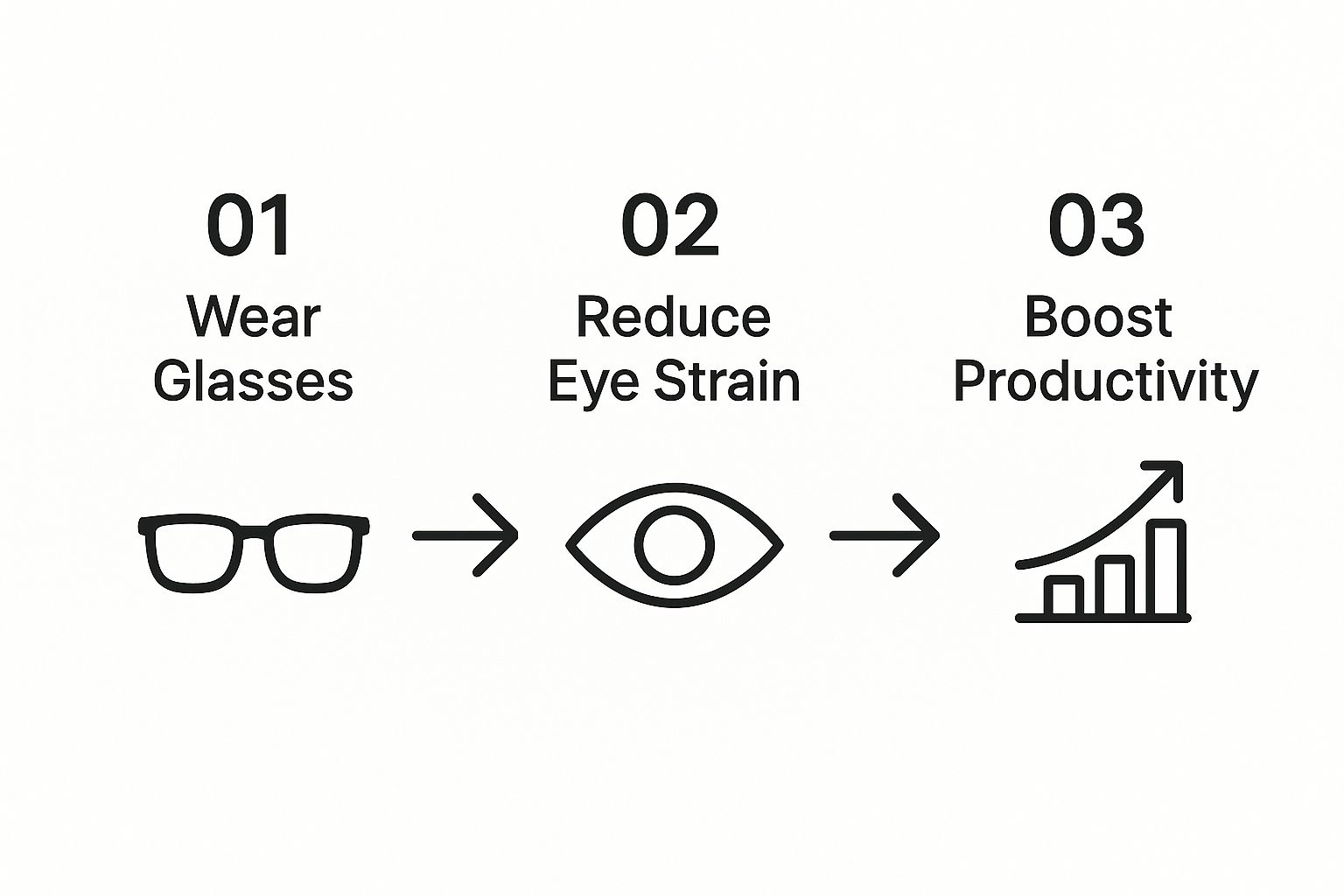
Creating a powerful pre-sleep ritual is all about consistency. While your orange colored blue light glasses are essential for blocking the light that kills melatonin and strains your eyes, they work best when you pair them with other proven techniques. It’s about building a fortress of good habits.
Here are the non-negotiables for a better sleep routine:
Want to dive deeper into sleep strategies? We've got a ton of great information on our resources page.
A racing mind is the enemy of good sleep. It’s no surprise that the same screen time that hurts our eyes can also ramp up our anxiety. Your amber blue light glasses do more than just block light; they create a visually calming, warm environment that helps your brain shift into a lower gear.
Combine them with these practices for the ultimate wind-down:
To really lock in these habits, a simple checklist can make a huge difference. Here's a step-by-step guide to structure your evening for optimal sleep.
| Time Before Bed | Action Item | Why It Works |
|---|---|---|
| 2-3 Hours | Finish your last meal and avoid heavy snacks or alcohol. | Gives your digestive system time to work, preventing disruptions to your sleep cycle. |
| 90 Minutes | Put on your Element Lux blue light blocking glasses. | Starts protecting your melatonin production from screen light, signaling to your brain it's time to get sleepy. |
| 60 Minutes | Power down all screens (phone, TV, laptop). | This "digital sunset" removes the biggest source of mental stimulation and disruptive blue light. |
| 45 Minutes | Dim the lights and do some light stretching or read a physical book. | Lowers overall light exposure and releases physical tension, promoting relaxation. |
| 15 Minutes | Practice deep breathing or write in a journal. | Calms the nervous system and clears your mind of lingering worries or to-do lists. |
| Bedtime | Ensure your room is cool, dark, and quiet. | Creates the ideal sensory environment for deep, uninterrupted sleep. |
Following a consistent checklist like this takes the guesswork out of winding down. It trains your body and mind, making the transition to sleep smoother and more natural every night.
All that screen time doesn't just tire out our eyes. It can actually put our nervous systems on high alert, feeding feelings of stress and anxiety. The intense blue light from our devices basically sends a non-stop "wake up!" signal to the brain, making it tough to truly relax in our always-on world.
The good news is, you don't need a total digital detox to find some calm. A few smart strategies can make a huge difference. By creating some healthy boundaries with your tech, practicing a little mindfulness, and tweaking your environment, you can take back control. And a great pair of blue light blocking glasses is a key part of that modern toolkit, giving you a direct way to curb the mental strain of our digital lives and actually unwind.
When you combine blue light glasses with other calming habits, you create a powerful effect. The real goal is to cut down on overstimulation from every angle, letting your mind and body chill out naturally.
Here are four of the best ways to find your calm in the evening:
Wear Blue Light Blocking Glasses: About an hour or two before you plan to sleep, make it a habit to pop on your amber or orange blue light glasses. This one simple move filters out all that jarring, stimulating light. It creates a warm, soft visual world that turns down the mental "noise" from screens and harsh indoor lighting.
Create a "Digital Sunset": Set a clear rule: the last hour before bed is a screen-free zone. If you absolutely have to look at a device, your glasses are non-negotiable. This simple boundary is a powerful signal to your brain that it's time to shift gears and move away from the constant input that fuels anxiety.
Take Mindful Breaks: Eye doctors are big fans of the ‘20-20-20 rule’. Every 20 minutes, you look away from your screen at something 20 feet away for at least 20 seconds. When you pair simple behavioral tricks like this with a tool like blue light glasses, you build a really solid defense against digital burnout. You can find more great info on the evidence behind blue light protection here.
Make Your Environment Calm: As the evening goes on, start dimming the lights around your home. When you pair that soft, warm ambient light with the gentle tint of your amber lenses, you create a deeply relaxing atmosphere. It’s like telling your nervous system it’s finally safe to power down for the night.
By filtering out the most agitating wavelengths of light, amber lenses help dial down your brain's alertness level. This encourages a state of calm, making it much easier to de-stress and get ready for a great night's sleep long before your head hits the pillow.
Ready to reduce eye strain and improve your sleep? The Element Lux collection offers premium blue light blocking glasses designed to help you unwind and rest better. Shop Now to find your perfect pair.
It’s a feeling we all know: tossing and turning, mind racing, knowing you have to be up in a few hours but sleep just won’t come. When your sleep schedule is a mess, it feels like more than just being tired. Your mood tanks, your focus disappears, and your whole day feels off-kilter.
The good news is you can get back on track, and it doesn’t require a complete life overhaul. This guide is all about small, practical changes you can start tonight to fix your sleep schedule for good.
If you feel like you're constantly fighting your body's internal clock, you're far from alone. It's a massive issue. The National Sleep Foundation's Sleep in America Poll revealed that a staggering six out of 10 Americans feel they don't get enough sleep.
Think about that—most people are walking around sleep-deprived. The poll also found that nearly four in 10 struggle to even fall asleep multiple nights a week. This isn't just about feeling groggy; it directly impacts your quality of life.
So what’s wrecking our sleep? It usually boils down to two things: a stressed-out mind and way too much artificial light.
An anxious, racing mind makes it nearly impossible to wind down. At the same time, the blue light pouring out of our phones, laptops, and TVs is constantly telling our brains, "Hey, it's still daytime! Stay awake!" This constant stimulation suppresses melatonin, the hormone that signals it's time for bed.
This is exactly why so many people are turning to blue light blocking glasses. They act as a shield, protecting your body's natural sleep signals from modern technology.
Getting your sleep schedule back on solid ground is all about building a powerful, consistent routine. Your body loves predictability. Here’s how to give it what it needs.
First, set a consistent wake-up time. I know, it's tempting to sleep in on weekends, but this is the single most important step. It anchors your entire internal clock, or circadian rhythm.
Right after you wake up, get some morning sunlight. Just 10-15 minutes of natural light tells your brain loud and clear that the day has started, reinforcing your wake-up cycle.
Then, focus on your evenings. You need a relaxing wind-down routine to transition from the chaos of the day to the calm of the night. This could be reading a book (a real one!), gentle stretching, or listening to quiet music.
And finally, make blue light blocking glasses part of that routine. Put them on 1-2 hours before you plan to sleep, especially if you're watching TV or scrolling. This simple habit protects your melatonin production and makes falling asleep so much easier.
Here's a quick summary of the most effective strategies you can use to get your sleep cycle back in order.
| Strategy | Primary Benefit |
|---|---|
| Consistent Wake-Up Time | Anchors your circadian rhythm and sets a predictable daily schedule. |
| Morning Sunlight Exposure | Reinforces wakefulness and helps regulate your internal clock. |
| Relaxing Evening Routine | Signals to your brain and body that it's time to wind down for sleep. |
| Wear Blue Light Blockers | Protects melatonin production from screen light, making it easier to fall asleep. |
By combining these simple but powerful habits, you can stop fighting against your body and start working with it to achieve the restorative sleep you need.
Your body has this amazing internal clock called the circadian rhythm, and its main cue comes from light. Bright, natural sunlight hitting your eyes in the morning is a powerful signal that tells your brain, "Hey, it's time to be alert and awake." It's nature's way of kickstarting your day.
But then night comes, and we're surrounded by artificial blue light from our screens. This sends a totally different, and frankly, confusing message. It actively suppresses the production of melatonin—your body's natural sleep hormone—tricking your brain into thinking it's still daytime. This one little disruption is a huge reason so many of us lie in bed scrolling, then wonder why we can't fall asleep.
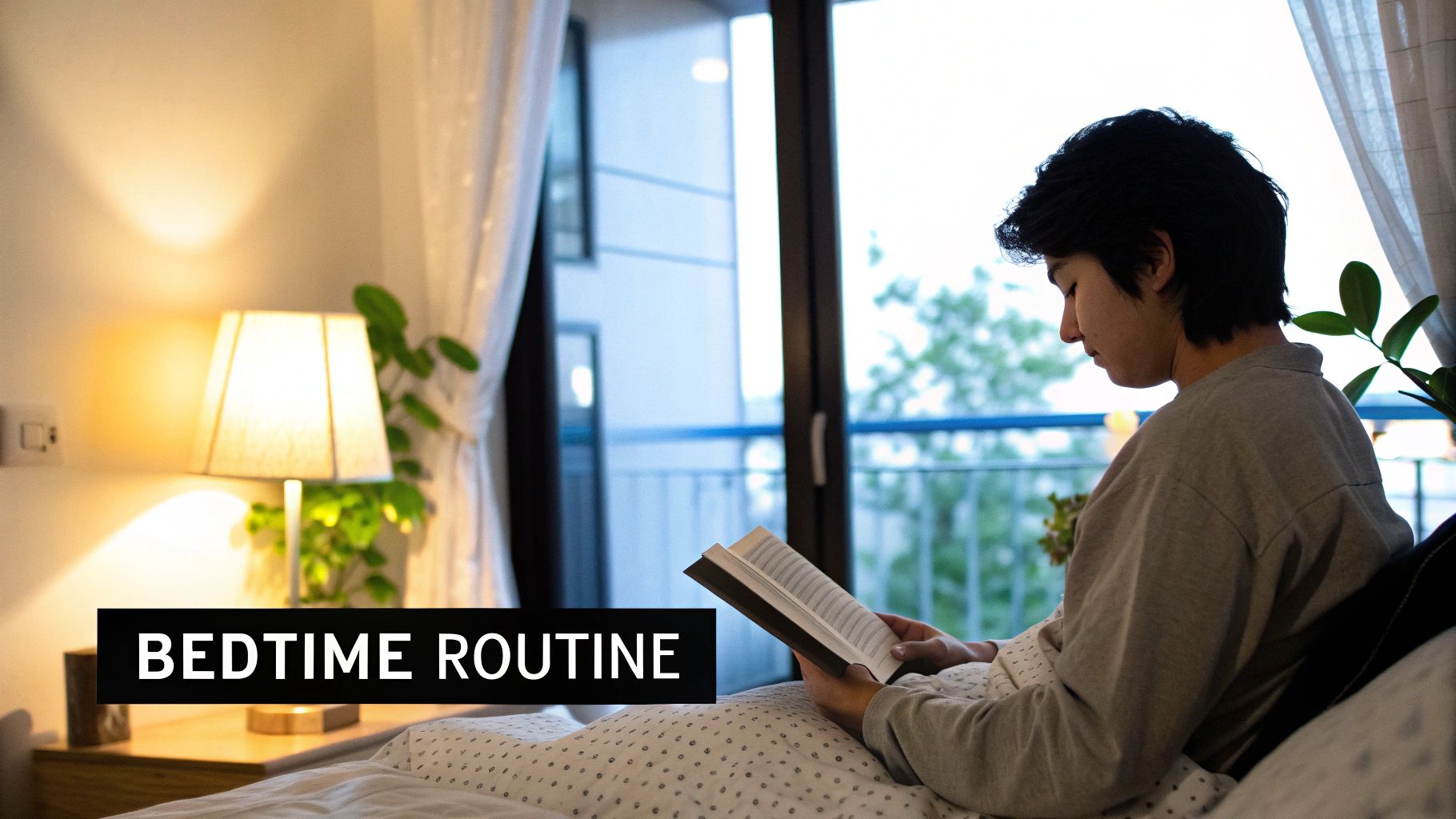
This is exactly where orange-colored blue light blocking glasses become a total game-changer, especially if you're trying to fix your sleep schedule. They help your sleep by filtering out the specific, disruptive wavelengths of blue and green light that are notorious for messing with your melatonin.
Think of them as creating a personal sunset. Even if you're staring at a bright screen, the glasses signal to your brain that the day is winding down, allowing your body to naturally prepare for rest.
On top of that, orange-colored glasses significantly cut down on digital eye strain—that lovely combo of headaches and tired eyes you get after a long day on the computer. By easing that physical discomfort, the glasses help you relax more deeply. If you want to dive deeper into the science, you can find more on our blue light blog.
Amber blue light glasses are perfect for helping you relax and de-stress before bed. The warm, soothing tint tones down the harsh glare from artificial lights and screens, creating a much calmer visual environment. Wearing them in the evening is a simple way to help your mind transition from a state of high alert to one of peace and quiet, letting you wind down naturally.
Making blue light glasses part of your nightly routine is one of the easiest yet most effective things you can do for your sleep. It’s a passive strategy that powerfully supports all your other healthy habits.
Of course, managing evening stress is also critical for good sleep. Here are four simple but effective methods that work perfectly alongside blue light glasses:
Think of a solid pre-sleep routine as a buffer zone. It’s the essential transition you need to shift from the chaos of the day into a state of calm, signaling to your body and brain that it’s time to power down. This isn't about following a rigid, joyless checklist; it's about creating a space for genuine relaxation.
A great starting point is to dim the lights across your home and make sure to avoid any stimulants. That means no caffeine after the early afternoon and swapping intense late-night workouts for something gentler.
Then, you can start layering in activities that you actually find calming. For many people, one of the most powerful additions to this ritual is wearing blue light blocking glasses for the last one to two hours before heading to bed. It’s a simple step, but it can make a world of difference when you’re trying to get your sleep schedule back on track.
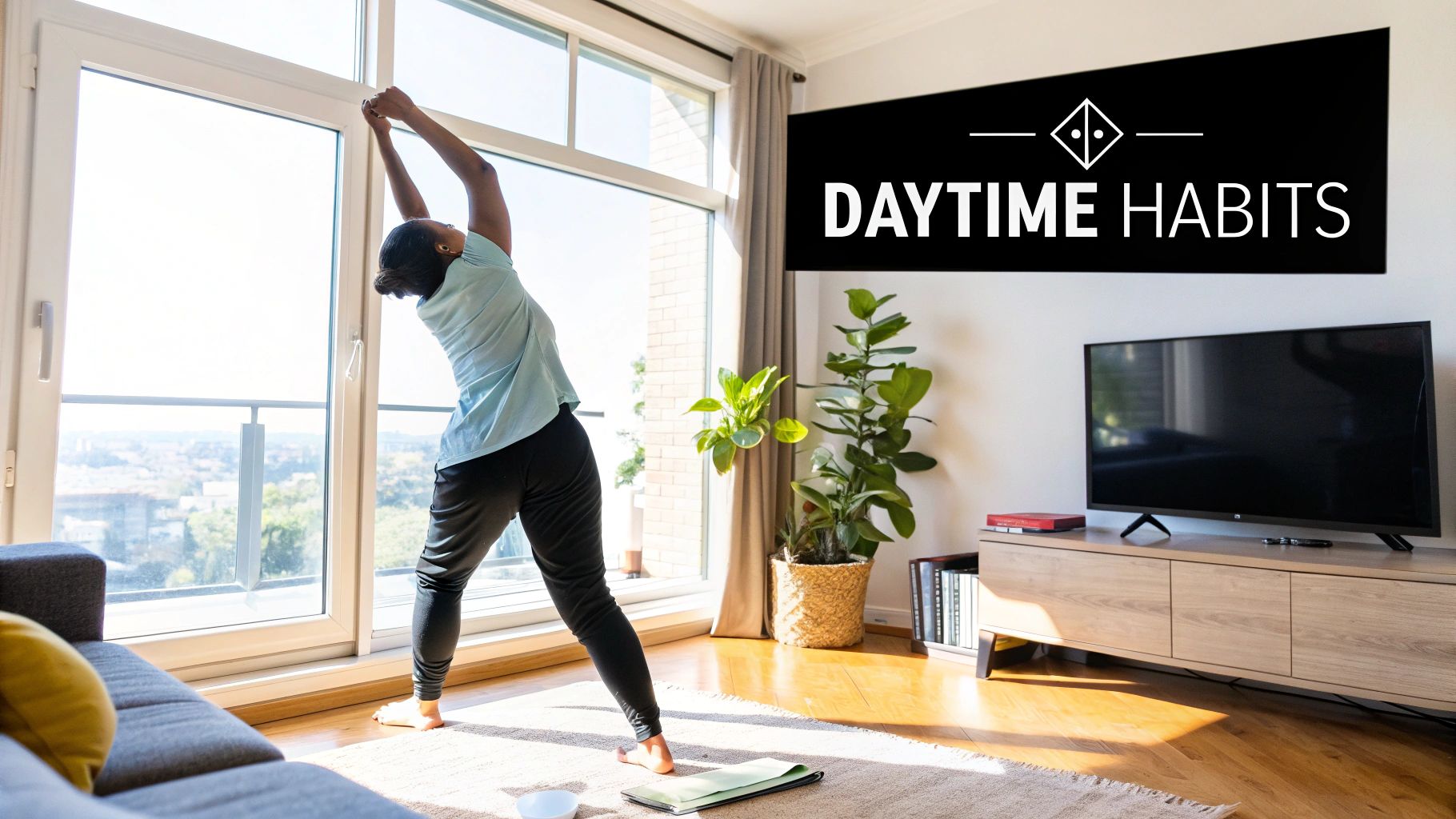
When it comes to winding down, orange-colored blue light glasses are incredibly effective. They work by filtering out the harsh, artificial light from screens and overhead lighting that often leads to digital eye strain. If you’ve ever felt physically tense or had a headache after a long day of screen time, you know exactly what I’m talking about.
By blocking these disruptive light wavelengths, the glasses allow your body's natural melatonin production to kick in without interference. The amber tint also creates a much warmer, more relaxing visual environment, which helps quiet your mind and makes the transition into sleep feel much more natural.
If you want to dive deeper into the science, you can explore our guide on how Element Lux glasses help with sleep.
Don't just take my word for it—consistency is key. A massive global study of over 88,000 adults found that having an irregular sleep schedule dramatically increases health risks. For instance, participants who went to bed after 12:30 AM had a 2.57 times higher risk of developing liver cirrhosis. It’s a stark reminder that when you sleep is just as crucial as how long you sleep.
It’s almost impossible to get your sleep schedule back on track when your mind is racing at 100 miles an hour. If you want truly restful nights, you have to tackle that nighttime stress head-on. The good news? It doesn't have to be some complicated, drawn-out process.
This struggle with sleep-related stress is becoming incredibly common. Have you ever heard of sleep anxiety? It’s that awful cycle of worrying about not being able to sleep, which, of course, keeps you awake. It's a huge issue, especially for younger adults juggling digital overload and other pressures. One report I read found that nearly 40% of Gen Z adults deal with this at least three times a week. That anxiety just feeds the sleeplessness. You can dig into more of the data in the Global Wellness Institute report on sleep trends.
The best way to combat this is with simple, practical steps you can actually stick with. A few small tweaks to your evening routine can send a powerful signal to your brain that it's time to unwind.
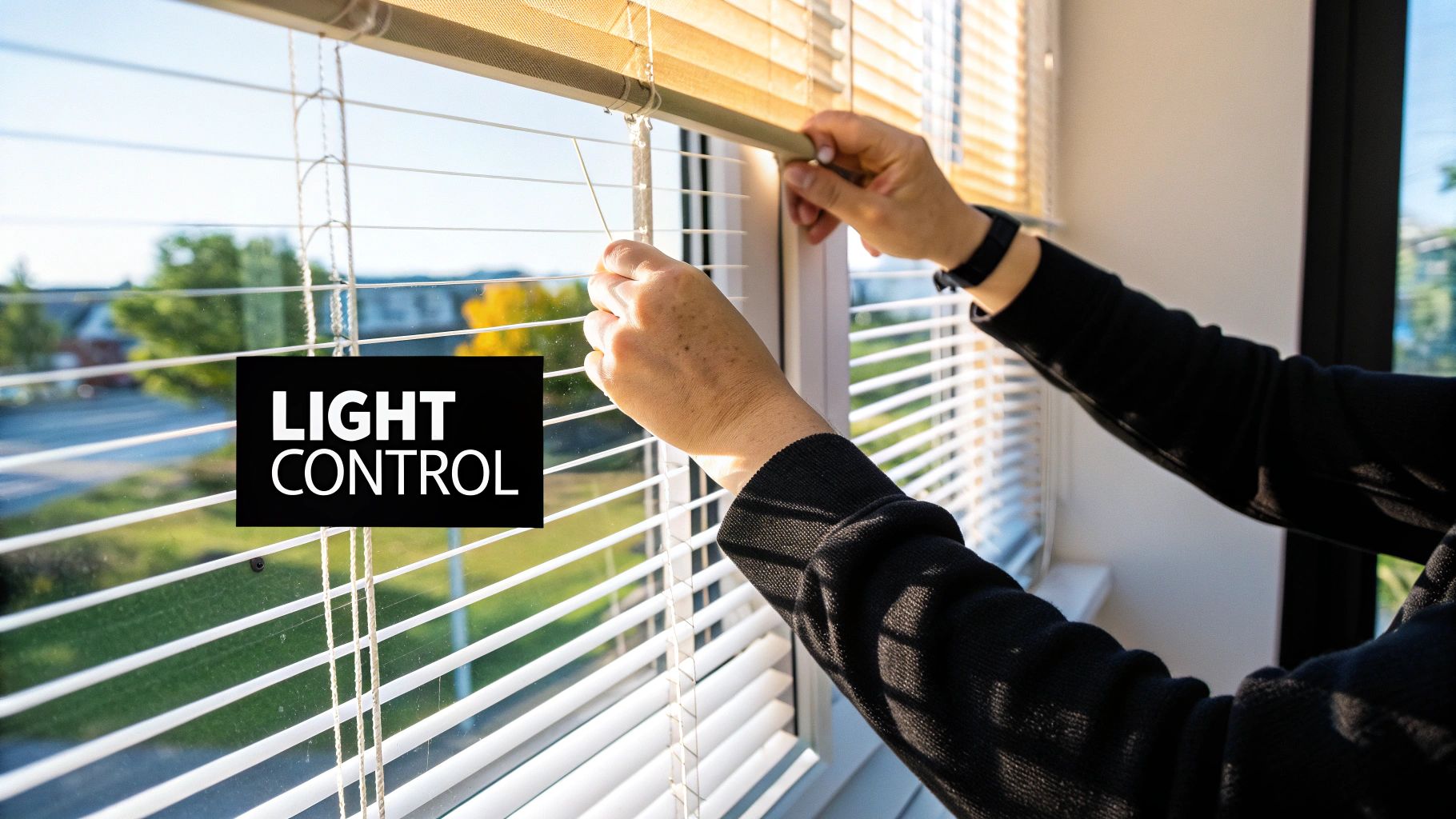
There's something about the warm tint of amber glasses that just immediately creates a more relaxing vibe. The more powerful orange lenses go a step further, blocking the specific blue light wavelengths that are notorious for causing digital eye strain and tanking your melatonin levels. It's a passive way to reduce the "wired" feeling you get from artificial light, making it that much easier for a busy mind to finally quiet down.
Alright, let's put all this together into a routine that actually sticks. When it comes to fixing your sleep schedule, consistency is your most powerful tool. The whole point is to give your body clock—your circadian rhythm—strong, reliable cues so it knows exactly when to power down and when to be alert.
You don't need a hundred new habits. Just focus on a few core ones that deliver the biggest results. Wake up at the same time every single day (yes, even on weekends). Get that morning sunlight as soon as you can. And make your blue light blocking glasses a non-negotiable part of your wind-down routine, especially in the last one to two hours before bed.
This is where those orange-colored blue light glasses really shine. They're incredibly effective at reducing digital eye strain by filtering out that harsh, high-energy light from your screens that often leads to headaches and fatigue. It's a simple step that helps your eyes, and in turn, your entire body, feel more relaxed as bedtime approaches.
Even more importantly, these glasses are your best defense for protecting your sleep. They block the specific wavelengths of light known to suppress melatonin, which is your body's natural "it's time for sleep" hormone. This lets you wind down naturally, even if you’re catching up on a show or reading on your tablet.
By creating a calmer visual world, those amber and orange lenses help quiet a busy mind. It makes the shift from being "on" and alert to a state of deep relaxation feel so much smoother.
For even more strategies like these, feel free to explore the articles over in our Element Lux resources.
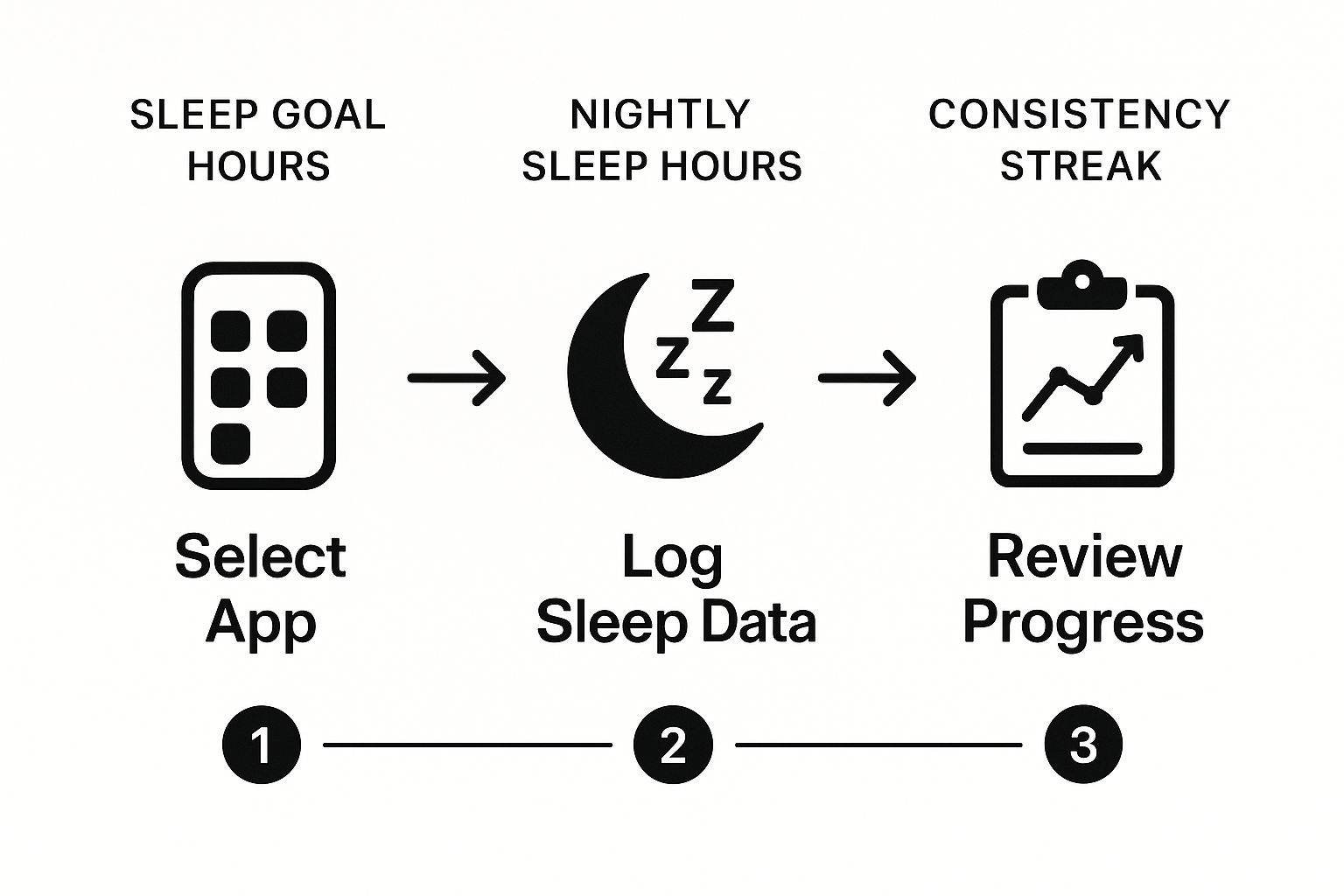
A great way to stay on track is to use an app to monitor your progress. Seeing your consistency streak or how your nightly sleep hours are stacking up against your goal can be a huge motivator. It makes it so much easier to spot patterns and stay committed to getting your sleep schedule back on track.
Changing your sleep habits always brings up a few questions. Let's tackle some of the most common ones that pop up when you're trying to get your schedule back on track.
It's simpler than you might think. Those amber or orange-tinted glasses are your best defense against the artificial light that’s tricking your brain into staying awake.
The orange lenses are fantastic at filtering out that harsh, high-energy light from your screens—the kind that gives you headaches and makes your eyes feel fried after a long day. This relief from eye strain helps your whole body feel more relaxed.
But more importantly, they act as a shield for your melatonin production. By blocking that specific wavelength of light, you’re allowing your body to start its natural wind-down process, even if you’re still scrolling or finishing up some work. Amber lenses do something similar, just a bit more gently, creating a warm, calming effect that helps you feel relaxed.
If you want to make a real impact, focus on these four foundational habits. They work well on their own, but when you combine them, they’re a game-changer.
A consistent evening routine is your signal to your brain that the day is over. By dimming the lights and putting on your amber glasses, you’re actively telling your body it's time to prepare for rest, making the transition to sleep much smoother.
We've all been there—lying in bed, staring at the ceiling, while stress keeps our brains buzzing. When that happens, you need a few simple tools to calm your nervous system down.
Try one of these next time you feel wound up:
Ready to finally take control of your sleep? The simplest, most effective step you can take tonight is to protect your eyes from the blue light that’s sabotaging your rest. Element Lux glasses are designed specifically to filter out the exact wavelengths that suppress melatonin, helping you fall asleep faster and wake up feeling genuinely refreshed.
See the difference for yourself and shop our collection now!
That glare staring back at you from your screen? It's more than just a minor annoyance. It’s a direct cause of digital eye strain, headaches, and a serious dip in focus. Tackling it for good means looking at a few key areas: your workspace, your device settings, and a few smart tools like anti-glare filters or specialized glasses.
When light from a window or an overhead lamp bounces off your screen, it creates a kind of visual static. Your eyes have to work overtime just to see the content, and that constant struggle leads to physical discomfort that can completely derail your productivity and well-being.
This isn't just a niche complaint; it's a massive, shared problem.
The global market for anti-glare screen protectors was already valued at around USD 1.2 billion in 2024. Projections show it’s on track to more than double, hitting USD 2.5 billion by 2033. That number tells a story: millions of us are looking for a real solution. You can dig deeper into the anti-glare market growth and its drivers if you're curious.
Glare isn't just a surface-level issue. A huge part of what makes it so harsh is the high-energy visible (HEV) blue light blasting from our screens. This specific wavelength is notorious for causing eye strain, but its biggest impact often comes after the sun goes down.
When you're bathed in blue light in the evening, it sends your brain a very confusing signal: "It's still daytime!" This directly suppresses the production of melatonin, the hormone that tells your body it’s time to sleep. This is where a targeted fix can make all the difference.
Orange and amber-lensed blue light glasses are designed specifically to filter out these disruptive wavelengths. By popping them on in the hours before bed, you’re basically telling your brain it's okay to wind down. This simple habit helps you relax, fall asleep faster, and get the kind of restorative rest your body craves.
By blocking the harshest light wavelengths, orange-lensed glasses don't just reduce glare—they help realign your body's natural rhythm for better sleep and less stress.
Think of these glasses as a tool to reclaim your evenings. They make your screen time more comfortable while actively supporting your body's natural sleep cycle, turning your device from a source of stimulation back into a tool for relaxation.
To give you a head start, here's a quick reference table with a few things you can do right now to start fighting back against screen glare.
This table gives you a quick overview of actionable strategies you can implement right now to start minimizing screen glare and its effects.
| Strategy Area | Quick Action | Why It Works |
|---|---|---|
| Environment | Position your screen at a 90-degree angle to windows. | This avoids direct light reflection, which is the primary cause of intense glare. |
| Device Settings | Increase your screen's contrast and lower its brightness. | Higher contrast makes text easier to read, while lower brightness reduces the light intensity hitting your eyes. |
| Protective Gear | Apply a matte-finish anti-glare screen protector. | It diffuses reflected light, turning sharp, mirror-like reflections into a soft, manageable glow. |
These small adjustments can add up to a significant improvement in your daily comfort and focus, making your screen a much more friendly place to be.
Before you spend a dime, your first line of defense against screen glare is your physical space. And the best part? The most effective solutions are often completely free. It’s about more than just yanking the blinds shut; it's about making a few smart, strategic tweaks to how you manage the light sources around you.
The goal isn't to work in a cave—it's to control the light.
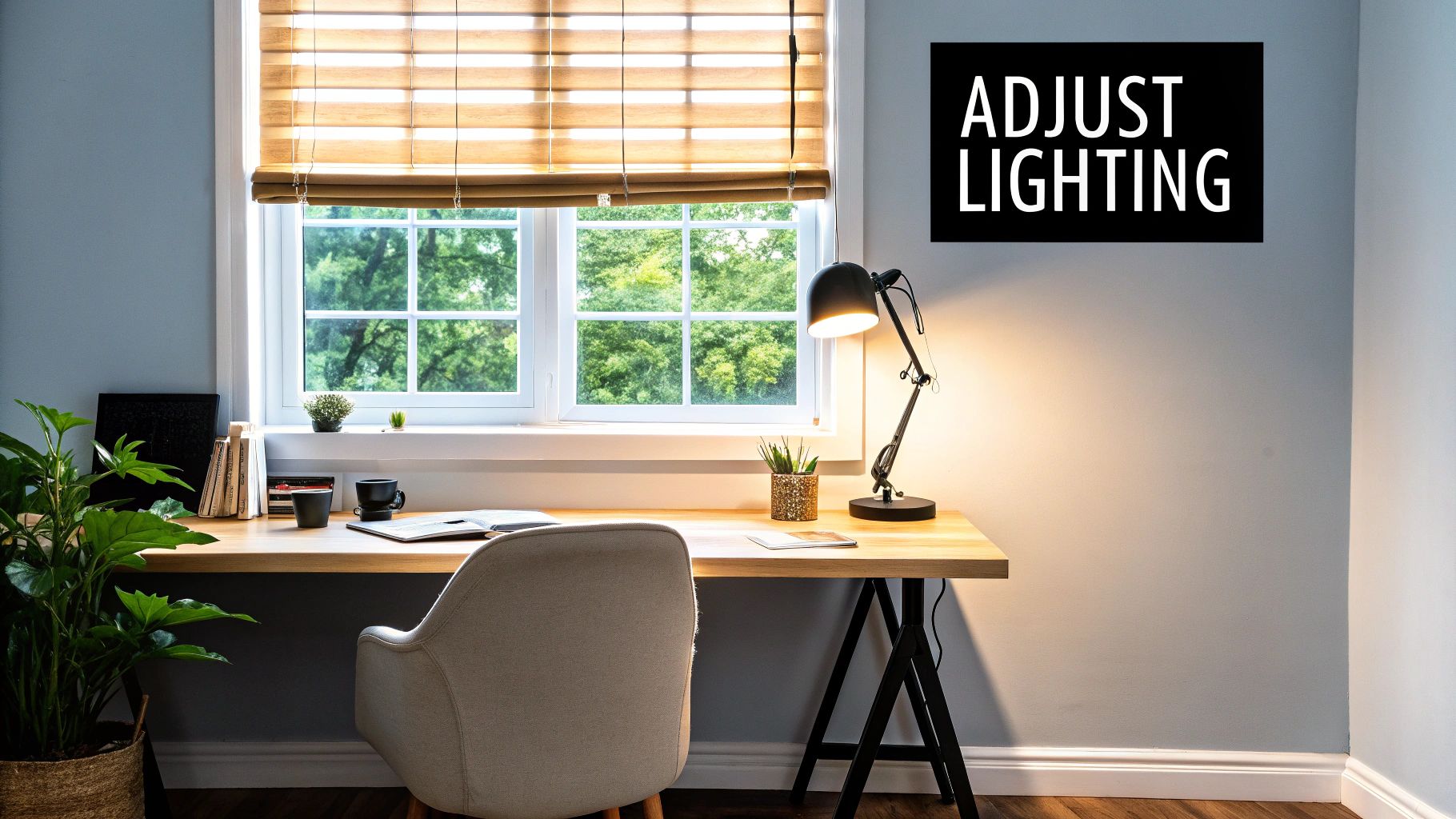
The single most effective thing you can do is place your monitor perpendicular to any windows. Think about it: if a window is directly behind you or in front of you, your screen basically becomes a mirror for all that incoming light.
By turning your setup to a 90-degree angle, you make sure the sunlight hits a wall instead of blasting directly onto your display. So if you have a big window in your home office, don't set up your desk facing it or with your back to it. Put it on an adjacent wall. This one simple change can wipe out the worst of the glare.
Your battle with glare doesn’t end when the sun goes down. Artificial lights can be just as annoying.
A great way to counter this is with bias lighting. This is just a soft, indirect light that you place behind your monitor. It works wonders by reducing the harsh contrast between a bright screen and a dark room, which helps your eyes relax and makes glare feel less intense.
Another culprit we often overlook is the wall right behind the screen. If it has a glossy or even a semi-gloss paint finish, it’s just bouncing light right back into your face.
A simple coat of matte-finish paint on the wall behind your monitor can absorb stray light instead of reflecting it, creating a more comfortable viewing environment with less ambient glare.
It’s clear more people are catching on to these issues. The market for anti-glare filters, for example, was valued at USD 2.1 billion in 2023 and is projected to hit USD 3.64 billion by 2032. That kind of growth shows just how much demand there is for products that cut down on the eye strain we all feel from staring at screens all day.
If you want to dive deeper into how to set up an eye-friendly workspace, check out the Element Lux collection of helpful resources.
Before you spend a dime on accessories, take a look at the device you’re already holding. Your phone, tablet, and computer all have settings designed to make the screen more comfortable to view, but most of us never touch them. Mastering these is the fastest, free-est way to start winning the war against glare.
The two most important settings are brightness and contrast. It’s a common reflex to crank up the brightness to overpower glare, but that’s a recipe for eye strain. It just floods your eyes with more harsh light.
Instead, try the opposite. Lower the brightness a bit and bump up the contrast. This simple tweak makes text and images pop, making them easier to see without overwhelming your eyes.
Another game-changer is Dark Mode. It's not just for looks—it fundamentally changes how your screen works by swapping the usual white background for a dark one with light text. This drastically cuts down on the amount of light your screen pumps out, which means less glare, especially when you’re in a dimly lit room.
Once you've got the basics down, dig a little deeper into your settings. Look for features like 'Night Shift' on Apple devices, 'Night Light' on Windows, or 'Eye Comfort Shield' on Android phones.
These aren't just simple screen dimmers. They actively filter out blue light, shifting your screen's colors toward a warmer, amber tone.
Why does that matter? That amber tint is key for anyone using screens in the evening. It mimics the way natural light changes as the sun goes down, signaling to your brain that it’s time to wind down. It’s the same science behind why amber blue light blocking glasses are so effective for getting your body ready for a good night's sleep.
If you’re looking for a physical fix, an anti-glare screen protector is a great option. Applying one is pretty straightforward, as this graphic shows.
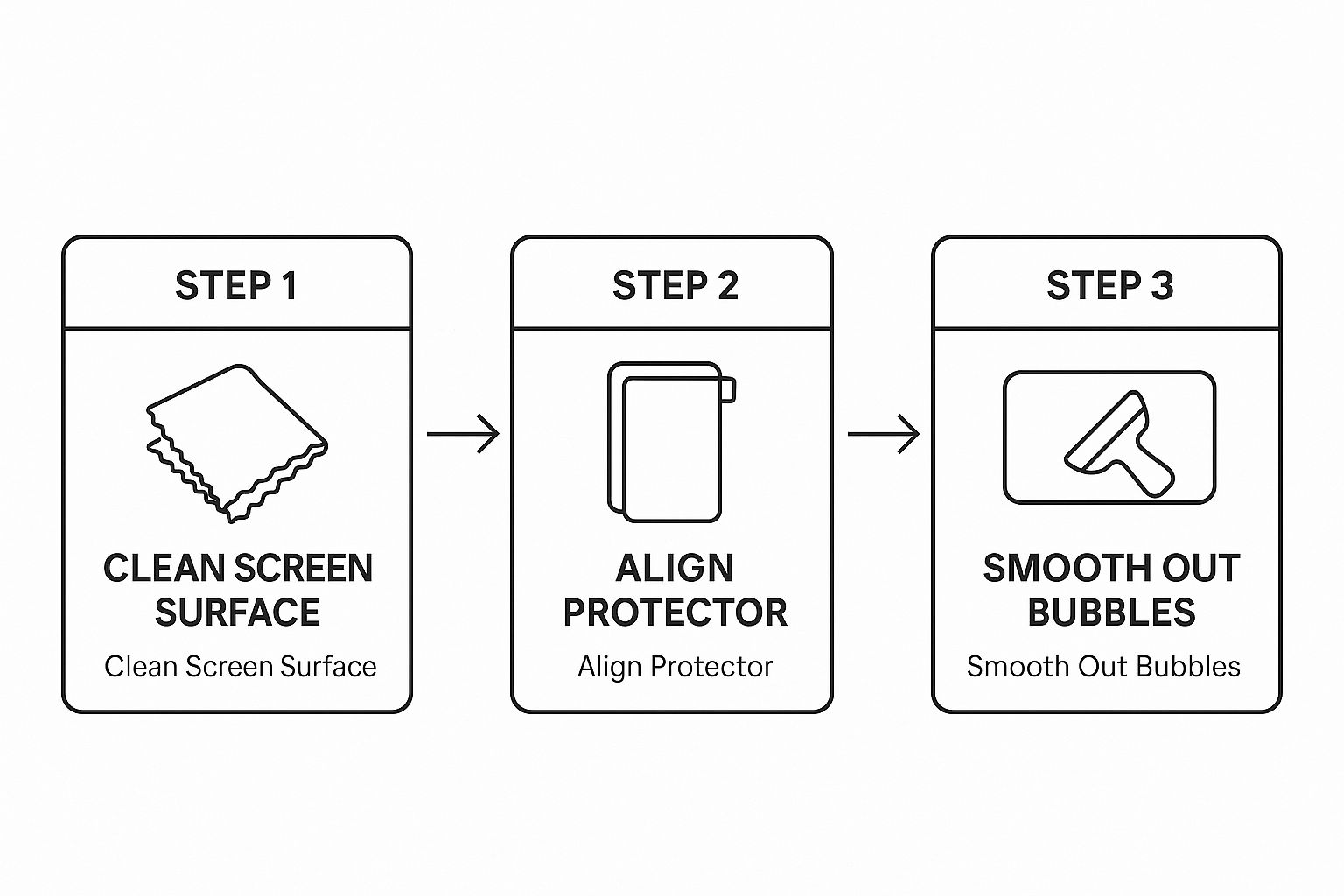
The key is a clean screen and careful alignment to get a bubble-free finish that diffuses those annoying reflections.
For a more permanent solution, you can look into anti-glare films. These are designed to scatter reflected light directly at the source. The demand for these is huge—the market was valued at around USD 1.2 billion in 2024 and is expected to hit USD 2.5 billion by 2033. If you're interested in the numbers, you can read the full research about the anti-glare film market to see just how fast it's growing.
So, you’ve repositioned your desk, fiddled with your monitor’s brightness, and still, that nagging eye fatigue just won’t quit. When you’ve done all the environmental tweaks you can, it’s time to bring in the heavy hitters: specialized eyewear.
Blue light blocking glasses, particularly those with orange or amber lenses like the ones we make at Element Lux, are a direct and powerful tool against screen-related discomfort. They go straight to the source of the problem.
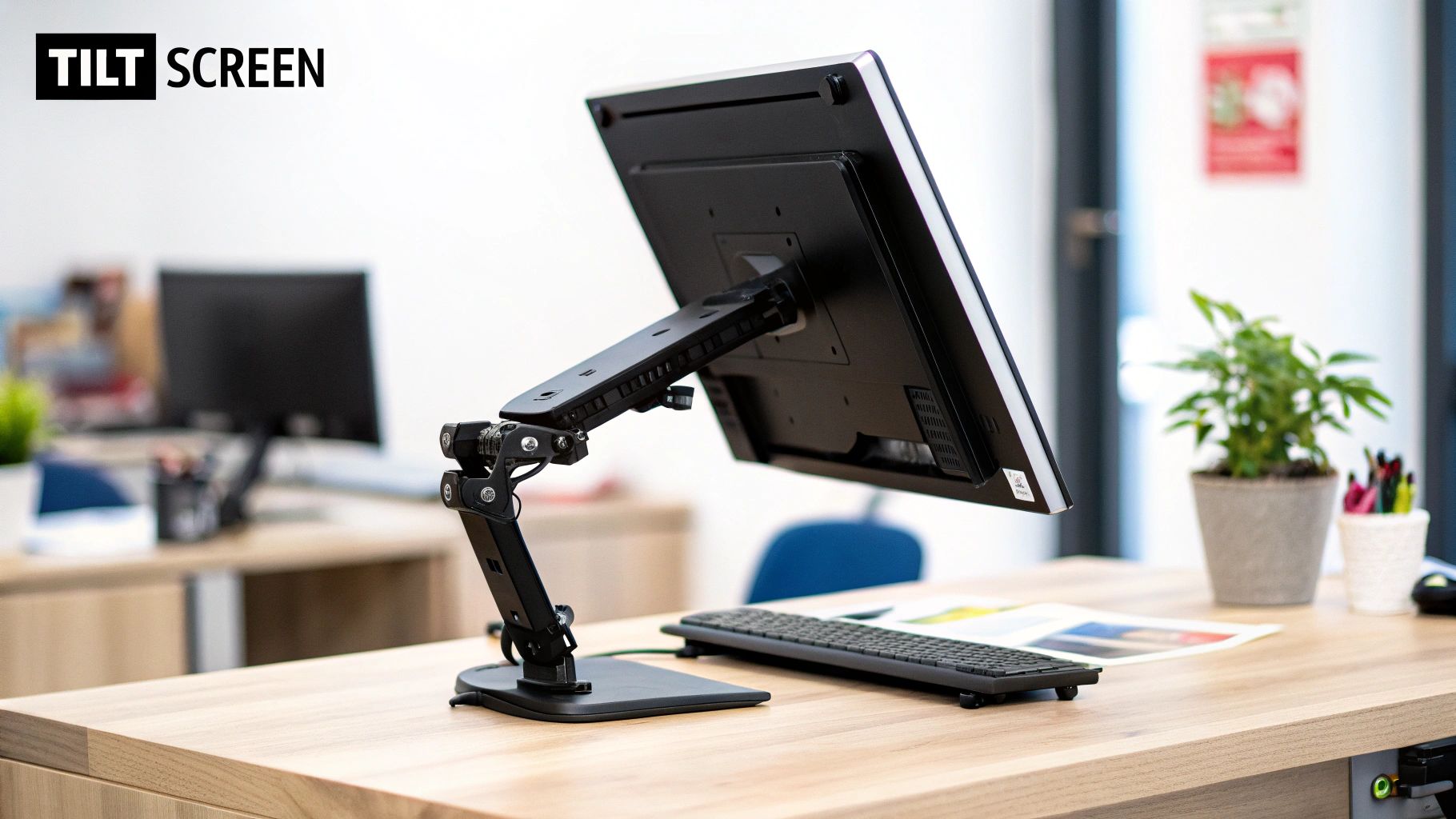
It’s not complicated science. Our screens blast out high-energy visible (HEV) blue light, a harsh wavelength that forces us to squint and puts a ton of strain on our eye muscles. The orange tint in these lenses is specifically engineered to filter out that intense light, giving you a softer, warmer view that lets your eyes finally relax.
The result is almost immediate. Whether you're burning the midnight oil on a project or just kicking back with a movie, your screen time becomes far more comfortable.
The perks of orange and amber lenses don't stop at your eyes—they’re a game-changer for your sleep cycle. When you’re exposed to blue light in the evening, it basically tells your brain, "Hey, it's still daytime!" This confusion suppresses the production of melatonin, the hormone that signals your body it’s time to sleep.
By popping on a pair of orange-colored blue light glasses a couple of hours before you plan to hit the hay, you effectively block those disruptive signals. This allows your body's natural melatonin production to kick in on schedule, making it easier to fall asleep and get the deep, restorative rest you need. Amber blue light glasses are fantastic for this too, helping you relax and wind down after a long day. If you want to dive deeper into how this all works, check out our in-depth blue light blog.
When you filter out stimulating blue light, amber and orange lenses help get your internal clock back in sync with the actual time of day. It’s a natural way to ease your body into sleep mode.
Adding blue light blocking glasses to your nightly routine is a simple change with a massive impact on your overall wellness. They are an essential tool for anyone serious about improving their sleep hygiene or just dialing down daily stress levels.
Ready to build a better evening routine? Here’s what works.
Top Ways to Get Good Sleep:
Top 4 Ways to Reduce Stress and Relax:
Tackling screen glare isn't just about making your eyes feel better in the moment. It's a huge piece of a much bigger puzzle: getting quality sleep and dialing down your daily stress. When you start managing the light you’re exposed to, you're doing more than just finding visual comfort—you’re actually working with your body's natural clock.
This is exactly where tools like Element Lux blue light blocking glasses make a real difference. They bridge the gap between our modern digital lives and our fundamental physical needs.
By filtering out the most disruptive blue light, orange-colored glasses give your eyes a much-needed break from the harsh light that causes digital eye strain, especially when you're looking at a bright screen in a dim room. Your eye muscles finally get a chance to relax, which helps prevent that all-too-familiar tension headache at the end of the day.
The benefits go way beyond just your eyes. When you pop on a pair of orange or amber blue light glasses in the evening, you’re sending a clear signal to your brain: it's time to wind down. This is crucial for kickstarting your body's production of melatonin, the hormone that governs your sleep-wake cycle, allowing for better sleep.
This one simple habit makes amber blue light glasses an incredible tool for decompressing. The world takes on a warmer, softer glow, creating a calmer visual space that helps you shift from a state of "go-go-go" to one of genuine rest. You can dive deeper into how our glasses help with sleep and the science behind it.
Blocking the most stimulating wavelengths of light with amber and orange lenses helps get your internal clock back in sync with the actual time of day. It’s a simple, natural nudge to tell your body it’s time to rest.
Making these glasses part of your evening routine is an easy, powerful step toward better overall wellness. To get you started, here are a few proven strategies I recommend.
When you're trying to solve screen glare and eye strain, a few questions always seem to pop up. Whether you're curious about different lens colors or just want to sleep better, let's clear things up with some straightforward answers.

Orange-colored blue light glasses are the heavy hitters when it comes to blue light. They're designed to filter out the most intense, high-energy wavelengths that our screens blast out. This gives your eyes a much-needed break from the harsh light that causes them to overwork, which is what leads directly to that familiar feeling of digital eye strain and tension headaches.
But the real magic happens at night. By blocking the specific blue light that messes with your melatonin production, orange-colored blue light glasses help your body get ready for rest. This allows your natural sleep cycle to take over, making it easier to fall asleep and stay asleep for a more restorative night.
They sure can. Think of amber blue light glasses as a way to change the "mood" of your environment. They transform the sharp, stimulating light from your screen into something much warmer and softer, almost like the gentle glow of a sunset.
It’s a subtle shift, but it has a powerful calming effect. It helps you ease out of that high-alert, work-focused mindset and into a more relaxed state. Putting on a pair of amber lenses in the evening is a fantastic way to start your wind-down routine and de-stress after a day of staring at screens.
By softening your visual input, amber lenses help your nervous system shift gears, making it easier to decompress after a long day of screen time and mental effort.
Looking for a few more practical steps to get better rest? Here are some proven methods that work wonders:
Ready to feel the difference for yourself? Less eye strain and better sleep are just a click away. Check out the collection of scientifically-designed eyewear at Element Lux to find the perfect pair for your evening routine.
Discover your solution at the Element Lux shop.
Tackling computer vision syndrome isn't just about one quick fix. It's about combining a few smart workspace adjustments, taking regular screen breaks, and using the right tools—like blue light blocking glasses—to dial down the symptoms. For most of us, the constant glare from our digital screens is the real culprit behind the headaches, dry eyes, and neck pain that sneak up on us.
If you spend your days staring at a screen, you know the feeling. That creeping discomfort of digital eye strain. It’s way more than just tired eyes; it’s a whole collection of symptoms we now call Computer Vision Syndrome, or CVS. This condition pops up because of the intense, prolonged focus our eyes have to maintain on our devices, often in less-than-ideal lighting or with wonky screen settings.
And it's not a niche problem. This is incredibly widespread. A huge meta-analysis that looked at over 66,000 people found that the prevalence of CVS is around 66%. Think about that—it means roughly two out of every three people glued to a screen are probably feeling its effects.
The first step to feeling better is recognizing what's going on. The signs of CVS can be both visual and physical, and they can seriously mess with your productivity and just how you feel day-to-day.
Sometimes it's tough to pin down exactly what's wrong. This quick-reference table breaks down the most common symptoms to help you see if digital eye strain is the issue.
| Symptom Category | Specific Symptoms |
|---|---|
| Ocular (Eye-Related) | Dryness, redness, itching, burning sensation, blurred vision, double vision. |
| Visual | Difficulty refocusing, increased light sensitivity, seeing afterimages. |
| Musculoskeletal | Headaches (especially around the temples), neck pain, shoulder stiffness, backaches. |
| General | Mental fatigue, reduced concentration, increased irritability. |
The tricky part is that these symptoms don't just clock out when you do. They can linger into your evening and even wreck your sleep. All that eye strain and blue light exposure can make it much harder to wind down, creating a nasty cycle of fatigue that you carry right into the next morning.
Here's the thing: our eyes work completely differently when we're looking at a screen versus reading a book. The pixels that make up text on a screen don't have the same sharp contrast or well-defined edges as ink on a page. This subtle difference forces our eyes to work much harder just to stay in focus, which leads to that all-too-familiar muscle fatigue.
On top of that, we have a bad habit of forgetting to blink when we're zoned in on our devices. Studies show we blink up to 60% less often in front of a screen. Blinking is your eye's natural way of keeping itself moist and clean by spreading tears across the surface. When you don't do it enough, you get the dryness and irritation that are hallmark signs of CVS.
Getting a handle on these root causes is the key to putting together a plan that actually works. If you're looking for more tips, you can explore the digital wellness info over at our resources page.
The space you work in has a massive impact on how your eyes feel at the end of the day. A few smart tweaks to your setup can bring almost immediate relief from that nagging eye fatigue and set you up for better long-term eye health.
The idea is to create an environment where your eyes can work comfortably, not harder than they have to. Let's start with your monitor. It should be about an arm's length away—that’s usually somewhere between 20 and 30 inches. This sweet spot keeps your eyes from constantly straining to focus.
Also, check the height. The top of your screen should sit right at or just a hair below your eye level. A classic mistake is having the monitor too high, which forces you to crane your neck back. Instead, you want a slight downward gaze of about 15 to 20 degrees. It feels much more natural and puts less stress on both your eyes and neck.
Beyond just where you put your monitor, your posture and daily habits are just as critical. A truly ergonomic setup isn't just about feeling comfortable; it's about minimizing the physical stress that leads to eye fatigue and muscle aches.
This simple infographic breaks down the three core pieces of proper workstation ergonomics.
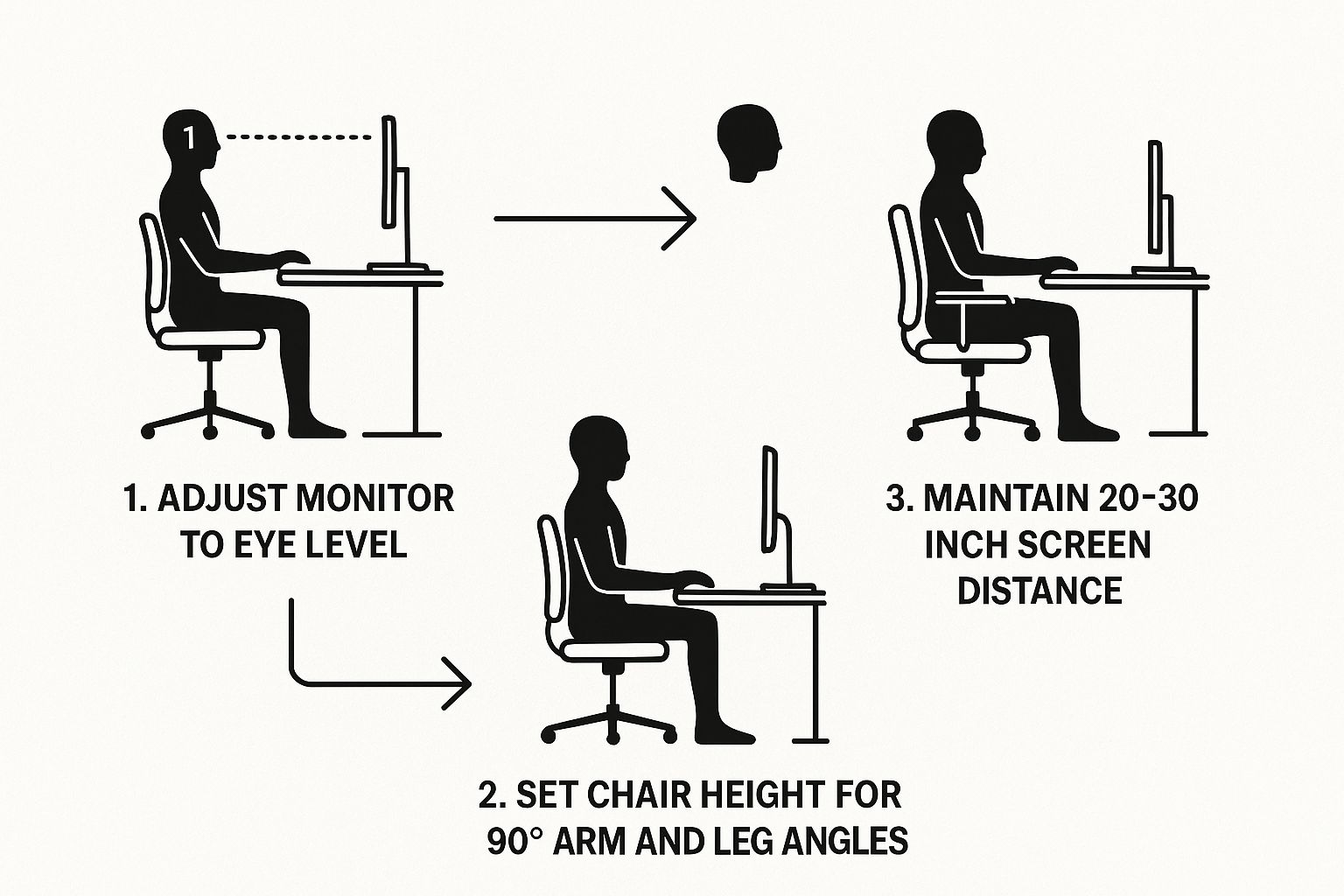
As you can see, getting your monitor, chair, and viewing distance in sync creates a balanced system that supports your body instead of fighting against it.
One of the best habits you can build is the '20-20-20 rule'. It sounds simple, but it’s a powerful way to treat computer vision syndrome. Every 20 minutes, take a 20-second break and look at something 20 feet away. That small action gives your eye muscles a much-needed chance to relax from the constant close-up work screens demand.
Don't forget to blink! When we're glued to a screen, our blink rate can plummet by as much as 60%. Making a conscious effort to blink more often keeps your eyes lubricated, fighting off the dryness and irritation that are hallmarks of digital eye strain.
Lighting is another huge piece of the puzzle. Try to position your desk so windows are to your side, not directly in front of or behind your screen. This cuts down on the harsh glare and reflections that are a major source of eye fatigue. If you can't move your desk, an anti-glare screen filter is a great investment.
Ultimately, managing Computer Vision Syndrome really comes down to these kinds of ergonomic and behavioral adjustments. Research even shows that simply reducing how long you use a computer without a break is a huge factor in easing symptoms. Interestingly, one study found that things like screen distance or font size weren't nearly as important as just breaking up those long stretches of screen time. You can dig into the full research on these findings over at oftalmoloji.org.
The artificial light pouring from our screens does more than just light up our faces—it's sending powerful signals straight to our brains, and it can throw our natural rhythms completely out of whack. This is especially true for the high-energy blue light that our devices emit in massive amounts.
When that light hits your eyes, particularly in the evening, it tricks your body into thinking it's still daytime. This constant exposure is a huge contributor to digital eye strain and a major roadblock in getting computer vision syndrome under control. It also directly interferes with your body's production of melatonin, the hormone that tells you when it’s time to sleep.
The result? You feel wired at night and completely groggy in the morning, stuck in a frustrating cycle of fatigue.
To fight back, one of the most powerful tools you have is a pair of orange colored blue light glasses, especially in the hours leading up to bed. Think of these lenses as a serious shield for your eyes. By blocking a massive spectrum of blue light, orange lenses reduce the visual noise and harsh glare that cause your eye muscles to overwork. This leads to a significant decrease in eye strain, headaches, and general fatigue after a long day of screen use.
Their deep orange tint is also specifically engineered to help with sleep. By filtering out over 99% of disruptive blue light wavelengths, wearing them for a couple of hours before bed creates an artificial sunset for your eyes. This sends a clear signal to your brain that the day is ending, allowing your body to naturally produce melatonin without interference. The result is an easier transition into deep, restorative sleep.
While orange lenses are the heavy-hitters for sleep prep, sometimes you need a less intense option for earlier in the evening. That's where amber blue light glasses come in. Their lighter, yellowish tint offers a more moderate level of blue light filtration, perfect for helping you relax and wind down.
Amber lenses take the harsh, glaring edge off screen light, which helps reduce eye strain and lets your mind and body ease into a more relaxed state. You'll notice a real reduction in digital fatigue, but without the significant color shift you get from darker orange lenses. This makes them ideal for watching a movie or reading on a tablet. For a deeper dive into the science, you can find more information on our blue light blog.
Wearing the right type of blue light blocking glasses at the right time is a simple yet incredibly effective strategy. It helps protect your eyes from strain and aligns your body's internal clock with your desired sleep schedule—a true cornerstone of managing computer vision syndrome.
Improving your sleep is all about building a solid, relaxing evening routine. Blue light blocking glasses are a fantastic start, but you can amplify the benefits by combining them with other healthy habits.
The mental fatigue from constant screen time can be just as draining as the physical eye strain. Taking active steps to lower your stress and anxiety in the evening is critical for both your mind and your sleep.
Fixing computer vision syndrome is about more than just managing daytime eye strain. It’s about getting your body’s natural rhythms back on track, and that starts with a good night's sleep. The constant flood of blue light from our screens can seriously mess with our internal clock, making it tough to fall asleep and stay asleep. It's a nasty cycle of poor rest and digital fatigue that hits both our productivity and our quality of life.
This isn't just a minor annoyance; it's become a major occupational hazard. An estimated 60 million people worldwide suffer from CVS, and about 1 million new cases pop up every year. The condition impacts nearly 70% of people who use computers regularly, often triggering sleep disruptions that just make the symptoms worse. You can read more about the research on the PMC website. Taking back control of your nights is a crucial first step to feeling better.
One of the simplest and most effective things you can do is manage your light exposure in the evening. Think of it this way: slipping on a pair of orange-colored blue light glasses for a couple of hours before bed is like sending a direct signal to your brain that the day is over. These lenses are specifically designed to filter out the exact wavelengths of blue light that stop melatonin production, letting your body prepare for sleep the way it's supposed to.
Amber blue light glasses play a similar role, but they’re perfect for earlier in the evening when you just want to start relaxing. The amber tint knocks the harsh, stimulating edge off your screen's light, helping both your muscles and mind unwind after a long day of staring at pixels.
When you make blue light blocking glasses part of your evening routine, you're essentially creating an artificial sunset for your brain. This simple habit helps reset your circadian rhythm, making it easier to drift off and get the deep, restorative rest your body needs to recover.
A consistent, relaxing nightly routine is the foundation for better sleep. While blue light blocking glasses are a huge part of the puzzle, pairing them with other healthy habits is what really makes the difference. If you're curious about the science behind it all, our detailed guide explains how these glasses can help with sleep.
The mental drain from constant screen time can be just as exhausting as the physical symptoms. Actively calming your mind in the evening is essential for both your mental health and your sleep quality.
The constant stream of information from our screens doesn't just wear out our eyes. It completely overloads our minds, leaving us in a state of digital stress and anxiety. If you really want to tackle computer vision syndrome, you have to address that mental fatigue, too. Learning to intentionally unplug is one of the most powerful skills you can develop for bringing back a sense of calm.
A great place to start is by creating a "digital sunset" for your evenings. This just means committing to turning off all your screens at least an hour or two before you actually plan to sleep. That simple boundary gives your brain a much-needed chance to switch off, process the day, and start unwinding without constant pings and notifications.
That screen-free window is the perfect opportunity to lean into hobbies that give both your eyes and mind a real break from pixels.
As you're winding down, wearing a pair of amber blue light glasses can make a huge difference in how relaxed you feel. The gentle, warm tint of amber lenses takes the harsh, stimulating edge off of both screen light and ambient light from around your home. It’s a subtle but effective signal to your nervous system that the day's demands are over and it's time to de-stress.
This calming effect on your visual system often translates into an overall feeling of ease, making it much simpler to disconnect from work thoughts and daily anxieties. It helps you build a bridge between a chaotic day and a peaceful evening.
Think of amber lenses as a filter for your entire environment. They soften the visual "noise" that contributes to mental fatigue, making it easier to slip into relaxing activities like reading a book or listening to music, fully preparing your mind for deep, restorative rest.
A solid night’s sleep is hands-down one of the best forms of computer vision syndrome treatment. By combining a few smart habits, you can build a powerful routine that genuinely promotes restorative rest.
Lowering your stress isn't something that just happens; it requires a bit of intentional practice. Here are four techniques that can help you calm your mind and reduce anxiety, especially after a long day staring at screens.
To tie this all together, here’s a quick look at how these strategies work in tandem to help you feel your best.
| Technique | Primary Benefit | How Blue Light Glasses Help |
|---|---|---|
| Digital Sunset | Gives the brain a break from constant stimulation to reduce mental fatigue. | Softens ambient light, making the screen-free transition feel more natural and less jarring. |
| Wind-Down Ritual | Signals to your body that it's time to sleep, promoting relaxation. | Filters out stimulating blue light, supporting the body's melatonin production for better sleep. |
| Mindful Breathing | Calms the nervous system and lowers heart rate, reducing immediate feelings of stress. | Reduces visual "noise" and eye strain, making it easier to focus inward on your breath. |
| Screen-Free Hobbies | Shifts focus from digital input to tactile, creative, or physical engagement. | The warm tint creates a cozier, more relaxing atmosphere for activities like reading or journaling. |
By actively managing your evening routine and using tools like blue light glasses, you can effectively combat digital stress and protect both your eyes and your mind.
Okay, so we've covered a lot of ground. Now, how do all these strategies actually work together in real life? It's one thing to know the individual steps, but it's another to see how they fit into a routine that brings real relief.
A big piece of the puzzle is understanding how different colored lenses can—and should—be used throughout your day and night. This isn't just about dimming the lights; it's about giving your brain the right cues at the right time.
Think of orange colored blue light glasses as your dedicated sleep-prep tool. Their deep, heavy tint is specifically designed to filter out the most disruptive blue light wavelengths, which helps reduce eye strain and fatigue. But their primary benefit is for sleep. By blocking the light that slams the brakes on melatonin production, wearing them an hour or two before bed sends a powerful signal to your brain: "Hey, the day is over." This makes it so much easier to not just fall asleep, but to get that deep, restorative rest your body craves.
Amber blue light glasses, on the other hand, are your evening wind-down companion. They offer a more moderate filter, perfect for softening the harsh glare from artificial lights and screens as you transition out of work mode. This gentle filtering helps your mind and body relax, shifting you out of that high-alert state and into a calmer one. They're ideal for those hours after dinner when you want to de-stress from the day.
Using blue light glasses is a fantastic start, but building a solid sleep routine around them is what truly locks in the benefits. Consistency is everything here.
Let’s be real: managing stress is just as crucial as managing screen time. Weaving some simple relaxation techniques into your evening can make a world of difference.
Ready to take control of your sleep and finally ease that eye strain? The science-backed lenses from Element Lux are designed to help you unwind and rest deeply. Explore our collection and find the perfect pair to start your journey toward better nights and brighter days.
So, do blue light blocking glasses actually work?
It's a fair question, and the honest answer is a qualified yes. Their effectiveness really hinges on two things: what you're trying to fix and, most importantly, the color of the lenses you choose. If you're chasing better sleep, the science overwhelmingly backs amber or orange lenses. For digital eye strain, however, the benefits of clear lenses are a lot murkier.
Let's face it, most of us spend a huge chunk of our day staring at a screen. That reality has pushed questions about eye health and sleep quality to the forefront. Blue light glasses are often pitched as the simple fix, but they're definitely not all created equal.
The real key is to get clear on your goal. Are you looking to signal to your brain that it's time to wind down and get a more restful night's sleep? Then orange and amber lenses are absolutely your best bet. They are designed specifically for this purpose.
But what if you’re just trying to combat that tired, gritty feeling your eyes get after a long day of work? When it comes to digital eye strain, the evidence is less convincing. A major 2023 review of multiple randomized controlled trials found very little consistent proof that blue-light filtering lenses do much to reduce eye strain for the average adult. You can dive into the full study yourself on the National Library of Medicine's website.
This infographic puts our screen habits into perspective and shows where people feel the most benefit.
As you can see, while many people feel a difference in eye strain, the measurable impact on sleep is where targeted, colored lenses truly make their mark.
Different lens colors are engineered to solve different problems. To make it simple, we've broken down which lens is right for your specific needs, whether you're battling afternoon eye fatigue or trying to reclaim your natural sleep cycle.
| Lens Type | Primary Benefit | Best For | Effectiveness |
|---|---|---|---|
| Orange/Red | Maximum Melatonin Support | Wearing 1-2 hours before bed to prepare for deep, restorative sleep. | Highly Effective for improving sleep onset and quality. |
| Amber | Evening Relaxation & Wind-Down | Casual evening use, like watching TV or scrolling, to reduce stimulation. | Effective for calming the nervous system and easing into rest. |
| Clear | Daytime Glare & Strain Reduction | All-day computer work to reduce screen glare and potential eye fatigue. | Minimally Effective; studies show limited, inconsistent benefits for eye strain. |
Ultimately, choosing the right tool for the job is what gets results. Orange and amber lenses are designed for sleep, while clear lenses are meant for daytime screen use—though their benefits are still up for debate.
Think of orange-colored blue light glasses as a powerful tool in your sleep arsenal. They work by blocking the specific wavelengths of light known to shut down melatonin—the hormone that basically tells your body, "Hey, it's time for bed."
When you wear them for an hour or two before you plan to sleep, you're helping your brain's natural transition into rest mode. This can make falling asleep feel easier and can lead to a deeper, more restorative night's rest.
Amber lenses offer a slightly gentler, but still effective, approach. They're perfect for helping you relax and wind down in the evening while you’re watching a movie or scrolling on your phone. They cut down on the stimulating glare from screens, helping to calm your nervous system without the intense color shift of darker orange lenses.
Ready to build a better evening routine? Here are four powerful ways to reduce stress and get your body ready for sleep:
To really get why blue light blocking glasses are so effective, you need to understand the light itself. Think of all the light you see as a rainbow, or a spectrum. Blue light is the high-energy, short-wavelength slice of that rainbow that our brains have been hardwired for millions of years to associate with daytime.
Natural blue light from the sun is a good thing! It keeps us alert and powers our internal body clock, often called our circadian rhythm.
The trouble starts when the sun goes down, but the artificial blue light from our screens stays on. Scrolling on your phone in bed or finishing up work on a laptop sends a powerful, unnatural signal to your brain: "It's still daytime!" This exposure throws a wrench in the production of melatonin, the hormone that tells your body it's time to sleep.
This is where orange-lensed blue light glasses come in as a powerful solution to a very modern problem. By filtering out the most disruptive wavelengths of blue light, they provide immediate relief from the digital eye strain that so many of us feel after a long day of screen time. This can mean fewer tension headaches and a much more comfortable evening.
More importantly, these glasses are a game-changer for sleep. The science is pretty clear: blue light directly impacts special cells in our eyes (called ipRGCs) that act as the master switch for our circadian rhythm. When you wear orange-lensed glasses in the evening, you're essentially creating an "artificial sunset" for your eyes, allowing your body to produce melatonin on a natural schedule. The result? You fall asleep faster and get the kind of deep, restorative rest your body craves.
Think of amber blue light glasses as your perfect partner for shifting from a busy day to a calm evening. They filter out a serious amount of that stimulating blue light, which helps quiet your nervous system without the intense color change of the darker orange lenses. This makes them perfect for kicking back to watch TV or for some casual evening scrolling.
By popping on a pair of amber lenses, you can cut through that "wired but tired" feeling you get after being glued to screens. They create a warmer, softer visual world that signals to your mind and body that it's officially time to start winding down for a peaceful night.
Key Takeaway: The goal isn't to block all blue light, all the time. It's about being smart with your exposure, especially in the hours before bed, to work with your body's natural sleep-wake cycle, not against it.
For more deep dives into optimizing your evenings, head over to the Element Lux blue light blog.
Great sleep isn't about finding one magic bullet; it's about building a solid, consistent routine.
Tackling evening stress is a huge part of falling asleep easily. Here are four simple but powerful strategies.
When the sun goes down, our bodies get the memo: it's time to start producing melatonin, the hormone that cues sleep. But modern life, with its constant glow of artificial light from screens, can seriously delay this crucial process. This is exactly where orange-lensed blue light glasses step in, acting as a powerful shield for your natural sleep cycle.
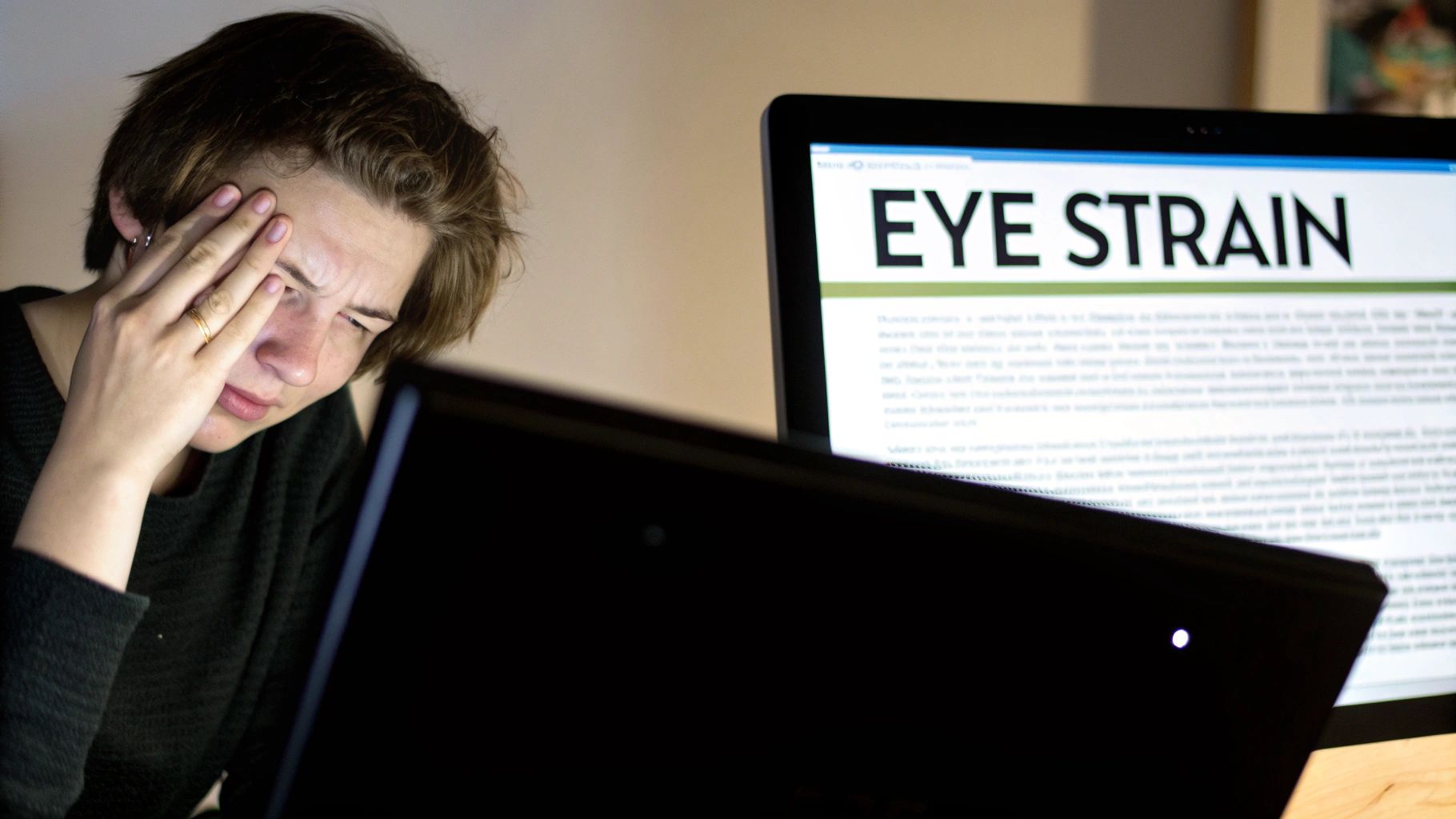
These glasses are designed to block a huge chunk of the blue and even green light wavelengths known to shut down melatonin production. By popping them on for an hour or two before you plan to sleep, you're essentially creating a personal sunset for your eyes. This simple act sends the right signals to your brain, allowing it to get on with the business of making melatonin, uninterrupted.
The result? A much smoother transition into slumber. Many people find they fall asleep faster and get more of the deep, restorative sleep their bodies are craving.
It's not just about sleep. Orange lenses also tackle the very real discomfort of digital eye strain. That harsh, high-energy glare from our screens can leave eyes feeling tired, dry, and overworked, sometimes even sparking tension headaches.
Orange-tinted glasses soften this intense light, making your evening screen time far more comfortable. By cutting the glare and filtering out the most jarring wavelengths, they help your eye muscles finally relax. That means less squinting and less fatigue, paving the way for a more peaceful wind-down before you hit the hay.
While the main event is better sleep, this added comfort makes a huge difference in how you feel at the end of the day. For a deeper dive into how our glasses help you rest, you can learn more about how Element Lux glasses help with sleep.
While blue light glasses are a fantastic tool, they work best when they're part of a bigger picture. Integrating them into a solid sleep hygiene routine can seriously amplify their benefits.
Let's face it: stress is a sleep-killer. Weaving some simple relaxation techniques into your evening can make all the difference.
Think of amber-lensed glasses as your secret weapon for bridging the gap between a chaotic day and a calm evening. While our darker orange lenses are the heavy hitters for pre-bedtime use, amber lenses offer the perfect middle ground. They filter out a serious amount of stimulating blue light, helping to ease your mind without the intense color shift of their darker cousins.
This makes them your go-to for pretty much any relaxing evening activity. Catching up on a TV show, reading on your tablet, or just scrolling on your phone after dinner—amber lenses wrap it all in a softer, warmer visual experience. By knocking down that harsh, stimulating glare from screens, they help quiet your nervous system and fend off that awful "wired but tired" feeling that screen-heavy days so often leave behind.
This gentle filtering is all about creating a peaceful pre-sleep environment. It's a clear signal to your brain that it's time to shift gears from "go, go, go" to quiet relaxation, preparing your body and mind for the deep rest you actually need.
The main job of amber lenses is to slash the high-energy blue light that keeps your brain locked in alert, daytime mode. That constant stimulation, especially after the sun goes down, is a major contributor to feelings of stress and mental burnout. The moment you put on a pair of amber glasses, you immediately soften your entire visual world.
This drop in stimulating light helps your mind transition more naturally into a state of relaxation. It’s not about forcing yourself to sleep; it’s about creating the right conditions for your body to wind down on its own. It’s a lot like dimming the lights in a room to set a calmer mood—amber lenses do the exact same thing, but just for your eyes.
Nailing down consistently great sleep isn't about one magic trick; it's about building a rock-solid routine. Blue light blocking glasses are a cornerstone of any modern sleep strategy, but they really shine when you pair them with other proven habits.
By making these practices a regular part of your evening, you create powerful cues that tell your body it's time to prepare for deep, restorative sleep.
Stress and poor sleep love to feed off each other, creating a cycle that can feel impossible to break. Here are four practical ways to snap that cycle, with your amber glasses playing a starring role in your wind-down toolkit.
While blue light blocking glasses are an incredibly powerful tool, they work best when they're part of a bigger, smarter sleep strategy. Think of them as a key player on your team, not a magic pill. Building a solid foundation of sleep hygiene is what truly transforms restless nights into rejuvenating ones.
The first and most critical step is controlling your evening light environment. This is where orange-lensed glasses, like ours at Element Lux, become your non-negotiable for any evening screen time. By filtering out the specific blue wavelengths that shut down melatonin production, they directly support your body’s natural wind-down process.
This simple habit eases digital eye strain from harsh screen glare, but more importantly, it signals to your brain that it's time to prepare for sleep. Melatonin gets the green light to do its job. Likewise, our amber lenses are perfect for helping you relax and wind down while watching TV or scrolling, reducing that stimulating glare and calming your nervous system.
Beyond managing light, a few other proven habits form the pillars of excellent sleep. When you combine these practices with your blue light glasses, you create a powerful synergy that your body will thank you for.
Stress and anxiety are notorious sleep thieves, locking you into a vicious cycle of worry and exhaustion. Here are four practical ways to quiet your mind, with your glasses playing a central role in your evening wind-down.
By weaving these habits together, you build a comprehensive routine for truly better sleep. For more actionable advice on rest and relaxation, check out the extensive guides in our Element Lux resources library.
We’ve all been there. A high-stress day bleeds into a restless night, and you wake up feeling even less prepared to face the next day's challenges. It’s a draining cycle that can feel impossible to escape.
Breaking free starts with creating a real wind-down routine in the evening, and one of the simplest, most effective tools you can use is a good pair of blue light blocking glasses.
By filtering out the harsh, stimulating light from all your screens, these glasses send a powerful signal to your nervous system to calm down. Orange-lensed glasses are especially good at this. They don't just ease digital eye strain; they tell your brain it’s time to start producing melatonin, the hormone that makes you sleepy. It’s a simple switch that helps you shift from a state of high alert to one of deep relaxation.
Here are four strategies you can start tonight to manage evening stress, with your blue light glasses leading the charge.
Think of this as your digital sunset. The single most impactful step you can take is to control your light exposure before bed. Simply putting on your Element Lux amber or orange glasses for at least 1-2 hours before you plan to sleep immediately cuts down on the anxiety-inducing stimulation from screens.
This one action protects your natural melatonin production, getting your body ready for truly restorative rest. It also helps reduce the eye fatigue that often leads to tension headaches and physical discomfort, making your entire evening feel more comfortable.
Stress often feels like a hamster wheel in your head, replaying the day's worries over and over. Mindfulness and deep breathing are incredibly effective ways to step off that wheel. You don't need to become a meditation guru overnight.
Just 5-10 minutes with a guided meditation app or a few simple, deep breathing exercises can dramatically lower your heart rate and cortisol levels. It pulls your mind out of the chaos and into the present moment.
This mental reset is crucial for creating the calm headspace you need to fall asleep.
After a long day hunched over a desk, stress gets trapped in your muscles—think tight shoulders, a sore neck, and an aching back. Gentle movement is a fantastic way to release all that stored-up tension.
Try a short, leisurely walk after dinner or 15 minutes of light stretching or yoga. The goal isn't a workout; it's about gently moving your body to increase blood flow and let go of the physical tightness that fuels feelings of anxiety.
Your body loves predictability. A consistent, screen-free ritual signals that the day is officially over and it's time to power down. Of course, "screen-free" is the ideal, but if you must use a screen, make sure you're wearing your blue light blockers.
Combining these four strategies helps you truly disconnect from the day's stressors. You'll transition smoothly into a state of deep relaxation, paving the way for the kind of restorative sleep your body and mind are craving.
If you're curious about blue light blocking glasses, you're not alone. The conversation usually comes down to a few key questions. Let's clear up the common ones so you can get the most out of your glasses.
Orange-colored glasses are powerhouses for both eye comfort and better rest. When it comes to eye strain, they filter out the harsh, high-energy blue light that creates screen glare. This glare forces our eye muscles to work overtime, which is what leads to that familiar feeling of fatigue and even headaches. The lenses create a much softer, more comfortable view for evening screen time.
But their role in sleep is even more important. By blocking the specific blue wavelengths that shut down your body's melatonin production, orange lenses let your natural sleep cycle do its thing. Putting them on for 1-2 hours before bed is like creating your own personal sunset—it sends a powerful signal to your brain that it's time to wind down for deep, restorative sleep.
Think of amber blue light glasses as your perfect accessory for unwinding. They filter out a good chunk of the stimulating blue light that keeps your nervous system on high alert after a long day of screen exposure.
This gentle filtering is what helps you avoid that "wired but tired" feeling you get from scrolling on the couch. It creates a warmer, less jarring visual environment that helps your mind and body ease from a state of alertness into one of peaceful rest.
While the right glasses are a game-changer, they work best when they're part of a solid evening routine.
Breaking the cycle of late-night stress and poor sleep is all about calming your system down.
Ready to take control of your sleep and relaxation? The Element Lux collection is designed with scientifically-backed amber and orange lenses to help you wind down naturally. Explore our glasses and find your perfect pair today.
If you’ve ever wrapped up a long day staring at your computer only to be hit with a pounding headache, you're definitely not alone. This is the all-too-common reality of a blue light headache, often triggered by spending hours in front of our digital devices. The intense, high-energy light blasting from your phone, laptop, and TV can seriously overstimulate your eyes and brain, leading straight to discomfort.
You can think of the blue light from your screens like a constant, high-frequency "buzz" that your eyes just weren't designed to deal with for hours on end. This constant stimulation is a major cause of digital eye strain, a condition whose symptoms are becoming more and more familiar to all of us.
When your eyes are fighting to focus on the scattered, high-energy light from a screen, the tiny muscles in them go into overdrive. That relentless effort can directly cause tension headaches—that classic tight, squeezing pain you feel around your forehead.
It’s not just how long you stare at a screen, but the intensity of that use, that fuels the pain. The link between digital screens and headaches is undeniable, especially for young adults who are glued to their devices. One study highlighted that 30.5% of participants were on screens for 7–9 hours a day, and most of them directly connected their screen time to how often they got headaches.
The takeaway is pretty clear: more screen time often leads to more frequent, more intense headaches. Your brain gets stuck in a state of high alert from the nonstop barrage of blue light, which makes it tough to wind down and leads to mental fatigue that shows up as very real, physical pain.
The pain from a blue light headache isn't just in your head. It often brings along other symptoms that are clear signals your eyes are overworked and desperately need a break.
Besides the headache itself, you might notice a whole host of other uncomfortable symptoms. These are all signs that your eyes are being pushed well beyond their limits by your screens.
Recognizing these symptoms is the first step toward getting real relief. If you're curious and want to dive deeper, you can learn more about blue light on our blog.
For a lot of us, that throbbing headache after a long day of screen time is more than just a minor annoyance. For some, it’s the first warning sign of a full-blown migraine. There’s a surprisingly direct connection here, and it often starts with something we all take for granted: sleep.
Your brain has a clever way of telling you it’s time to wind down. It releases a hormone called melatonin, which is basically the "go to sleep" signal. But when you're scrolling on your phone or finishing up work late at night, the intense blue light from the screen acts like a blaring alarm, telling your brain to stop making melatonin. This makes it harder to fall asleep and seriously messes with the quality of the rest you do get.
This is where things get serious for migraine sufferers. A lack of deep, restorative sleep is one of the biggest, most well-documented migraine triggers out there. Migraines are a deeply disruptive neurological condition that affects over 1 billion people globally, and anything that throws off your body's internal clock—your circadian rhythm—can set one off.
By disrupting melatonin, blue light directly sabotages your sleep-wake cycle. This creates a vicious pattern: more screen time leads to worse sleep, and worse sleep makes you far more likely to suffer a painful migraine. You can dive deeper into the science behind sleep disruption and migraines on ncbi.nlm.nih.gov.
If you’ve ever had a migraine, you know all about photophobia. It’s that extreme, painful sensitivity to light where even a dim lamp feels like a spotlight. For many, blue light is the absolute worst offender.
This means the very devices we rely on for work, connection, and entertainment can turn into instruments of torture during an attack. They don’t just trigger the migraine; they can make it feel a thousand times worse and drag out the recovery process. If you want to get a better handle on managing light sensitivity, we’ve got some great info in our online resources.
Think of it this way: when you have a migraine, your brain is already in a state of high alert. Blasting it with high-energy blue light is like pouring gasoline on a fire. It just amplifies the pain and keeps the attack going longer.
Taking control of your blue light exposure, especially in the evening, is one of the most practical things you can do to break this cycle. When you shield your eyes, you're not just reducing eye strain—you're protecting your sleep and giving your brain a fighting chance to stay calm and migraine-free.
Okay, so we know what’s causing the problem. Let's talk solutions. One of the most direct and effective ways to fight back against blue light headaches is to use specially tinted glasses. Think of them as a personal shield for your eyes, filtering out the most aggressive wavelengths of light before they have a chance to trigger strain and pain.
But here’s the thing: not all blue light glasses are the same. The color of the lens makes all the difference. Orange and amber lenses are engineered to block a much wider spectrum of high-energy blue light than their clear or lightly tinted counterparts. This powerful filtration is exactly what you need to reduce the digital eye strain that so often leads to a nagging tension headache after hours in front of a screen.
This protection is even more critical if you're sensitive to light. Photophobia is a brutal symptom for over 92% of people who suffer from migraines, and blue light is a major offender. In fact, research shows that exposure to bright blue light can make migraine pain worse for up to 80% of subjects, making it a powerful trigger to avoid. You can dig into the full study on migraines and light sensitivity on headachejournal.onlinelibrary.wiley.com if you want to see the science for yourself.
Beyond just preventing eye strain during the day, orange colored blue light glasses are a game-changer for your sleep. By blocking the disruptive blue light that suppresses melatonin—the hormone that signals "it's time for bed"—they help your body's natural sleep-wake cycle function properly. Wearing them in the evening allows your body to produce melatonin naturally, making it easier to fall asleep and stay asleep. This leads to the deep, restorative rest your brain needs to prevent headaches.
Similarly, amber blue light glasses create the perfect environment for you to relax and wind down. They cast a warm, soothing glow that helps your brain shift from a state of high alert to one of calm. This mental transition is crucial for reducing the stress and tension that often contribute to blue light headaches, allowing you to decompress after a long day.
By making tinted glasses part of your daily routine, you give your eyes and brain the protection they need to navigate a world full of screens without the painful consequences.
This isn't just about managing symptoms; it's a proactive step that gets to the root cause of screen-induced discomfort. Pair it with other healthy habits, and you’ll be amazed at the difference it can make.
If you want to fight back against blue light headaches, the battle often starts with winning the war for better sleep. This isn't just about what happens when your head hits the pillow; it’s about building a solid routine in the hours leading up to bedtime, with blue light management at its core.
The single most powerful habit you can adopt is slipping on a pair of orange or amber colored blue light blocking glasses about one to two hours before you plan to sleep. Think of it as creating your own personal sunset. These glasses filter out the harsh, stimulating blue light from all your screens and indoor lighting, giving your brain the signal it needs to start producing melatonin—the hormone that says, "Hey, it's time to wind down."
Orange colored blue light glasses are a game-changer for reducing digital eye strain when you're on your phone or laptop in the evening. They block a huge chunk of that high-energy light that makes your eye muscles tired and achy, which is a classic trigger for tension headaches. They are just as crucial for sleep, as they protect the melatonin your brain needs to produce for a night of deep rest.
Amber blue light glasses do a similar, equally important job. They cast everything in a warm, soothing hue that helps your brain switch from its frantic "day mode" to a much calmer "night mode." This simple shift is vital for preparing your mind and body for a night of truly restorative rest.
Beyond just wearing the right eyewear, layering in a few other habits can make a massive difference in your sleep quality and how often you get headaches. These practices work together to get your body's internal clock back on track.
Here’s what you can start doing tonight:
This simple visual breaks down a few key steps for preventing digital eye strain during the day, which makes your nighttime routine even more effective.
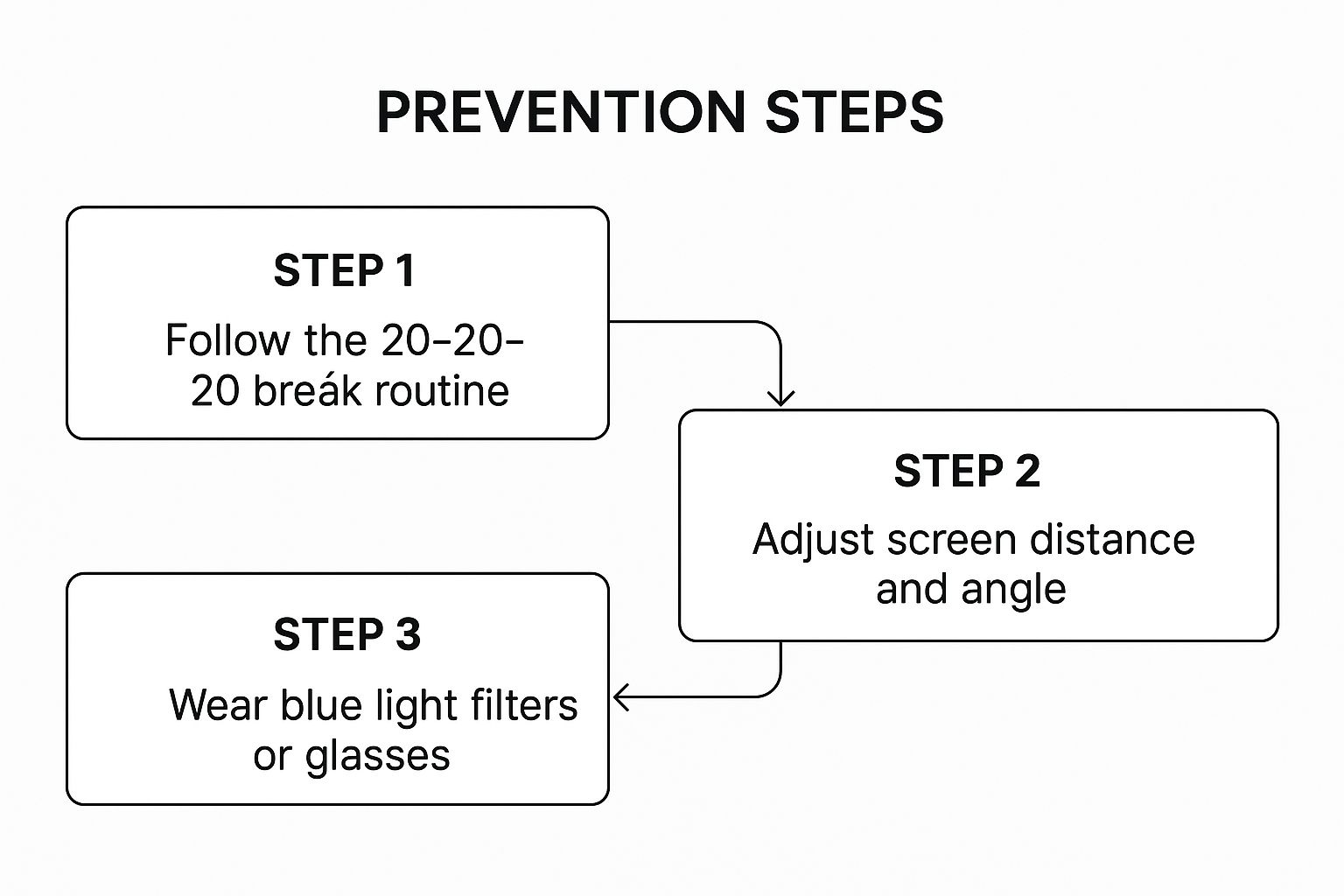
By tackling these things during the day, you’re reducing the cumulative strain that so often builds into an evening headache.
| Strategy | How It Helps | When to Do It |
|---|---|---|
| Wear Amber/Orange Glasses | Blocks stimulating blue light to allow natural melatonin production. | 1-2 hours before bedtime. |
| Set a Consistent Sleep Schedule | Reinforces your body's internal clock (circadian rhythm). | Every day, including weekends. |
| Optimize Your Bedroom | Creates an environment conducive to deep, uninterrupted rest. | Every night. |
| Avoid Late-Night Stimulants | Prevents interference with your natural sleep cycle. | No caffeine after 2 p.m.; no heavy meals/alcohol 2-3 hours before bed. |
| Establish a "Wind Down" Routine | Signals to your brain and body that it's time to prepare for sleep. | The last 30-60 minutes before bed. |
By adopting these habits, you aren't just dodging headaches—you're making a real investment in your overall health and well-being.
Stress and anxiety are like fuel for headaches and migraines. That constant tension doesn't just stay in your head—it often shows up as real, physical pain. Learning how to manage that daily pressure is one of the best things you can do to prevent a blue light headache from taking hold. It's all about intentionally creating moments of calm and giving your brain a much-needed break from all the stimulation.
A surprisingly simple but effective habit is making blue light blocking glasses part of your evening routine. Think of it as drawing the curtains on your digital day. The modern world inside your home, lit by bright LEDs and filled with screens, is constantly telling your brain to stay on high alert.
Slipping on a pair of orange or amber colored blue light glasses in the evening sends a powerful signal to your brain: it's time to wind down.
Orange colored blue light glasses are your best defense against the digital eye strain that builds up after a long day of screen time. They filter out the harsh, high-energy light that forces your eye muscles to work overtime, stopping the tension that so often escalates into a headache. They also protect your melatonin production, which is crucial for getting the deep, restorative sleep that keeps headaches at bay.
In the same way, amber blue light glasses help you relax and decompress. They wrap your surroundings in a warm, gentle light, which can have an almost immediate calming effect on your entire nervous system. This helps your mind transition from a state of focus and alertness to one of rest and recovery.
By creating a less stimulating visual environment, you give your mind the space it needs to decompress. This simple act can significantly lower your stress levels, making you far more resilient to headache triggers.
Getting better sleep is one of the most powerful moves you can make to slash both your stress and headache frequency. A well-rested brain is just less reactive to triggers. Weaving a few quick relaxation habits into your day can stop stress from spiraling out of control.


We've explored the deep connection between our screens, our sleep, and that nagging pain of a blue light headache. To finish up, let's tackle some of the most common questions that pop up when people are trying to find relief.
Think of this as a quick-reference guide. These are the key takeaways to help you feel confident in your plan for managing screen time and protecting your well-being.
The color of your blue light glasses really does matter, especially when your goal is to prevent headaches and get better rest. It all comes down to filtering out specific wavelengths of light that cause the most trouble.
Orange colored blue light glasses are your heavy hitters for fighting digital eye strain. They block a huge chunk of the high-energy blue light that forces your eye muscles into overdrive—a major cause of tension headaches. This filtering is just as important for sleep, as it stops blue light from shutting down melatonin, the hormone that tells your brain it's time for bed.
In the same vein, amber blue light glasses are fantastic for helping you relax and wind down. Their warm tint creates a much calmer visual environment. It’s like a signal to your brain, telling it to switch from an alert, "daytime" mode to a restful, "evening" state. Easing that mental tension is a huge step in preventing headaches.
Boosting your sleep quality is one of the single most effective things you can do to prevent headaches. When your brain is well-rested, it's just plain better at handling triggers. Here are the habits that make the biggest impact:
Stress is a massive headache trigger for so many people. Getting a handle on it is essential for finding any kind of long-term relief.
Building small, consistent habits to unwind each day can dramatically reduce how susceptible you are to both stress headaches and migraines. You're basically giving your nervous system a chance to hit the reset button.
Here is a top 4 list of ways to reduce stress or anxiety and relax:
Ready to take back control of your sleep and finally say goodbye to blue light headaches? Element Lux offers high-quality, scientifically designed glasses that block over 99% of disruptive blue light. Protect your eyes, improve your sleep, and feel your best.
Explore our collection and shop now!
In a world that never seems to power down, getting a good night's sleep can feel like a distant dream. Tossing, turning, and staring at the ceiling is a frustratingly common experience for students, professionals, and anyone struggling to unplug. But what if the key to unlocking quicker, deeper sleep doesn't lie in a pill bottle, but in a series of simple, natural adjustments to your evening routine? Reclaiming your rest is crucial not just for energy, but for mental clarity, immune function, and overall well-being.
This guide explores powerful, evidence-based natural ways to fall asleep faster. We'll move beyond generic advice and provide actionable strategies to calm your mind, relax your body, and prime your internal clock for rest. From ancient breathing exercises that quell anxiety to modern tech solutions like wearing orange-colored blue light blocking glasses to reduce eye strain and signal your brain it's time to wind down, you'll find a curated set of techniques you can implement tonight. Prepare to discover how to reclaim your nights and wake up feeling refreshed and ready to conquer your day.
Progressive Muscle Relaxation (PMR) is a deep relaxation technique developed by Dr. Edmund Jacobson in the 1920s. This method is based on the simple practice of systematically tensing specific muscle groups and then releasing the tension, which helps you become more aware of physical sensations and distinguish between a state of tension and one of deep relaxation. By consciously releasing physical stress, you signal to your brain that it's safe to power down, making it one of the most effective natural ways to fall asleep faster.
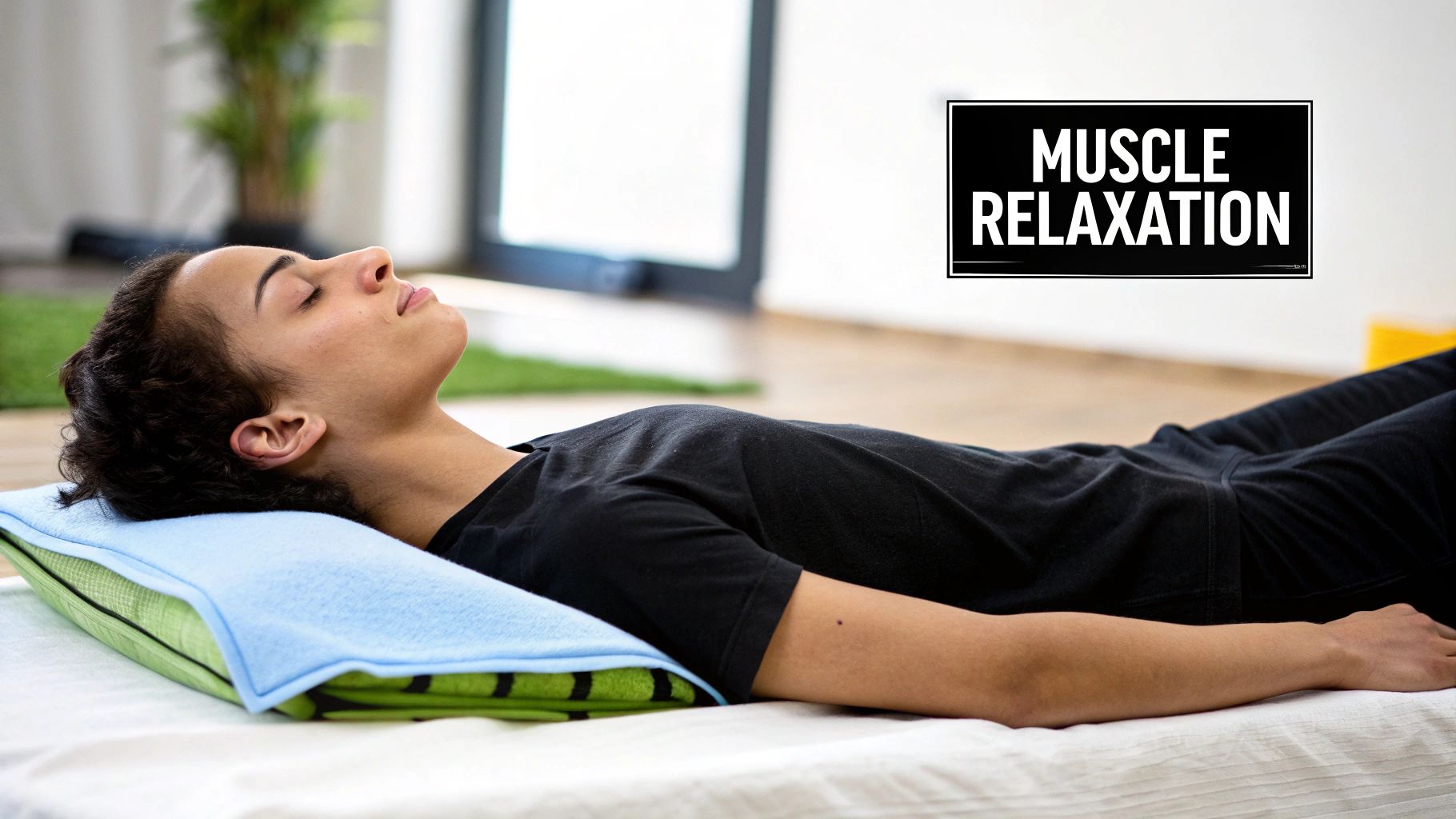
The process works by interrupting the feedback loop of anxiety. When you're stressed, your muscles tighten, which sends signals to your brain that reinforce feelings of unease. PMR actively breaks this cycle. This powerful mind-body technique has been adopted in high-stress environments, from military training programs to professional sports, where managing stress is critical for performance and recovery.
The goal is to move methodically through the body, typically starting from your feet and working your way up to your head. Lie comfortably in your bed and follow these steps:
Key Insight: The magic of PMR lies in the contrast. Pay close attention to the sensation of the muscle completely relaxing after being tensed. This contrast trains your body to recognize and release stored tension you may not even be aware of.
If you are new to this practice, using guided audio from apps like Headspace or Calm can be incredibly helpful. Practicing for a few minutes during the day can also make the technique more automatic and effective when you use it at night to fall asleep.
The 4-7-8 Breathing Technique, popularized by Dr. Andrew Weil, is a rhythmic breathing exercise rooted in the ancient yogic practice of pranayama. This simple yet powerful method acts as a natural tranquilizer for the nervous system. The technique involves inhaling through your nose for a count of four, holding your breath for a count of seven, and then exhaling completely through your mouth for a count of eight. This specific ratio is designed to activate the parasympathetic nervous system, our body's "rest and digest" response, which effectively reduces heart rate, lowers blood pressure, and calms the mind, making it one of the most direct natural ways to fall asleep faster.
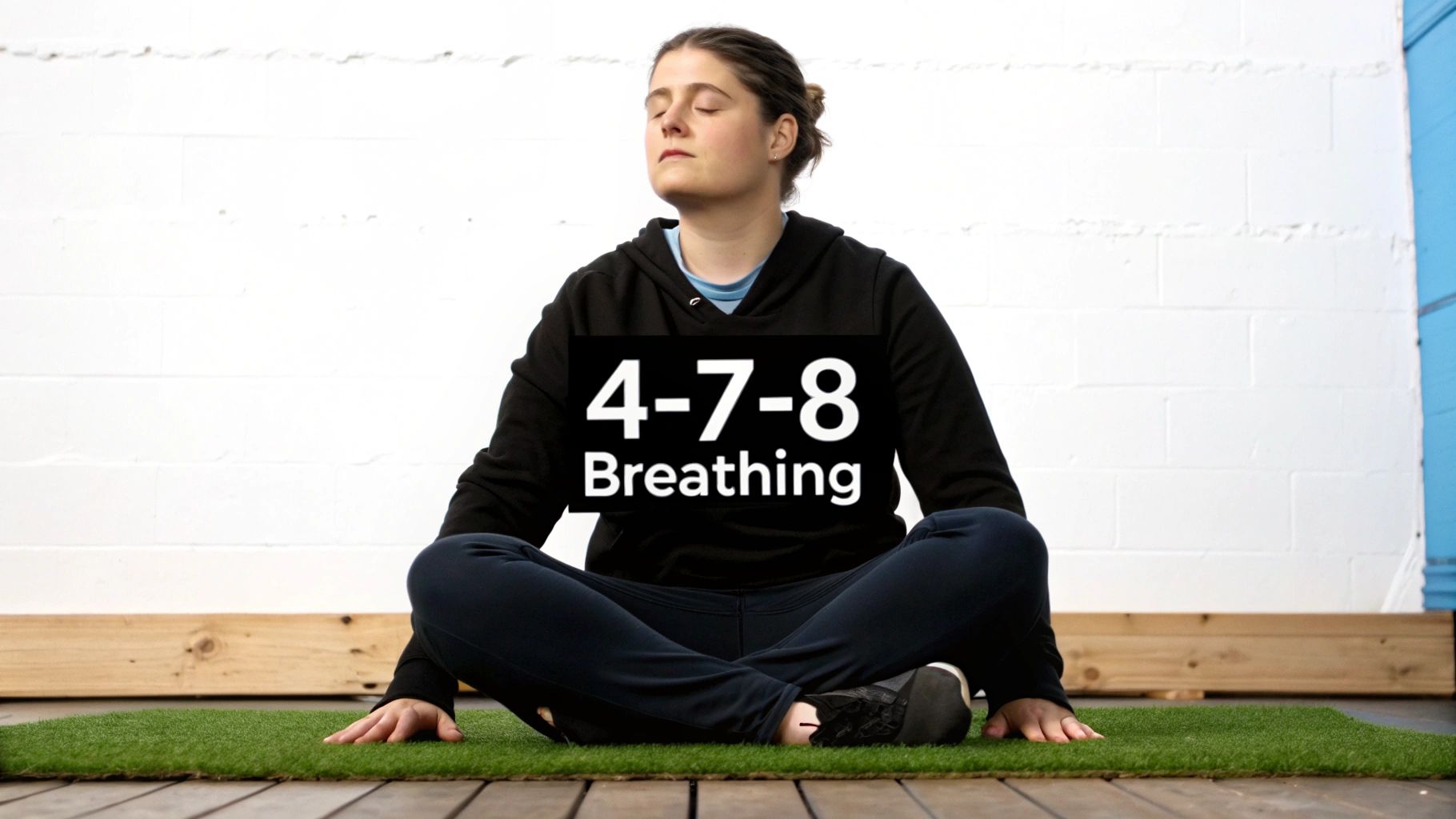
This breathing pattern works by deliberately slowing your respiration, which counters the shallow, rapid breathing associated with stress and anxiety. The extended exhale helps expel more carbon dioxide, while the seven-second hold allows for greater oxygen uptake into the bloodstream. Its effectiveness has led to its adoption in high-pressure fields, from corporate wellness programs helping employees manage workplace stress to sleep clinics worldwide that teach it as a primary tool for combating insomnia.
To get started, find a comfortable position, either sitting with your back straight or lying down in bed. Place the tip of your tongue against the ridge of tissue just behind your upper front teeth and keep it there throughout the entire exercise.
Key Insight: The absolute time you spend on each phase is not as important as keeping the ratio of 4:7:8 consistent. The extended exhale is the most critical part of the practice, as it is the key to activating the parasympathetic response that helps you relax and wind down.
For the best results, practice this technique at least twice a day. You can use it to manage anxiety during the day or, most effectively, right before bed to prepare your body and mind for rest. Don't be concerned if you feel slightly lightheaded at first; this sensation typically passes with practice.
Sleep hygiene refers to a comprehensive set of behavioral and environmental practices designed to promote consistent, high-quality sleep. Rather than being a single technique, it's a holistic approach to building a lifestyle that supports your body's natural sleep-wake cycle. By consciously managing your environment, routines, and habits, you create powerful cues that signal to your brain it's time to rest, making this one of the most foundational natural ways to fall asleep faster.
The principles of sleep hygiene are not new; they form the bedrock of protocols used by institutions like the Stanford Sleep Medicine Center and are integrated into corporate wellness programs at innovative companies like Google. The goal is to eliminate "sleep saboteurs" and reinforce behaviors that align with your circadian rhythm. A key modern focus is managing artificial light exposure, especially the blue light from screens, which can trick your brain into thinking it's still daytime and suppress melatonin production.
Implementing good sleep hygiene involves making small, consistent adjustments across several areas of your life. Start by focusing on these high-impact practices:
Key Insight: Sleep hygiene is about building a supportive ecosystem for sleep. It's not about a single perfect night but about creating a sustainable routine that makes quality sleep the default, not the exception. The most effective strategy is to combine multiple practices, like a cool, dark room and blue light blocking glasses, to create layers of sleep-promoting signals for your brain.
Guided Imagery, often called visualization, is a therapeutic technique where you use your imagination to create calm, peaceful, and detailed mental scenes. This practice transports your mind away from the day's worries and anxieties, effectively quieting the mental chatter that often stands between you and a restful night. By focusing your attention on a tranquil inner world, you activate your body's relaxation response, making it one of the most powerful natural ways to fall asleep faster.
This mind-body technique is far more than simple daydreaming; it's a focused practice that leverages the brain's inability to distinguish between vividly imagined events and real ones. When you visualize a serene beach, your brain releases neurochemicals associated with relaxation, just as it would if you were actually there. This method is so effective that it’s used in high-stress clinical settings, from cancer treatment centers to help patients manage anxiety to children's hospitals for pediatric sleep issues.
The key to effective visualization is engaging as many senses as possible to make the scene feel real. Lie down comfortably in your bed, dim the lights, and walk your mind through these steps:
Key Insight: The goal is not to force sleep but to become so absorbed in your peaceful mental environment that you forget you are trying to sleep. This gentle distraction allows your body's natural sleep processes to take over without the interference of a stressed or overactive mind.
This practice pairs well with other sleep-hygiene habits, like using amber or orange-lensed blue light glasses in the evening. As you wind down, these glasses help reduce eye strain from screens and signal to your brain to produce melatonin. You can learn more about how blue light glasses help you relax and sleep better to enhance your nighttime routine.
Aromatherapy is an ancient practice that uses natural plant extracts, known as essential oils, to promote health and well-being. When used for sleep, this technique harnesses the power of scent to calm the nervous system and prepare the mind for rest. The olfactory system has a direct pathway to the limbic system, the brain's emotional center, which is why certain scents can instantly trigger feelings of relaxation and safety, making this a potent natural way to fall asleep faster.
The science behind it involves the natural chemical compounds in oils like lavender, which contain linalool and linalyl acetate. These compounds have been shown to have sedative and anxiolytic (anti-anxiety) effects. This practice is so effective that it's used in diverse settings, from hospitals using aromatherapy to reduce patient anxiety to luxury spas incorporating it as a standard for relaxation treatments. Even lavender farms in Provence, France, have become destinations for "sleep tourism."
Integrating aromatherapy into your nightly routine is simple and can be personalized to your preferences. The key is consistency and finding the scents that work best for you.
Key Insight: Your brain can become accustomed to a scent over time, reducing its effectiveness. To prevent this "olfactory fatigue," rotate between 2-3 different calming oils every few weeks. This keeps your brain responsive to their relaxing signals.
When choosing oils, opt for 100% pure, therapeutic-grade products to ensure you are getting the full benefits without synthetic additives. Always perform a patch test on a small area of skin before applying an oil topically to check for sensitivity.
Cognitive Behavioral Therapy for Insomnia (CBT-I) is considered the gold-standard, first-line treatment for chronic sleep problems. Unlike sleeping pills, this approach addresses the root cause of sleeplessness by identifying and changing the negative thoughts and behaviors that disrupt your ability to rest. It's a structured program that helps you reframe unhelpful beliefs about sleep and establish a healthier relationship with your bed and bedtime routine.
This method works by breaking the frustrating cycle of "trying" to sleep. When you worry about not sleeping, your body releases stress hormones that make sleep nearly impossible, which then reinforces your anxiety. CBT-I teaches you practical skills to dismantle this cycle. Its effectiveness is so well-documented that it's a core treatment strategy in VA hospitals for veterans with sleep disorders and is the foundation for successful digital therapeutics apps like Sleepio.
While a full CBT-I program is best done with a therapist, you can implement its core principles on your own. Start by integrating these powerful strategies into your evening:
Key Insight: The power of CBT-I lies in conditioning. It's not about forcing sleep but creating the ideal mental and environmental conditions for sleep to happen naturally. Consistency is more important than perfection.
Herbal teas and natural supplements are some of the oldest natural ways to fall asleep faster, harnessing plant-based compounds used for centuries to promote relaxation. These remedies work by interacting with your body's neurochemistry, containing bioactive compounds that can influence key neurotransmitters like GABA and serotonin or support the production of melatonin. This helps to gently calm the nervous system and regulate sleep-wake cycles without the use of synthetic chemicals.
The practice of using botanicals for sleep is a global tradition, from chamomile tea being a bedtime staple in Europe to passionflower's use in South American remedies. Modern integrative medicine now studies these compounds, validating their ability to reduce the time it takes to fall asleep. By creating a warm, soothing ritual, a cup of herbal tea also signals to your body that it's time to wind down, making the transition to sleep more seamless.
To get the most benefit, it's important to choose the right herb and prepare it correctly. Incorporating this into your evening routine 30-60 minutes before bed can significantly enhance its effects.
Key Insight: The effectiveness of herbal remedies is highly individual. Start with a single-herb tea to see how your body responds before trying blends. The ritual of preparing and sipping the tea is as important as the herb itself for creating a sleep-conducive mindset.
Always choose organic, high-quality sources to ensure purity and potency. When brewing tea, steep it covered for at least 5-10 minutes to extract the maximum amount of beneficial compounds. Before starting any new supplement, especially if you take other medications, it's wise to consult with a healthcare provider. To learn more, explore additional wellness resources on herbal teas and natural supplements at Element Lux.
Managing stress is a critical component of preparing your body for a good night's sleep. An overactive, anxious mind is one of the biggest barriers to falling asleep quickly. By incorporating dedicated relaxation techniques into your evening, you can calm your nervous system and create a peaceful transition to rest.
Navigating the journey to better sleep can feel overwhelming, but as we've explored, you now have a powerful arsenal of natural ways to fall asleep faster. Falling asleep quickly isn’t about a single magic trick; it's about creating a personalized and consistent evening ritual that signals to your body and mind that it's time to rest. From the calming rhythm of the 4-7-8 breathing technique to the deep physical release of Progressive Muscle Relaxation, each strategy offers a unique pathway to tranquility.
The true power lies in synergy, combining these active practices with passive environmental controls. While optimizing your sleep hygiene and exploring cognitive behavioral techniques are foundational pillars, addressing the modern-day challenge of artificial light is non-negotiable for lasting success. This is where a high-quality pair of blue light blocking glasses becomes an indispensable part of your toolkit.
In our screen-saturated world, our bodies are constantly receiving mixed signals. The blue light from phones, tablets, and computers tells our brain to stay awake, suppressing the natural production of melatonin, the crucial hormone that governs our sleep-wake cycle. Even with the best intentions, it's difficult to completely avoid screens in the evening.
This is why incorporating orange-colored blue light blocking glasses is one of the most effective natural ways to fall asleep faster. These orange lenses are specifically designed to block the most disruptive wavelengths of blue and green light, which sends a powerful signal to your brain to begin melatonin production. This helps reset your internal clock, making it easier to fall asleep. Additionally, amber blue light glasses are excellent for helping you relax and wind down in the hours before bed, reducing the mental stimulation from artificial light and letting you transition into a calmer state of mind.
Ultimately, taking control of your sleep is an act of self-care that pays dividends in every area of your life. By thoughtfully combining ancient relaxation practices with modern solutions like blue light blocking glasses, you are not just hoping for better sleep; you are actively creating it. You are equipping yourself with the tools to calm your nervous system, harmonize your hormones, and reclaim your nights for the deep, restorative rest you deserve.
Ready to make a powerful, passive change to your evening routine? Discover how Element Lux glasses can become the cornerstone of your sleep toolkit, effortlessly blocking disruptive blue light so you can fall asleep faster, naturally. Explore the collection and find your perfect pair at Element Lux.
It’s a story we all know too well. You're scrolling on your phone late at night, and suddenly, sleep feels like a distant memory. This isn't just a lack of willpower; it’s your biology getting tricked. The connection between blue light and circadian rhythm is the real culprit here, as the glow from our screens fools your brain into thinking it's still daytime.
Ever felt tired but completely wired after an evening glued to your laptop? You can thank your body's internal 24-hour clock, known as the circadian rhythm. Think of it as a master conductor for your body, signaling when it's time to feel alert and when it's time to wind down.
For thousands of years, this internal clock was perfectly in sync with the sun. Bright morning light was the cue to wake up, and the growing darkness of night was the signal to prepare for sleep. Simple.
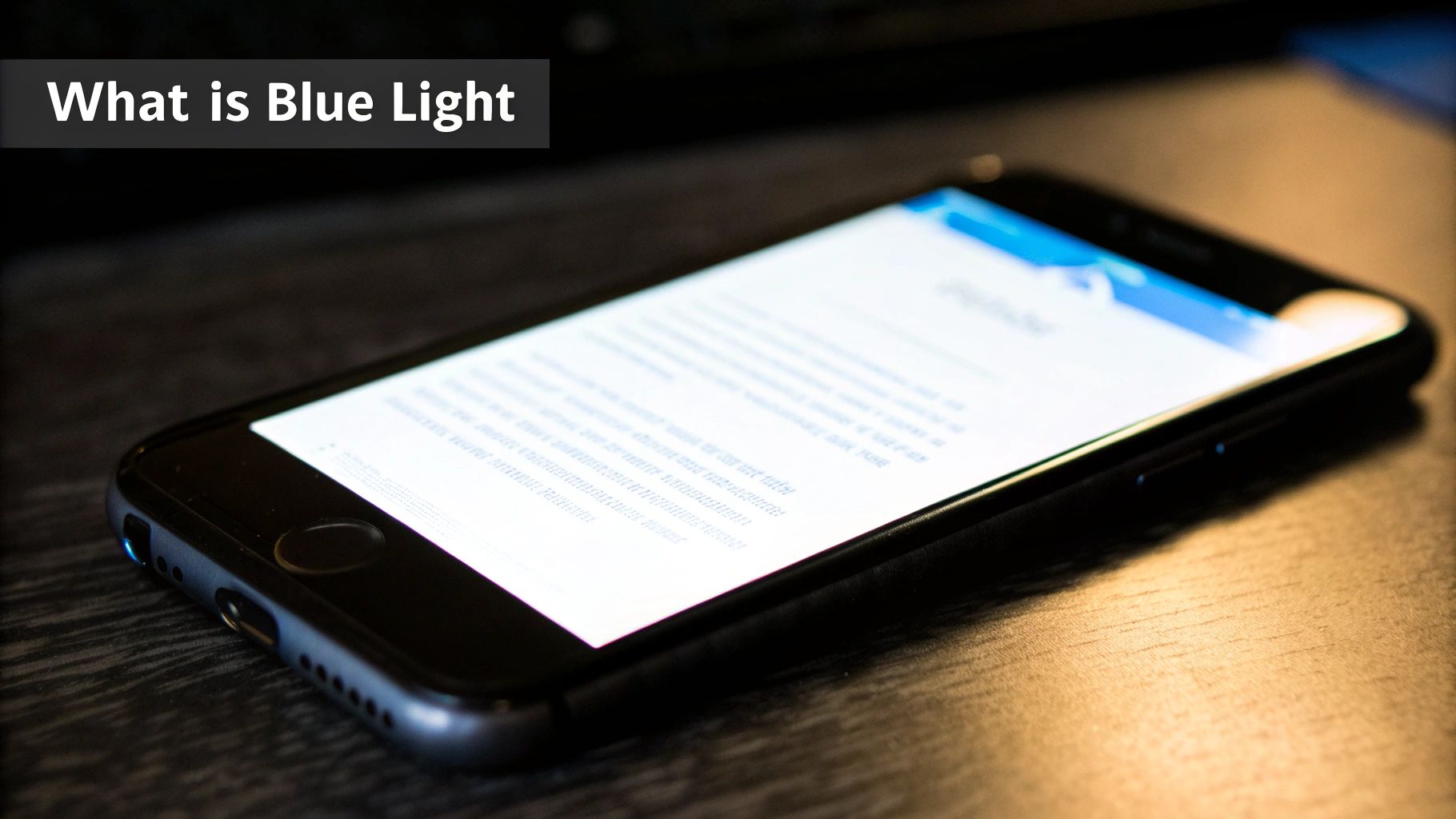
But modern life threw a wrench in the works: artificial light from our screens. Our smartphones, tablets, and TVs blast out a high concentration of blue light, which happens to look a lot like the bright midday sun to our brains. When your eyes pick up this light late at night, they send a powerful "it's daytime!" alert straight to your brain.
That "daytime" signal triggers one critical problem: it slams the brakes on melatonin production. Melatonin is the hormone that essentially tells your body, "Hey, it's time for bed."
Blue light is especially good at shutting this process down. Research has shown that specific blue light wavelengths don't just delay the release of melatonin; they can shift your entire sleep cycle by up to three hours. That's roughly double the impact of green light.
You're essentially giving yourself a case of "digital jet lag." Your body knows it's late, but your brain, confused by the constant stream of blue light, refuses to send out the "sleep messenger."
This disruption does more than just make it harder to fall asleep. It chips away at the quality of the rest you finally get. Your body’s natural rhythm is absolutely essential for physical repair, mental clarity, and emotional balance.
Understanding this biological hack is the first step toward taking back your nights. By getting smart about your light exposure, you can help your internal clock get back on schedule, paving the way for deeper, more restorative sleep.
For more insights into how light impacts your well-being, explore our comprehensive blue light blog.
Ever wondered why a late-night scroll through your phone leaves you feeling wired, even when you're exhausted? To figure that out, we need to take a quick trip deep inside your brain.
Tucked away in there is a tiny but powerful region called the suprachiasmatic nucleus, or SCN. You can think of it as your body's master clock. It's the central command center in charge of keeping your entire system running on a 24-hour schedule.
Every morning, sunlight hits your eyes and sends a powerful "wake up!" signal straight to this master clock. The SCN then gets to work, coordinating everything from your metabolism and hormone levels to your body temperature. It makes sure every part of you is in sync with the day.
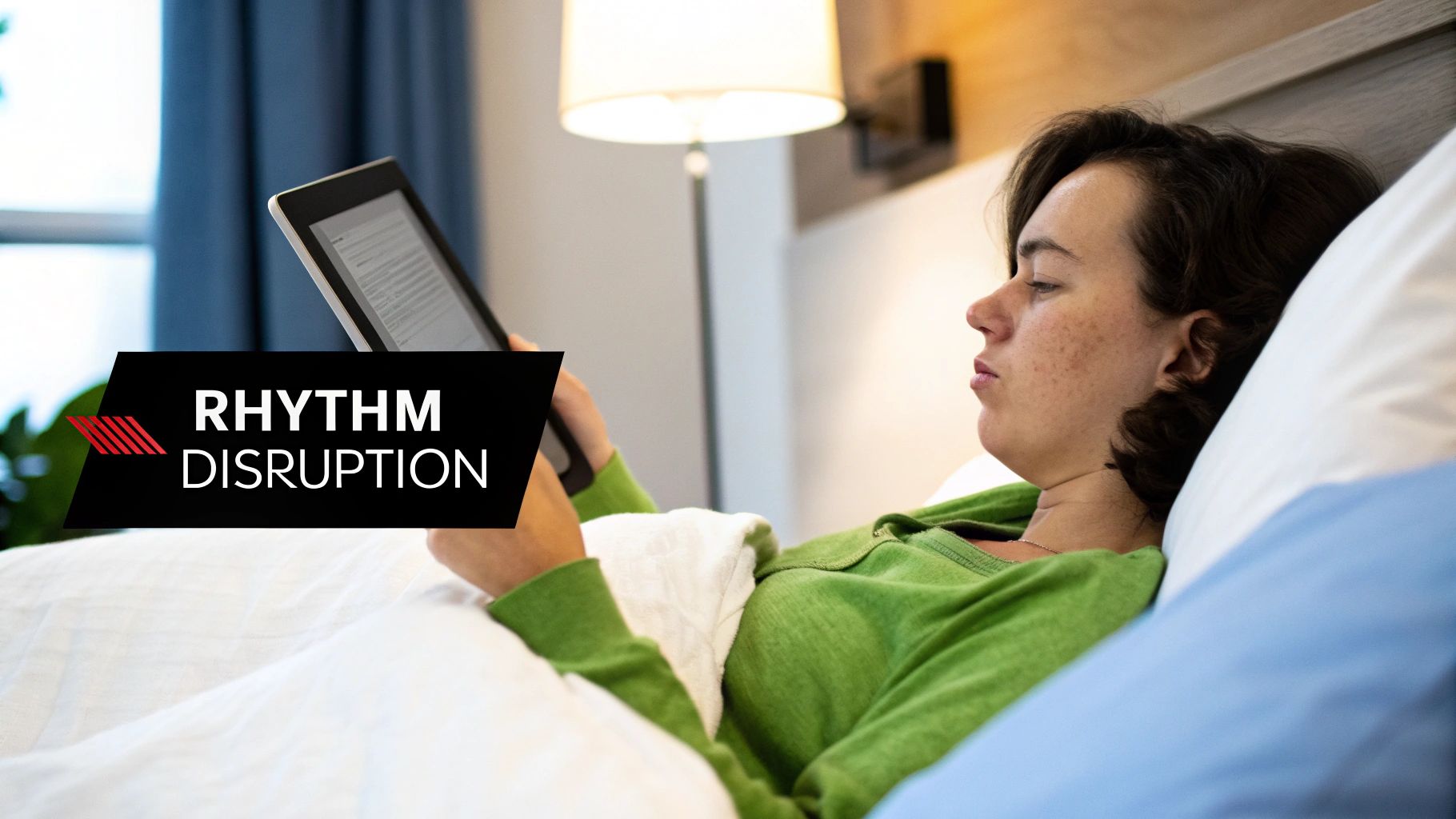
But as evening rolls in and the natural light outside fades, the master clock starts preparing your body for shutdown. It sends out a critical message to start producing melatonin, the hormone that acts as your body's "sleep messenger." That rising melatonin level is what makes you feel drowsy and ready for bed.
This is where artificial blue light from our screens completely sabotages the entire process.
Your eyes have specialized cells that aren't for seeing in the way you might think. These cells contain a unique photopigment called melanopsin, which happens to be extremely sensitive to blue light.
When melanopsin detects the blue wavelengths pouring out of your devices, it sends an emergency alert right back to your master clock: "The sun is still up! Stay alert!"
This creates a frustrating state of digital jet lag. Your body is physically tired and knows it's nighttime, but your brain, tricked by all that artificial light, refuses to release the sleep messenger. The result is that awful feeling of being exhausted but unable to fall asleep, all thanks to the disrupted relationship between blue light and your circadian rhythm.
Wearing orange-lensed blue light glasses, like those from Element Lux, acts as a protective shield. By filtering out these disruptive wavelengths, they prevent the "daytime" signal from ever reaching your brain, allowing your body to produce melatonin naturally.
So we know that blue light can throw your internal clock into a state of "digital jet lag." What's the most direct way to fight back? It's simple, really: stop the disruptive light from ever reaching your eyes in the first place.
This is exactly what amber and orange-lensed glasses were designed to do. Think of them as a specialized shield for your eyes, built for nighttime. Unlike those clear or faintly yellow daytime lenses that only filter a tiny fraction of blue light, these darker tints are serious about protection. They are engineered to block the intense blue and even some green light wavelengths—the very ones that scream "it's daytime!" to your brain.
We’ve all been there. After hours glued to a screen, your eyes feel gritty and tired, your vision gets a little blurry, and a dull headache starts to creep in. That’s digital eye strain, and it happens because your eyes are working overtime to process the harsh, high-energy visible (HEV) light blasting from your devices.
Orange-tinted lenses work by absorbing a huge chunk of that aggressive HEV light. This immediately softens the screen's glare and reduces the stark contrast, making everything look a little warmer and calmer. Your eye muscles can finally relax. For many people, the relief from fatigue and strain is almost immediate.
This isn't just about physical eye comfort. Putting on a pair of amber-lensed glasses sends a powerful signal to your entire nervous system. By cutting off that constant stream of "stay awake!" blue light, you're giving your brain the message it's been waiting for.
It's like flicking a switch from a high-alert, ready-for-anything state to a calm, restorative one. You’re essentially telling your body, "The day is done. Time to power down and prepare for sleep." This mental shift is a game-changer for anyone who has trouble switching off their brain at night.
The data below paints a clear picture of the problem these glasses solve, connecting screen time directly to poor sleep and suppressed melatonin.
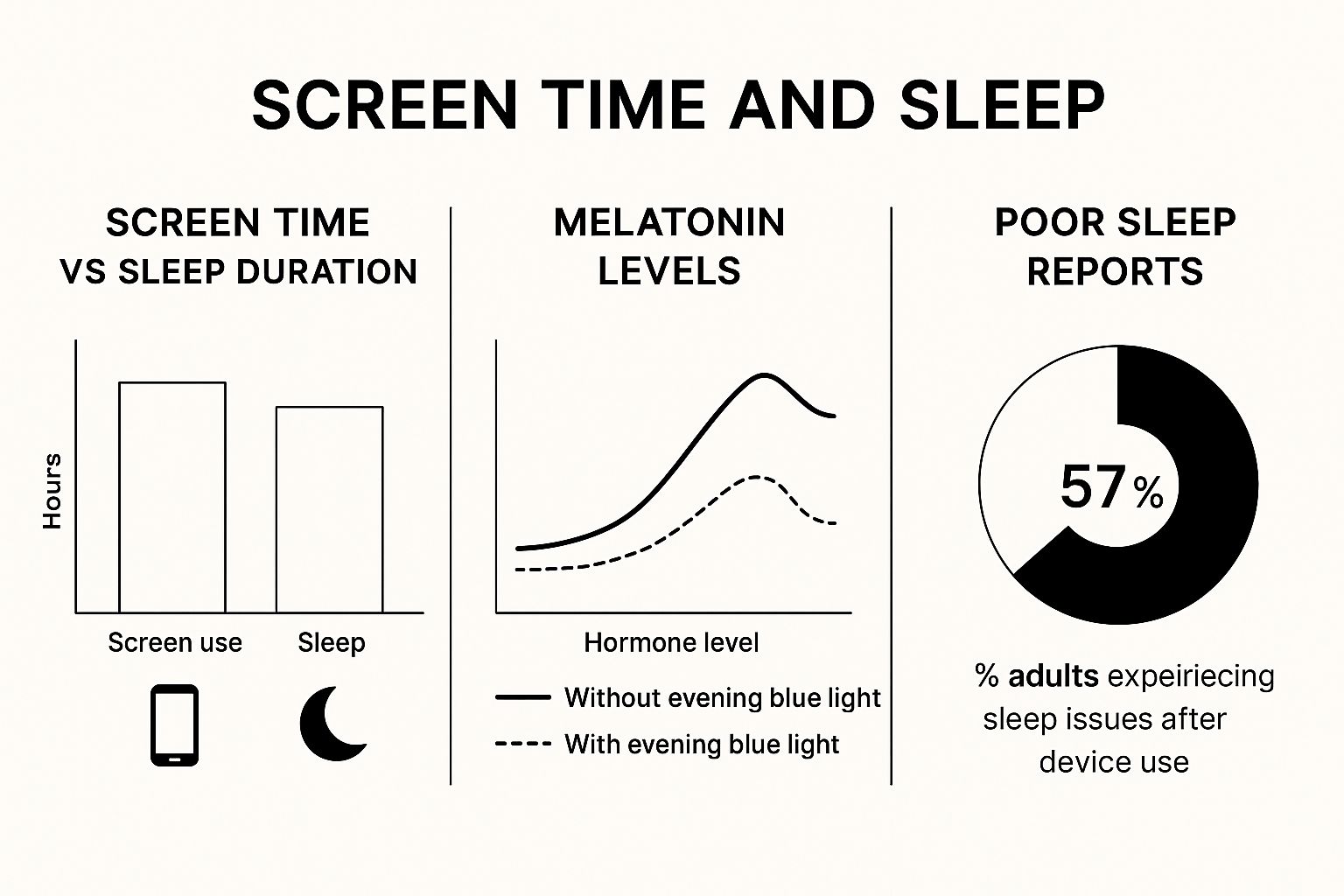
The takeaway is undeniable: more screen light at night equals less quality sleep.
Not all blue light glasses are the same. The color of the lens tells you a lot about its purpose and how much protection it offers. Choosing the right pair depends entirely on when you'll be using them and what you're trying to achieve.
| Lens Color | Blue Light Blocked | Best For | Ideal Use Case |
|---|---|---|---|
| Clear | 10% – 30% | Daytime screen use, reducing digital eye strain at the office. | Professionals who work on a computer all day and want to reduce eye fatigue without color distortion. |
| Yellow | 40% – 70% | Late afternoon, overcast days, or heavy indoor screen use. | Gamers, designers, or anyone needing a bit more protection and contrast enhancement during the day. |
| Amber | 90% – 98% | Evening use, 2-3 hours before bed. | Winding down after work, watching TV, or casual evening screen use while protecting your melatonin. |
| Orange | 99%+ | Maximum nighttime protection for sleep. | Anyone serious about optimizing their sleep, worn 2-3 hours before bed to block virtually all disruptive light. |
Ultimately, amber and orange lenses are your best bet for sleep, while clear and yellow are better suited for daytime eye strain. For a complete wind-down routine, a darker tint is non-negotiable.
Here’s the main event: the real magic of true orange-lensed glasses is how they protect your melatonin production. By blocking over 99% of the blue light spectrum that messes with your sleep, these glasses let your brain receive the "darkness" signal it needs to start releasing this crucial sleep hormone.
Consistent use for two or three hours before you hit the pillow helps get your internal clock back on track. This makes it far easier to fall asleep naturally and, more importantly, stay asleep for that deep, restorative rest your body craves.
You can think of it this way: orange lenses don't make you sleepy. They simply remove the artificial barrier—blue light—that's preventing your body from doing what it naturally wants to do at night: sleep.
If you’re curious about the deeper science, we break it all down in our detailed guide on how these glasses improve sleep.
Knowing the science behind blue light is one thing, but actually doing something about it is what gets results. The good news? You don't need a total life overhaul to reclaim your natural sleep cycle. A few smart, consistent habits can make a massive difference in how fast you fall asleep and how deeply you rest.
The single most effective tool you can use is a quality pair of orange-lensed blue light blocking glasses. Think of them as a fortress for your eyes. When you wear them for just 2-3 hours before bed, you’re creating a personal sanctuary from the melatonin-killing signals blasted by screens, lightbulbs, and every other artificial light source. This simple habit lets your brain start its natural wind-down process, just like it's supposed to.
Orange-tinted glasses do more than just protect your melatonin. They provide immediate relief from digital eye strain by cutting the harsh, high-energy glare from your screens. This visual noise reduction helps your eye muscles relax, easing that tired, gritty feeling and the tension headaches that come with too much screen time.
More importantly, this preps your mind for sleep. Once your brain is no longer getting hit with stimulating light, your nervous system can finally shift from that alert, "fight-or-flight" state into a calm, "rest-and-digest" mode. It's a crucial transition for anyone who struggles to quiet a racing mind at the end of the day.
Amber lenses work in a similar way, acting as a powerful shield against disruptive light. They’re perfect for your evening wind-down routine. By filtering out a huge chunk of the blue light spectrum, they send a clear signal to your body that the day is over. This creates a psychological cue to relax, making it far easier to detach from the day's stressors and get ready for a peaceful night.
Study after study shows the damage evening screen use can cause. One found that just two hours of blue light exposure at night pushed participants' internal clocks back by an average of 1.1 hours—a massive disruption.
While glasses are your secret weapon, layering in other healthy habits will fast-track your journey to better rest. A holistic approach makes the benefits from blocking blue light really stick.
Managing evening light is just as much about managing stress as it is about sleep. After all, a calm mind falls asleep much easier. Here are four ways to build a relaxing pre-sleep ritual.
By combining these strategies, you can build a powerful evening routine that protects your blue light and circadian rhythm connection from modern-day disruptions. To dive deeper into sleep science and optimization, check out the valuable information in our Element Lux resources.
Managing your light exposure in the evening does more than just get you ready for sleep—it’s a powerful way to bring down stress and anxiety. After a long day, it's easy for your nervous system to get stuck in high gear. By taking control of your environment, you can gently guide your body and mind toward genuine relaxation, making it much easier to unwind and recover.
The most important piece of any effective evening routine is physically blocking the stimulating light that keeps you feeling wired. This is where a quality pair of amber or orange blue light glasses becomes your best friend. They’re a direct intervention, cutting off the frantic "daytime" signals that modern lighting beams into your brain.
If you deal with digital eye strain, orange-tinted glasses can be a game-changer. They work by absorbing the harsh, high-energy visible (HEV) light blasting from your screens, which softens the glare and cuts down on the visual "noise" that forces your eye muscles to work overtime. You’ll often feel almost immediate relief from that tired, gritty feeling and the tension headaches that come with too much screen time.
This physical relief is just the first step. More importantly, by blocking the specific wavelengths that slam the brakes on melatonin, orange lenses let your body start its natural sleep prep right on schedule. This keeps your blue light and circadian rhythm in sync, paving the way for a night of deep, uninterrupted rest.
In the same way, amber-lensed glasses are a fantastic tool for encouraging relaxation. When you put them on in the evening, they create a warm, calm visual environment that signals to your brain that the day is officially done. It's a simple act that helps you transition from a state of active stress to one of peaceful rest.
By filtering out the most disruptive light, amber glasses allow your nervous system to shift from its alert, "fight-or-flight" mode into its restorative "rest-and-digest" state. This mental downshift is crucial for anyone who has trouble switching off their thoughts and truly unwinding before bed. It’s the key to letting go of the day's anxieties.
The real magic of wearing amber or orange lenses isn't just about what they do—it's about what they prevent. They stop artificial light from hijacking your biology, allowing your body's natural relaxation and sleep processes to take over just as they were always meant to.
While glasses are your most direct tool for managing light, you can amplify their benefits by building a solid routine around them. A consistent evening ritual trains your body and mind to recognize when it's time for sleep.
A calm mind is the foundation of good sleep. The same strategies that protect your sleep cycle also work wonders for dialing down evening stress and anxiety.
When you start digging into the world of blue light, a lot of questions pop up. We've compiled the most common ones here to give you clear, straightforward answers you can actually use to sleep better, cut down on eye strain, and just feel better overall.
You know that tired, gritty, headache-y feeling you get after staring at a screen all day? That's digital eye strain, and it’s a direct result of the harsh, high-energy visible (HEV) light blasting from our devices.
Orange-tinted lenses, like the ones from Element Lux, are a game-changer here. They act as a powerful shield, absorbing a huge chunk of those aggressive blue wavelengths. This immediately cuts down on screen glare and visual static, allowing your eye muscles to finally relax. The relief from that built-up fatigue and tension is almost instant.
The single biggest reason orange lenses improve sleep is by protecting your body's melatonin production. Melatonin is the hormone that basically tells your body it's time to wind down for sleep, but its release is incredibly sensitive to light.
By blocking over 99% of the blue and green light that tricks your brain into thinking it's still noon, orange glasses let your body produce and release melatonin on a natural schedule. Wearing them for two or three hours before you plan to sleep is the best way to ensure the connection between blue light and circadian rhythm stays intact. It makes falling asleep—and staying asleep—so much easier.
Amber lenses are perfect for easing into your evening. They work much like orange lenses by filtering out a lot of that stimulating blue light, but their slightly lighter tint makes them great for general evening activities like watching a movie or reading.
By shutting off the constant "stay alert!" signals from your lamps and screens, amber glasses help your nervous system shift gears from a high-stress day mode to a more relaxed state. It's a powerful psychological cue that the day is over, helping both your mind and body unwind naturally for a restful night.
Think of it this way: amber and orange glasses don't force you to relax. They simply remove the artificial light signals that are actively preventing you from relaxing.
Great sleep is all about building a solid routine. While wearing blue light blocking glasses is probably the most effective hack for our modern environment, you can create a powerful synergy by pairing them with other healthy habits to reset your sleep cycle.
A calm mind is a prerequisite for good sleep. The very same strategies that protect your circadian rhythm are also incredibly good at dialing down evening stress and anxiety.
Ready to take back your evenings and finally get the rest you deserve? The Element Lux blue light blocking glasses are scientifically designed to filter out the exact wavelengths of light that sabotage your sleep.
Discover the difference and shop now.
If you’ve ever finished a long day at your desk with tired, scratchy, or blurry eyes, you’re in good company. The usual suspect is digital eye strain, a condition officially known as Computer Vision Syndrome (CVS). It's the direct result of our screen-saturated lives, and recognizing the signs is the first step to feeling better.
That nagging headache behind your eyes or the fuzzy vision that creeps in after a few hours on your laptop isn't just a minor inconvenience. It's a clear signal from your body that your eyes are overworked. Digital eye strain kicks in when you focus intently on a screen for extended periods, causing the tiny muscles in your eyes to get seriously fatigued.
This is a far more widespread issue than most people think, and it’s not just about computers. It’s the hours we spend on our tablets, phones, and even binge-watching our favorite shows. We also tend to blink a lot less when we're staring at a screen, which is a fast track to dryness and irritation.
To make matters worse, a bad ergonomic setup—like a monitor that's too high or low—can compound the problem, leading to neck and shoulder pain as you instinctively contort your body to compensate for tired eyes.
The problem has become so common that experts are now tracking it on a global scale. A comprehensive 2025 study, which analyzed data from over 66,000 workers across more than 20 countries, found that about 69% of workers experienced some degree of CVS. That's a huge slice of the modern workforce.
This really highlights how crucial it is to learn practical ways to reduce eye strain in our day-to-day. You can find out more about how digital habits impact eye health in this comprehensive guide on our blue light blog.
The key takeaway is that digital eye strain isn't just a temporary discomfort—it's a chronic issue affecting a majority of the modern workforce. Recognizing common symptoms is crucial for taking preventative action.
You might be brushing off some of these common symptoms:
Understanding these signs and connecting them to your screen habits is the foundation for protecting your long-term eye health and, frankly, just getting through your workday without feeling drained.
Lasting relief from digital eye strain isn’t about quick fixes. It’s about being intentional with your environment and daily routines. When you create a workspace that works for you instead of against you, you're laying the foundation for real, long-term comfort. Even small, consistent adjustments can make a huge difference in how your eyes feel at the end of the day.
A great place to start is the famous 20-20-20 rule. It’s simple but incredibly effective. Every 20 minutes, take a 20-second break to look at something about 20 feet away. This little pause gives the tiny, hard-working muscles in your eyes a much-needed chance to relax, stopping that slow burn of fatigue from constant, close-range focus.
Beyond just taking breaks, the physical setup of your screen plays a massive role. You want your monitor positioned about an arm's length away—that’s roughly 20 to 26 inches—with the top of the screen at or just slightly below your eye level. This simple ergonomic tweak keeps you from craning your neck or straining your eyes up or down.
Just as important is getting your screen’s brightness and contrast right. They should match the ambient light in your room. If your screen is way brighter than your surroundings, it’s like staring into a lightbulb. If it’s too dim, your eyes have to work overtime just to see what's on the screen.
This image breaks down a super simple three-step process for getting your lighting right to cut down on glare and balance the brightness.
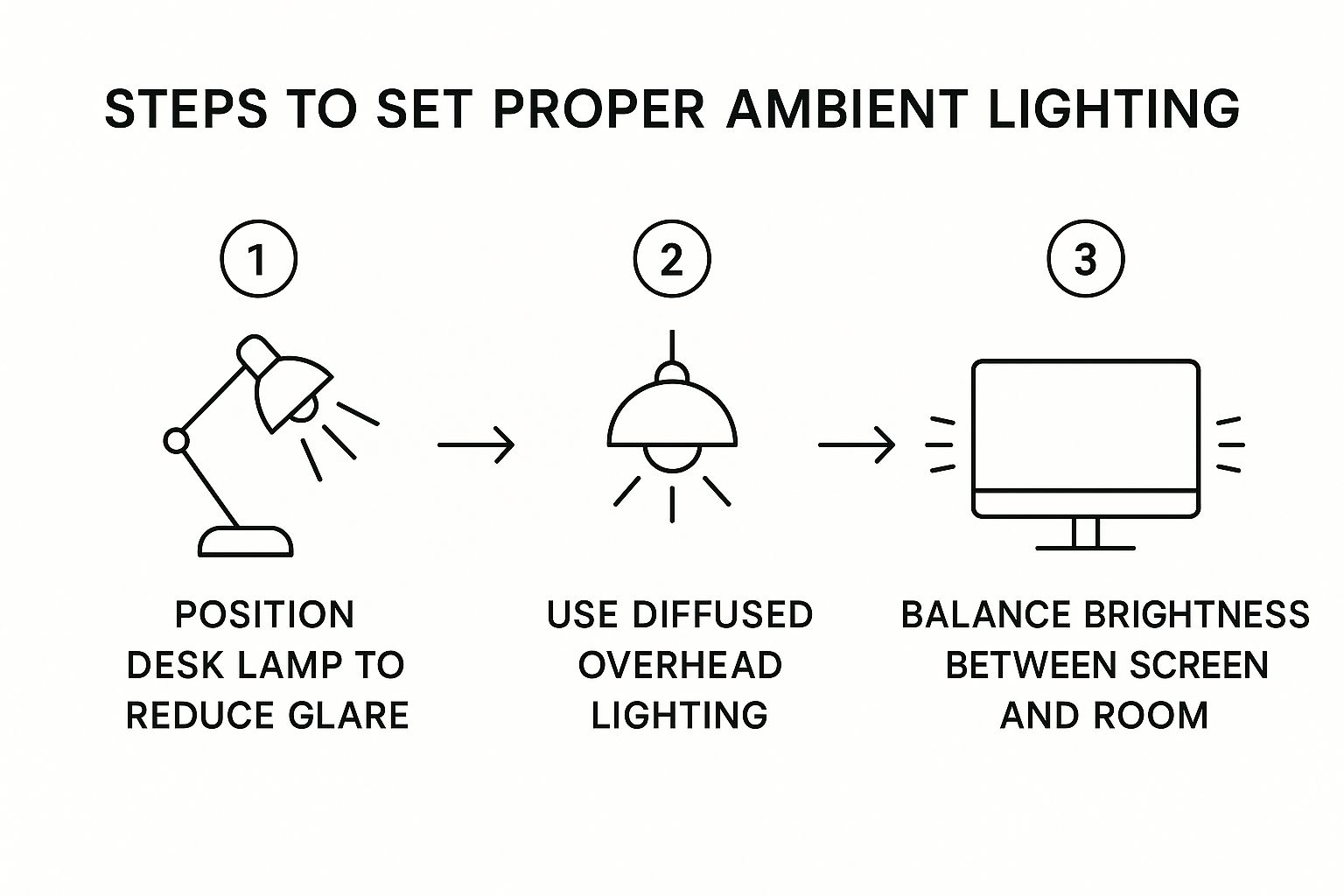
Here's another trick that’s easy to forget: just blink! When we stare at screens, our blink rate can drop by more than half, which is a fast track to dry, irritated eyes. Making a conscious effort to blink fully and often helps keep your eyes naturally lubricated. If they still feel dry, a few drops of artificial tears can provide immediate relief.
For a deeper dive into other helpful habits and tools, explore the valuable information available in our Element Lux resources section.
This is where blue light blocking glasses come in. Integrating them into your routine, especially in the evening, is a powerful strategy for both eye comfort and better sleep. The high-energy visible (HEV) light blasting from our screens is a major contributor to digital eye strain, leaving our eyes feeling tired and wired.
By filtering out these harsh wavelengths, orange-colored blue light glasses reduce glare and visual noise, allowing your eye muscles to relax. This can make extended screen time feel significantly more comfortable.
But the benefits go way beyond just immediate eye relief. When you wear them in the hours before bed, these glasses block the specific blue light frequencies known to suppress melatonin—that’s the hormone that tells your body it's time to sleep. This helps your brain naturally wind down, making it easier to fall asleep and get the deep, restorative rest you need.
Amber blue light glasses serve a similar, crucial purpose. They create a calming visual environment that helps you relax and de-stress after a long day of screen exposure. Think of them as a signal to your brain that the stimulating part of the day is over, paving the way for a peaceful transition into your evening and, eventually, a great night's sleep.
Okay, so you've nailed the ergonomic adjustments and you're taking regular screen breaks. That’s foundational stuff. But sometimes, you need a more direct tool in your corner to fight back against digital eye strain.
This is where orange-lensed blue light blocking glasses come in. Think of them as a powerful ally, specifically built to filter out the high-energy visible (HEV) light that our screens blast at us all day. This is the aggressive, harsh light that's largely responsible for that gritty, tired-eye feeling you get after a long day at the computer.
Unlike clear or even some yellow lenses that only catch a tiny fraction of blue light, a good pair of orange lenses are designed to block a significant portion of the most intense, problematic wavelengths. By cutting down on all that harsh visual "noise," they ease up the glare and finally let those tiny muscles in your eyes relax. It makes hours of screen time feel much more comfortable and sustainable.
Picture this: you're on a tight deadline, staring down a massive spreadsheet for hours. The numbers start to swim, and that familiar dull headache starts creeping in behind your eyes. This is the exact scenario where orange-lensed glasses can provide real, tangible relief, helping to sharpen your focus and ease the visual fatigue that just kills productivity.
Here’s a great example—the Element Lux blue light blocking glasses are designed specifically for this.
You can see that distinct orange tint in the Element Lux lenses. That’s the key to their power in filtering out all that disruptive blue light.
The benefits don't just stop at eye comfort during the day. One of the biggest wins with these glasses is their ability to support better sleep. When you're exposed to blue light in the evening, it basically tricks your brain into thinking it's still daytime. This messes with your body's natural production of melatonin—the crucial hormone that tells your body it’s time to wind down and rest.
When you pop on a pair of orange or amber blue light glasses for an hour or two before bed, you’re creating a protective shield. It's a simple habit that helps your brain transition into sleep mode naturally, which often means falling asleep faster and getting more of that deep, restorative sleep we all need.
By blocking the specific blue light that suppresses melatonin, orange-lensed glasses help recalibrate your internal clock. It’s a small step that can lead to deeper, more refreshing sleep, which is critical for everything from your mood to your cognitive function.
On top of the sleep benefits, amber and orange blue light glasses are fantastic for helping you relax and decompress after a mentally draining day. The warm tint creates a much calmer visual environment, toning down the stimulating effects of bright screens and harsh overhead lighting.
Think of it as a clear signal to your brain: the high-alert, work-focused part of the day is officially over.
Adding them to your evening routine helps draw a real boundary between your "on" time and "off" time. In a world where it's so easy to stay connected 24/7, that separation is essential for managing stress and anxiety.
Here are a few top ways to get better sleep and reduce stress, with blue light blocking glasses as a cornerstone of your routine.
Top Ways to Get Good Sleep
Top 4 Ways to Reduce Stress and Relax
We've all been there. It's late, you're physically exhausted, but after an hour of scrolling on your phone or finishing up some work on the laptop, your brain just feels… wired. That's not just in your head—it's a biological response to blue light.
Evening exposure to blue light from screens sends a jolt to your brain, tricking it into thinking it's still daytime. This suppresses the production of melatonin, the crucial hormone that signals your body it's time to wind down. When melatonin is out of whack, you're left tossing and turning, unable to get the restorative sleep you desperately need.
This is where slipping on a pair of orange or amber blue light glasses a couple of hours before bed can be a total game-changer. These aren't just tinted lenses; they're specifically engineered to filter out the exact wavelengths of blue and green light that are most notorious for messing with melatonin.
By blocking those disruptive signals, you're essentially creating an artificial sunset for your eyes. This simple act allows your brain to get back on track with its natural sleep-wake cycle, making the transition into sleep feel smooth and effortless. The result? You fall asleep faster and get more of that deep, refreshing sleep your body craves.
If you're interested in the nitty-gritty science, you can learn more about how our glasses help with sleep and support your body's natural rhythms.
Think of it this way: by blocking the light frequencies that halt melatonin production, orange and amber lenses help you hit the reset button on your internal clock. It's a small tweak to your evening routine that can pay huge dividends for your sleep quality and overall well-being.
There's also a psychological benefit. The warm, soft tint of amber glasses has a noticeable calming effect on the nervous system. It creates a gentler, less stimulating visual environment that signals to your mind that the high-alert part of your day is officially over.
This mental shift is huge for managing the day-to-day stress and anxiety that so many of us carry into the evening. It paves the way for a more peaceful, relaxing end to your day. The Element Lux amber glasses pictured here are designed precisely for this—to create a soothing effect while blocking all that junk light.
The distinct amber tint is what makes the magic happen, filtering out harsh blue light and creating a visual experience that's perfect for evening use.
Pairing blue light glasses with a few other smart habits can create a powerful evening routine. Here are a few of our favorites.
Top Habits for Great Sleep:
Top 4 Ways to De-Stress Before Bed:
Let's be honest, winding down after a long day is tough. The world wants us to stay plugged in, but our minds and bodies are begging for a break. Creating a solid pre-sleep routine is one of the best things you can do to fight back against daily stress and signal to your body that it's time for deep, restorative rest.
The real game-changer in a modern evening ritual? Managing your light exposure. The first, most powerful step is shielding your eyes from the stimulating glow of screens with a good pair of amber or orange blue light glasses. These are specifically designed to filter out the exact light frequencies that keep your brain buzzing long after you’ve logged off.
When you slip on a pair of orange-colored blue light glasses in the evening, you’re doing more than just giving your tired eyes a break. You're actively supporting your body's natural sleep cycle. That blue light from screens and overhead lighting is notorious for suppressing melatonin—the hormone that tells your body it's time for bed. Blocking it makes falling asleep (and staying asleep) so much easier.
Similarly, amber blue light glasses create an instantly warm, calming visual environment. It's like drawing the curtains on the day's mental chaos. Putting them on helps you ease out of that high-alert state and into one of peaceful rest.
Making blue light blocking glasses a non-negotiable part of your evening is a proactive move for better sleep, less stress, and an end to that all-too-familiar end-of-day eye fatigue.
With smart light management as your foundation, a few other habits can seriously upgrade your sleep quality. Think of them as reinforcing the message to your body that it's time to power down.
Your wind-down routine isn't just about preparing for sleep; it's about actively calming a stressed-out mind. Here are four simple but effective ways to find your chill before bed.
| Activity | Benefit | Recommended Timing |
|---|---|---|
| Put on Amber/Orange Glasses | Blocks sleep-disrupting blue light | 1-2 hours before bed |
| Dim Household Lights | Reduces overall light stimulation | 1 hour before bed |
| Read a Physical Book | Calms the mind without screen glare | 30-45 minutes before bed |
| Gentle Stretching or Yoga | Releases physical tension | 15-20 minutes before bed |
| Deep Breathing/Meditation | Lowers heart rate and reduces anxiety | 5-10 minutes before bed |
| No Screens in Bed | Keeps the bedroom a sleep-only zone | Final hour before bed |
Consistency is everything. It might feel a little strange at first, but stick with it for a week, and you’ll start to notice a real difference in how quickly you can relax and how refreshed you feel in the morning.
If you’re just diving into the world of eye care, it’s easy to get bogged down with questions. Let’s tackle some of the most common ones so you can feel confident you’re making the right choice for your eyes.
A big one I hear all the time is about the difference between lens colors. It's actually pretty simple. Orange-colored blue light glasses are your heavy hitters. Think of them as your nighttime shield, designed to block a massive amount of blue light. They’re ideal for protecting your sleep hormones in the evening or for anyone who spends long hours staring at a screen after sundown.
Then you have amber blue light glasses. These offer a softer, warmer tint that creates a much more calming visual environment. I like to think of them as the perfect accessory for winding down after a long, stimulating day—great for relaxing without feeling like you're in total darkness.
So, how does this actually help you sleep? By wearing orange or amber glasses in the evening, you're blocking the specific light that tricks your brain into thinking it's still daytime. This stops the suppression of melatonin—your body's natural sleep signal—and allows your internal clock to do its job. It’s a surprisingly simple habit that can make falling asleep easier and help you get that deep, restorative rest we all need.
Better sleep naturally leads to less stress. When you're well-rested, you’re just better equipped to handle whatever the day throws at you. It’s the foundation for emotional resilience.
If you want to make your blue light glasses a core part of your sleep routine, here’s how:
When you manage blue light exposure and stick to a solid routine, you’re hitting the problem from both sides. You’re tackling the physiological triggers (light) and the psychological ones (habit) that mess with sleep and drive up stress.
And it's not just about sleep. These glasses can be a game-changer for your whole relaxation routine.
Ready to feel the difference for yourself? The science-backed lenses from Element Lux are specifically designed to cut down on eye strain, help you relax, and support the deeper sleep you deserve.
Explore our collection and find your perfect pair today!
It feels like getting a truly great night's sleep is a thing of the past, doesn't it? If you're tired of waking up feeling like you've barely slept, you're not alone. Figuring out how to improve sleep quality can feel overwhelming, but it usually boils down to a few powerful changes. The real secret is creating a consistent routine, making your bedroom a true sleep sanctuary, and getting smart about your light exposure at night.
Making small, dedicated adjustments in these areas can completely change how rested you feel.
That feeling of running on empty has become a shared modern experience. For so many of us, restful nights are just a distant memory. We get caught in a vicious cycle of stress, late-night screen time, and chaotic schedules that actively sabotage our ability to get the deep, restorative sleep our bodies and minds are desperate for.
This isn't just a hunch; it's a documented crisis. A recent global survey found that people are losing, on average, nearly three nights of quality sleep every single week. The top culprits? Stress, anxiety, and financial worries—a perfect storm that keeps your mind racing long after the lights are out. You can read the full sleep survey findings to see just how common these sleep roadblocks have become.
The journey back to better nights starts with something called sleep hygiene. It sounds clinical, but all it really means is the collection of habits and practices you follow that are essential for good sleep and feeling alert during the day. Think of it just like dental hygiene—small, consistent actions every day add up to long-term health.
The good news is that improving your sleep hygiene doesn't mean you have to overhaul your entire life overnight. It’s all about making small, intentional tweaks to your daily and nightly routines.
The goal is to create a powerful and consistent signal for your brain and body that it's time to wind down and prepare for rest. Even minor tweaks can have a major impact.
To help you get started, we've put together a quick guide to the most effective strategies you can try. Sometimes, just pinpointing one or two areas to focus on first can make the whole process feel much more manageable.
Here's a snapshot of the top strategies we'll be diving into. Use this table to identify which area might give you the biggest win right away.
| Strategy | Primary Benefit | Key Action |
|---|---|---|
| Wind-Down Routine | Signals to your brain it's time for sleep | Wear blue light glasses and disconnect from screens. |
| Sleep Sanctuary | Creates a distraction-free rest environment | Keep your room dark, quiet, and cool. |
| Mind Management | Calms stress and pre-sleep anxiety | Practice journaling or deep breathing exercises. |
| Lifestyle Habits | Supports your natural sleep-wake cycle | Get morning sunlight and maintain a regular schedule. |
By tackling just one of these, you’re already on your way to reclaiming your rest. Now, let’s dig into the details.
The last couple of hours before you hit the pillow can make or break your night's sleep. Seriously. What you do during this time sends powerful signals to your brain, telling it to either power down for the night or stay revved up and alert. Creating a consistent wind-down routine is one of the single most effective things you can do to improve your sleep, and it all starts with light.
As the sun sets, your brain is cued to start producing melatonin—the hormone that makes you feel drowsy. But the bright, artificial blue light blasting from our phones, tablets, and TVs throws a massive wrench in that natural process. This specific wavelength of light is a lot like daylight, which tricks your brain into thinking it should still be wide awake, slamming the brakes on melatonin production.
This is where a good pair of blue light blocking glasses becomes a total game-changer. Think of them as a protective filter, shielding your eyes from the very light that's keeping you wired.
If you spend your evenings scrolling social media, finishing up work, or binging a new series, you know the feeling: tired, gritty eyes, maybe even a dull headache. Orange-colored lenses are fantastic for combating that digital eye strain. They soften the harsh glare from screens by filtering out the most intense blue light wavelengths, making your evening screen time far more comfortable.
Want to go deeper into the science? You can explore the connection between blue light and sleep right here on our blog.
The image below really drives home how crucial a consistent schedule is for healthy sleep, which often starts with managing your light exposure in the evening.
It’s a simple reminder that our bodies thrive on predictability. Give your body a consistent pattern, and it will learn to follow it right into a better night's sleep.
While orange lenses are great for eye strain, amber blue light glasses are specifically designed to help your mind and body relax and prepare for sleep. These lenses, like the ones from Element Lux, filter out a much wider spectrum of blue and even some green light—the two wavelengths most guilty of messing with your melatonin.
By blocking over 99% of blue light, amber lenses give your body the green light to produce melatonin naturally, even if you’re still looking at a screen. This simple change makes the transition from alert and awake to relaxed and sleepy feel so much easier.
Putting on blue light glasses is just one piece of the puzzle. Here are a few other simple, powerful habits to build into your evening ritual.
If it's your brain that won't shut off, you need to actively work on calming your nervous system. Here’s what works for me.
Think of your bedroom as a space dedicated entirely to rest and rejuvenation. When it's cluttered, bright, or noisy, it's basically telling your brain to stay on high alert. Nailing your sleep environment is one of the most fundamental parts of learning how to improve sleep quality, and it all comes down to the big three: light, sound, and temperature.
Controlling light is probably the most important piece of the puzzle. Even a tiny bit of ambient light sneaking in from streetlamps or glowing electronics can mess with your melatonin production and lead to choppy, unsatisfying sleep. The goal here is to get your room as close to pitch-black as you possibly can.
Blackout curtains are a fantastic investment for this, but honestly, a simple, high-quality sleep mask can work wonders, too.
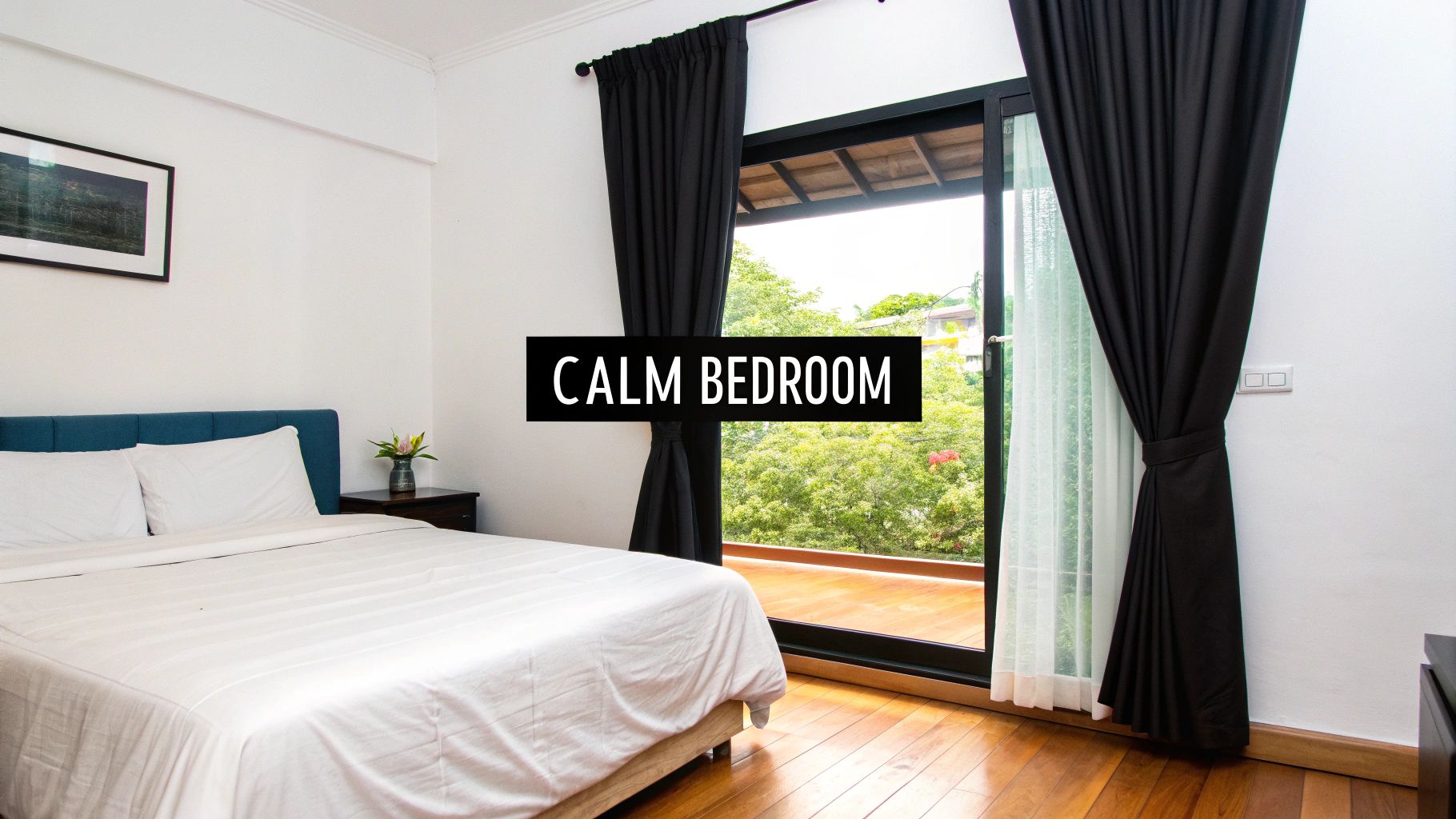
Once you've handled the darkness, a quiet and cool room really sets the stage for deep, uninterrupted rest. Building these habits into your routine can make a huge difference in how fast you fall asleep and how refreshed you feel when you wake up.
A restful environment isn't a luxury; it's a biological necessity. By consciously curating your bedroom for sleep, you give your body the best possible chance to repair and recharge each night.
Let's be real: stress and anxiety are two of the biggest culprits behind bad sleep. Creating a relaxing atmosphere is just as crucial as managing the physical environment. Here are four simple but powerful ways to calm your mind before hitting the pillow.
Lying in bed while your mind cycles through to-do lists, worries, and random thoughts is one of the most frustrating roadblocks to a good night's sleep. You know you need to rest, but your brain just won't get the memo.
The good news? You can absolutely learn to pump the brakes, calm your nervous system, and manage the stress that’s keeping you wide awake.
And it’s not just you. This is a global issue. A massive report analyzing over 105 million nights of sleep revealed a worldwide dip in sleep quality, with daily stress being a primary culprit. This really underscores how vital it is to have a few tools in your back pocket to quiet your mind. You can dig into the full global sleep trends report if you want to see the bigger picture.
One of the most powerful things you can do to stop thoughts from spinning on a loop is to get them out of your head and onto paper. This simple practice, often called a "brain dump," only takes 10-15 minutes before bed.
Just grab a notebook and jot down everything that's taking up mental space. It could be your to-do list for tomorrow, a nagging worry, or even a great idea you don't want to forget. The simple act of writing it down signals to your brain that the thought has been captured, which frees it from the need to keep reminding you.
Deep, controlled breathing is a direct line to your body's relaxation response. When we're stressed, our breath gets shallow and fast. By intentionally slowing it down, you activate the parasympathetic nervous system—your body’s "rest and digest" mode.
A ridiculously simple but effective technique is box breathing.
Repeat this cycle for just a few minutes. You’ll be genuinely surprised at how quickly it can slow a racing heart and settle a busy mind.
Mental stress and physical tension are two sides of the same coin. A few gentle, restorative yoga poses before bed can work wonders to release the tightness that builds up in your muscles all day—especially in the neck, shoulders, and back.
This isn't about a full workout. Think simple, feel-good poses like Child's Pose, Cat-Cow, or Legs-Up-The-Wall. These movements ease muscle strain and bring on a sense of calm. The focus here is on slow, mindful movements synced with your breath, which is the perfect prep for deep rest.
This is a cornerstone habit for me. Consistently wearing amber blue light blocking glasses every evening is a non-negotiable part of my wind-down routine. The warm, orange-hued lenses from Element Lux do more than just block over 99% of disruptive blue light—they create a calming visual bubble around you.
The amber tint acts as a powerful psychological cue. It creates a tranquil buffer between the chaos of your day and the quiet of your night. It’s like telling your brain, “Okay, the day is officially done.”
When you make these glasses a firm part of your evening, you're getting a one-two punch: the physiological benefit of protecting your melatonin production, plus the psychological comfort of a consistent, relaxing ritual. It’s a powerful combination that helps quiet a racing mind and guide you toward a much more peaceful night.
Fantastic sleep doesn’t magically happen the moment your head hits the pillow. It’s actually the direct result of conscious, healthy choices you make all day long, starting from the moment you wake up. If you really want to learn how to improve sleep quality, you have to look at your entire 24-hour cycle, not just that last hour before bed.
Your daily habits—what you eat, when you move, and how you manage light exposure—play a massive role in setting your body up for a successful night of rest.
One of the most powerful things you can do is lock in a consistent sleep-wake cycle. That means going to bed and waking up at roughly the same time every single day. Yes, even on weekends. This simple discipline reinforces your body's natural circadian rhythm, making it far easier to fall asleep when you want to and wake up feeling refreshed.
To really anchor that internal clock, get outside for at least 10-15 minutes of bright, natural sunlight first thing in the morning. This direct light exposure sends a clear signal to your brain to shut down melatonin production (the sleep hormone) and essentially starts the countdown for its release later that evening. Think of it as hitting the "start" button on your sleep cycle for the day.
Movement is another critical piece of the puzzle. Regular physical activity can dramatically improve sleep depth and duration. The key is all in the timing—try to wrap up any intense workouts at least three hours before you plan to go to sleep. This gives your body plenty of time to cool down and your heart rate to return to a resting state.
What and when you eat has a direct line to your sleep quality. A heavy, rich meal too close to bedtime can trigger indigestion and keep you up. A good rule of thumb is to have your last big meal 2-3 hours before you turn in for the night.
And then there's caffeine. It's the most obvious sleep disruptor, and its long half-life means it can hang around in your system for hours. To keep it from messing with your ability to fall asleep, make a hard-and-fast rule: no caffeine after 2 p.m.
Similarly, while a glass of wine might make you feel drowsy at first, alcohol seriously fragments your sleep later in the night. It actively prevents you from getting the restorative deep sleep your body and brain desperately need.
The struggle for quality sleep is a massive global issue. It's estimated that a staggering 852 million adults worldwide suffer from insomnia, a condition that torpedoes both health and productivity. You can read more about the global prevalence of insomnia to see just how widespread this problem is.
By making mindful choices throughout your day—from getting that morning sun to timing your last coffee—you create the ideal conditions for your body to wind down naturally when night falls.
When you combine these lifestyle habits with a solid evening routine—which should absolutely include wearing your Element Lux blue light blocking glasses—you create a powerful, multi-pronged strategy for reclaiming your rest and boosting your energy all day long.
Diving into a new routine to improve your sleep can bring up a lot of questions. Let's tackle some of the most common ones to help you fine-tune your approach and build confidence in your new habits.
If you spend your evenings staring at screens, you know that tired, gritty feeling your eyes get. Orange-colored blue light glasses are designed specifically to reduce this digital eye strain by filtering out the harshest, highest-energy wavelengths of light.
This filtering takes the edge off the sharp glare from your devices, making screen time a lot more comfortable and cutting down on those nagging end-of-day headaches.
The real magic for sleep is how these glasses interact with your brain's melatonin production. When your eyes are exposed to blue and green light at night, your brain gets tricked into thinking it's still daytime. This suppresses the release of melatonin, the hormone that tells your body it’s time to sleep.
Orange colored blue light glasses, like the ones from Element Lux, block over 99% of this disruptive light. This sends a clear signal to your brain that it's nighttime, allowing melatonin to be produced naturally so you can actually feel sleepy when you're supposed to.
Wearing amber blue light glasses for 90-120 minutes before bed is one of the most effective ways to protect your natural sleep cycle while still using modern technology.
Great sleep isn't about one magic trick; it's about building a solid, multi-faceted routine. For a deeper dive, you can find a ton of valuable information in our sleep improvement resources.
A racing mind is the enemy of good sleep. If you have trouble shutting off your brain at night, here are four proven strategies to help you find some calm.
Ready to transform your nights and energize your days? The single best step you can take is to protect your eyes from disruptive blue light in the evening. Discover how the expertly designed amber lenses from Element Lux can help you relax, wind down, and achieve the deep, restorative sleep you deserve.
Shop Our Blue Light Blocking Glasses Now
If you're like most of us, your days are bookended by screens. From the morning scroll to the late-night Netflix binge, our eyes are constantly bathed in the glow of digital devices. The result? That all-too-familiar feeling of tired, achy eyes and a brain that just won't switch off when it's time to sleep.
This isn't just in your head. It’s a real phenomenon called digital eye strain, and it's becoming a bigger problem as our lives move more and more online. Thankfully, there’s a straightforward tool that can help: glasses that block blue light.
Think of these glasses as a key part of your digital wellness toolkit, helping you protect your eyes and get your rest back on track. It's no surprise that as more people become aware of digital eye health, the demand for these glasses is skyrocketing. The global market, valued at around USD 35.26 million in 2025, is expected to jump to nearly USD 65.61 million by 2034. That’s a huge leap, all driven by our screen-filled lives.
So, how do these glasses actually work? It's all about filtering out the specific type of light that causes the most trouble, especially after the sun goes down.
Glasses with orange-colored lenses are your best friend for evening screen time. They are specifically designed to filter out the most disruptive blue light, which can dramatically reduce the eye fatigue and tension that builds up after a long day. The intense glare from screens forces your eye muscles to work overtime, but orange lenses cut through that harshness, allowing your eyes to finally relax and making screen time far more comfortable.
Even more importantly, this powerful filtering process sends a crucial signal to your brain: it's nighttime. Blue light from screens tricks your brain into thinking it's still daytime, suppressing the production of melatonin—the hormone that tells you it's time for sleep. By wearing orange lenses for 2-3 hours before bed, you block these confusing signals, allowing your body to produce melatonin naturally so you can fall asleep faster and get deeper, more restorative rest.
While deep orange lenses are perfect for the last few hours before bed, amber blue light glasses are ideal for relaxing and winding down earlier in the evening. They block a significant amount of stimulating blue light, which helps calm your nervous system without the intense color shift of their orange counterparts. This helps you transition from a high-alert, productive mindset to a more relaxed state, making them a great choice for watching a movie or reading on your tablet when you’re looking to de-stress.
Of course, glasses are just one piece of the puzzle. For a truly restful evening, it's best to build a routine around them. You can find more tips and tricks over on our blue light blog.
A simple yet effective evening routine can make all the difference. Combining blue light glasses with other relaxation techniques creates a powerful signal to your body that it's time to rest and recover.
Ready to build a better wind-down routine? Here are a few simple, practical steps you can take.
Not all blue light glasses are created equal. You might think the color of the lens is just a style choice, but it’s actually the key to how they work. The specific tint determines which wavelengths of light get filtered out, making some glasses perfect for daytime use and others essential for nighttime.
Think of it like this: you have sunglasses for the day and a different pair for driving at dusk. In the digital world, you need a similar approach. Understanding this difference is critical if you want to crush those screen-induced headaches during the workday or finally get that deep, restorative sleep you’ve been chasing.
When your main goal is prepping your body for sleep, orange-colored blue light glasses are your secret weapon. These lenses are engineered to be heavy hitters, blocking a huge chunk of the light spectrum—we’re talking nearly all blue light and a good amount of green light, too. This powerful filtration is what you need in the hours leading up to bed.
See, evening exposure to blue and green light tricks your brain into thinking it’s still high noon. This confusion slams the brakes on melatonin, the hormone that signals your body it’s time to sleep. By popping on a pair of orange lenses for two or three hours before you turn in, you’re basically creating a personal sunset that shields your eyes from those disruptive signals. This lets your melatonin levels rise naturally, making you feel sleepy right on schedule.
Beyond sleep, this intense filtering also brings immediate relief from digital eye strain. After a long day staring at screens, your eyes can feel fried. The deep orange tint cuts through the harsh, high-energy glare, letting your eye muscles finally relax and making your evening screen time feel so much more comfortable.
While orange lenses are the champs for nighttime, amber blue light glasses play a different, but equally important, role. These are your go-to for relaxing and winding down during the day or in the early evening. They filter out a solid amount of the most intense blue light without making your world look completely different.
This makes amber lenses perfect for when you need to dial down the mental stimulation and ease into a calmer state. By toning down the intensity of the light from your devices, these glasses help settle your nervous system. This can be a game-changer on stressful workdays or when you're trying to shift from a high-alert mindset to one of relaxation. Many people find that wearing amber glasses helps them feel less anxious and more centered.
The right lens at the right time is the foundation of effective blue light management. Amber lenses help you find calm during the day, while orange lenses prepare you for deep, restorative sleep at night.
Using the correct glasses is a cornerstone of a healthy routine. Here are some of the best strategies for improving sleep and cutting stress, with blue light management as a key player.
If you've ever found yourself doom-scrolling on your phone late at night, only to toss and turn for hours when you finally try to sleep, you know exactly what blue light disruption feels like. It’s not just a feeling of being “wired”; it's your biology at work. Your brain is literally being tricked into thinking it's still daytime, sabotaging your chances of getting truly restorative sleep.
The main culprit here is the suppression of melatonin, the hormone your body releases to signal that it's time to wind down. The specific blue and green light wavelengths blasting from our screens hit the brakes on this crucial process. But there's a simple, incredibly effective way to fight back and reclaim your sleep cycle.
This is where a good pair of orange-colored blue light glasses becomes a game-changer for modern life. By popping on a pair for just two to three hours before bed, you're essentially creating a personal shield against the most disruptive artificial light. These lenses are specifically engineered to block nearly all blue and green light, stopping those confusing "it's daytime!" signals from ever reaching your brain.
This simple act allows your body’s melatonin production to kick in naturally, helping you feel sleepy when you're supposed to. The result? You don't just fall asleep faster—you also achieve a higher quality of deep sleep throughout the night. It's a foundational step for building a solid evening routine.
While orange lenses are the heavy hitters for pre-sleep prep, amber blue light glasses are perfect for relaxing earlier in the evening. Their tint filters out a significant amount of stimulating blue light, which helps calm your nervous system and dial down the mental alertness that screens always seem to cause.
This makes them ideal for kicking back with a movie or reading on a tablet when you want to de-stress but aren't quite ready for bed. They help create a smoother transition from a hectic day to a restful evening, setting the stage for a peaceful night ahead.
By filtering out the artificial 'daylight' from our screens, blue light blocking glasses give your brain the clear signal it needs: it's time to wind down. This one simple habit can be the key to unlocking consistent, high-quality sleep.
It's clear people are catching on. The anti-blue light glasses market was valued at USD 1.43 billion in 2023 and is expected to rocket to USD 3.57 billion by 2030. This boom shows just how many of us are looking for a real solution to the screen-time struggle.
Crafting a smart evening routine is key to maximizing your sleep quality. Integrating blue light glasses is a powerful first step, but pairing them with other healthy habits will take your rest to the next level. Here’s a simple timeline to follow.
| Time Before Bed | Recommended Action | Primary Benefit |
|---|---|---|
| 2-3 Hours | Put on your orange-lensed blue light glasses. | Protects melatonin production from all screen light. |
| 1-2 Hours | Switch to relaxing, non-screen activities. | Allows your mind to disengage and begin winding down. |
| 1 Hour | Prepare your bedroom: dim the lights, cool the room. | Creates an environment conducive to deep sleep. |
| 30 Mins | Practice mindful breathing or light stretching. | Lowers your heart rate and calms the nervous system. |
By following a simple plan like this, you create a powerful ritual that signals to your body that it’s time for restorative rest.
Wearing blue light blocking glasses is a huge leap forward, but it works best as part of a complete sleep-hygiene strategy.
A calm mind is a sleepy mind. If you struggle to switch off your thoughts at night, try incorporating these relaxation techniques.
Being constantly plugged in can leave your nervous system feeling like it’s always on high alert. That relentless stream of notifications and the stimulating glare from our screens creates a low-grade hum of stress that, unfortunately, many of us now mistake for normal.
The good news is that reframing your approach to screen time is a powerful way to reclaim your calm. A cornerstone of this strategy is managing your exposure to blue light. By consciously filtering the light you see, you can directly influence your body's stress and sleep responses. This one habit, paired with a few other mindful practices, gives you a practical toolkit for finding balance.
Think of the bright, blue-rich light from your screens as a digital shot of espresso for your brain. That’s great during the day, but in the evening, it keeps your system revved up and on edge. This is exactly where different types of glasses that block blue light become essential tools for unwinding.
Orange colored blue light glasses are fantastic for tackling the physical symptoms of digital stress. After a long day, they dramatically cut down on screen glare, which helps soothe tired eye muscles and ease the tension that often builds into headaches. This physical relief is often the very first step toward feeling mentally calm.
Meanwhile, amber blue light glasses are perfect for dialing down the mental buzz. They filter a significant amount of the most intense blue light, helping your nervous system shift out of a high-energy "work mode" and into a more relaxed state. They're ideal for winding down in the evening without feeling overstimulated by your devices.
Your bedroom should be a sanctuary for rest, not just another room to work or scroll in. The habits you build around your sleep space have a massive impact on your ability to disconnect and recharge. The single most important piece of this puzzle is protecting your melatonin production.
Wearing orange lenses for two to three hours before bed is the most effective way to shield your melatonin from the disruptive glare of screen light. This allows your body's natural sleep signals to do their job, making it much easier to fall asleep and stay asleep.
By creating a clear boundary between your active day and your restful night, you give your mind and body the unambiguous signal they need to power down. This simple consistency can dramatically reduce feelings of nighttime anxiety and stress.
To build on this foundation, try incorporating these other proven strategies for crafting a sleep-promoting environment.
Reducing stress isn't just about what you do at night; it's also about how you manage your energy throughout the day. Building small, intentional breaks into your screen time can prevent mental and physical tension from building up in the first place.
The goal here is simply to interrupt the constant focus that screens demand. These brief pauses give your eyes a much-needed rest, release physical tension, and help you reset your focus.
So, you're ready to find the perfect pair? Choosing the right blue light blocking glasses isn't just about picking a frame you like. To really get the benefits, you have to think about how the lenses, the fit, and the overall quality will work with your daily life. This is about finding a tool that fits seamlessly into your routine, whether you're trying to beat that afternoon eye strain or prepping for a night of deep, restorative sleep.
The demand for these glasses has exploded, which shows just how many of us are looking for some relief. The global market for non-prescription blue light blocking glasses was valued at around USD 9.76 billion in 2021 and is on track to hit USD 14.45 billion by 2025. That's a huge jump, and it points to a major shift in how we think about our digital wellness.
This is the most critical decision you'll make: choosing the right lens for the right time of day. Your needs at 2 PM during a heavy workday are completely different from your needs at 10 PM when you're trying to wind down.
Orange lenses are your ultimate nighttime shield. They're engineered to block nearly all blue light and a good chunk of green light, too. This is crucial because it protects your body's natural production of melatonin, the sleep hormone. Wearing a pair for two or three hours before bed is one of the best ways to signal to your brain that it's time to sleep—even if you're still looking at a screen. They also give you maximum relief from that harsh glare that causes end-of-day headaches and tired eyes.
For daytime use or those early evening hours when you're relaxing, amber lenses are the way to go. They filter out the most intense, high-energy blue light to ease eye fatigue and help calm your nervous system, all without messing up your color perception too much. This makes them perfect for working on your computer or watching a movie when you want to feel more relaxed and less mentally wired.
This image breaks down some of the key benefits people report after making blue light blocking glasses a part of their routine.
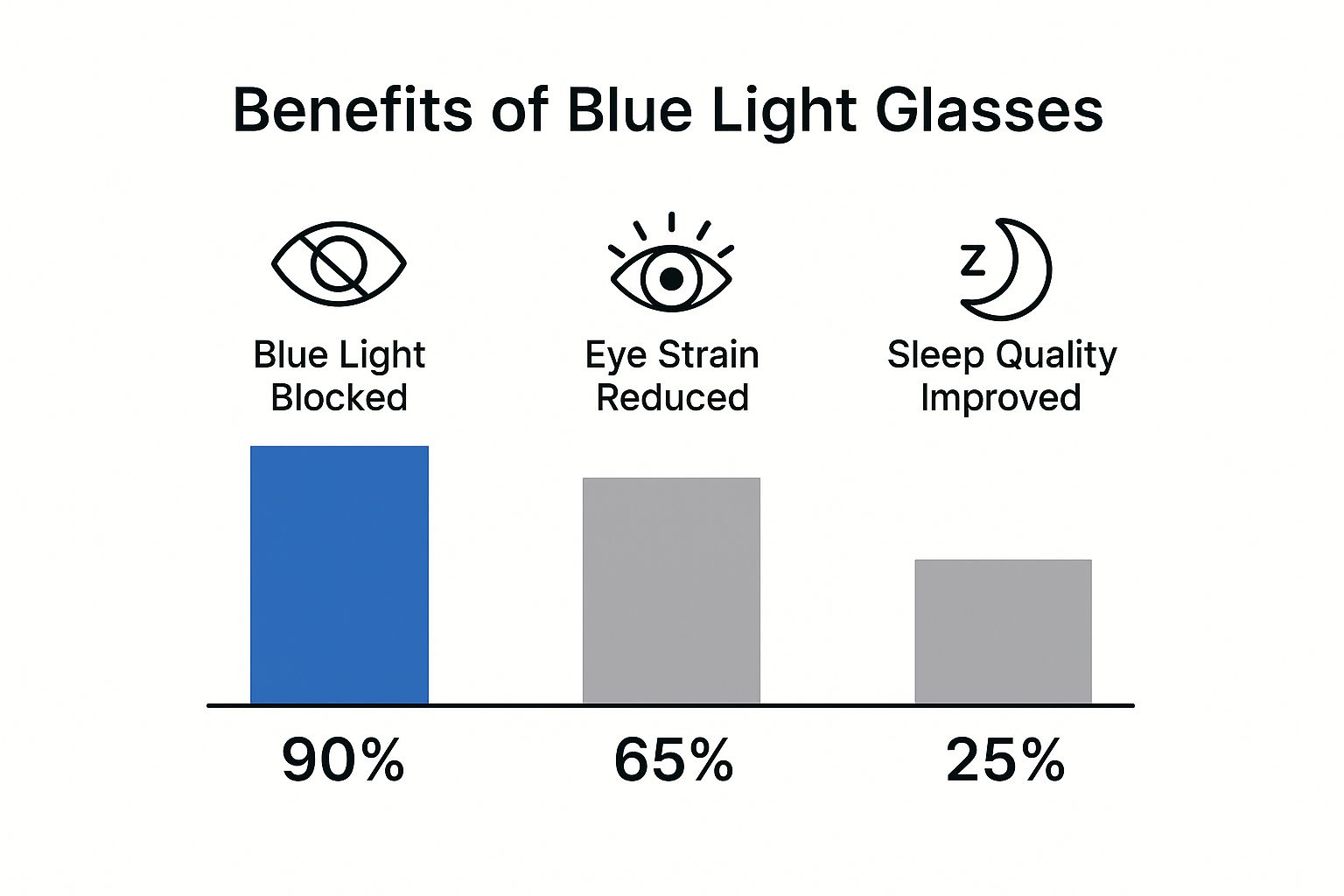
As you can see, the goal is to significantly cut down on blue light exposure to reduce eye strain and, most importantly, set yourself up for better sleep.
Choosing between amber and orange can feel tricky, but it really comes down to what you're doing and when. Think of it as having different tools for different jobs. This table breaks it down to help you decide.
| Feature | Amber Lenses | Orange Lenses |
|---|---|---|
| Best Time of Day | Daytime & Early Evening | 2-3 Hours Before Bed |
| Primary Goal | Reduce eye strain, calm nervous system | Maximize melatonin production, promote deep sleep |
| Blue Light Blockage | Blocks most high-energy blue light (400-455nm) | Blocks nearly all blue & some green light (400-550nm) |
| Color Perception | Minimal distortion, colors remain recognizable | Significant color shift, world appears very orange |
| Ideal Activities | Computer work, studying, watching TV, gaming | Reading on a tablet, scrolling on phone before sleep |
Ultimately, amber lenses help you manage your day, while orange lenses help you own your night.
Let's be honest—even the most effective lenses won't do you any good if the glasses are too uncomfortable to wear. You'll just end up leaving them on your desk.
High-quality frames are lightweight and designed for you to wear for hours, so you barely even notice they're on. Look for durable materials that can handle being tossed in a bag or accidentally dropped.
On top of that, premium lenses often have extra features that make a huge difference. An anti-glare coating cuts down on those annoying reflections from your screen and overhead lights, while a scratch-resistant coating helps keep your vision crystal clear. Investing in a well-made pair means you get both the protection you need and an experience that feels good. You can check out a range of high-quality options when you decide to shop now for your perfect pair.
Choosing the right glasses is all about matching the technology to your routine. Use amber lenses to find calm and focus during the day, and switch to orange lenses at night to protect your sleep.
When you align your choice with your daily habits, these glasses stop being a simple accessory and become a powerful tool for your well-being.
Thinking about adding a pair of blue light blocking glasses to your daily kit? It's smart to have questions. You want to know when to wear them, what they actually do, and how to pick the right pair for you. Let's get into some of the most common questions we hear and clear things up.
Absolutely. That intense, high-energy glare blasting from your screens makes your eye muscles work overtime, leading to that all-too-familiar feeling of fatigue, dryness, and even tension headaches.
Think of orange colored blue light glasses as a powerful shield. They dramatically cut down on the harshest light wavelengths hitting your eyes. This gives your eye muscles a chance to relax, and the relief can feel almost immediate. Slipping on a pair after a long day in front of the computer can feel like a deep sigh of relief for your eyes, making your evening screen time so much more comfortable.
This is where orange lenses are a complete game-changer. Your body's internal clock runs on a hormone called melatonin—it’s the signal that tells your brain it’s time to wind down and sleep. The problem is, blue and green light from screens slams the brakes on melatonin production, tricking your brain into thinking it's still the middle of the day.
By blocking nearly all of that disruptive blue and green light, orange colored blue light glasses protect your body's natural process. When you wear them for 2-3 hours before bed, you allow your melatonin levels to rise as they should, helping you feel tired at the right time. The result? You don't just fall asleep faster; you get deeper, more restorative sleep all night long.
While orange lenses are your go-to for serious sleep prep, amber blue light glasses are your perfect partner for unwinding earlier in the evening. They filter a big chunk of the stimulating blue light but without the intense color shift you get from orange lenses.
This filtering helps calm your nervous system, which often gets stuck in "go-mode" from constant screen use. By toning down that digital buzz, amber lenses help you shift from a state of high alert to one of relaxation. They're ideal for watching a movie or reading on your tablet when you just want to chill out.
The secret is using the right tool for the job. Think of amber lenses as your 'relax mode' for the evening and orange lenses as your 'sleep mode' for those final hours before hitting the pillow.
Getting consistently great sleep is about building a solid routine, and managing blue light is a huge piece of that puzzle. When you combine smart habits, you create powerful signals that tell your body it's time for deep rest.
Stress and sleep are deeply connected. If you can manage your stress, your sleep will almost certainly improve. Weaving a few simple relaxation techniques into your day and night can make a world of difference.
By layering these strategies, you can take back control from our screen-filled world. The payoff is better rest, less stress, and a healthier, happier you.
Ready to feel the difference that reduced eye strain and deeper sleep can make? The right pair of glasses is a powerful first step. Check out the high-quality, scientifically-designed options from Element Lux to find the perfect fit for your routine.
Shop Now and Reclaim Your Rest
Let's cut right to the chase: Yes, blue light blocking glasses work. But there’s a big "but" involved. Their effectiveness really hinges on what you’re trying to achieve.
If you’re looking to improve your sleep, the science is pretty solid. Studies consistently show that glasses with orange and amber lenses are fantastic at filtering out the specific light that messes with your body's internal clock. For tackling digital eye strain, however, the picture is a bit more complicated. Strain often comes from a mix of things—like screen glare and just not blinking enough—not only from blue light.
The most important thing to understand is that not all blue light glasses are the same. The color of the lens is everything. Different tints are designed for different jobs, whether it's for daytime eye comfort or getting your brain ready for bed. This guide will walk you through the science so you can pick the right pair for your needs.
This image gives a great snapshot of how blue light impacts us and what these glasses are designed to do.
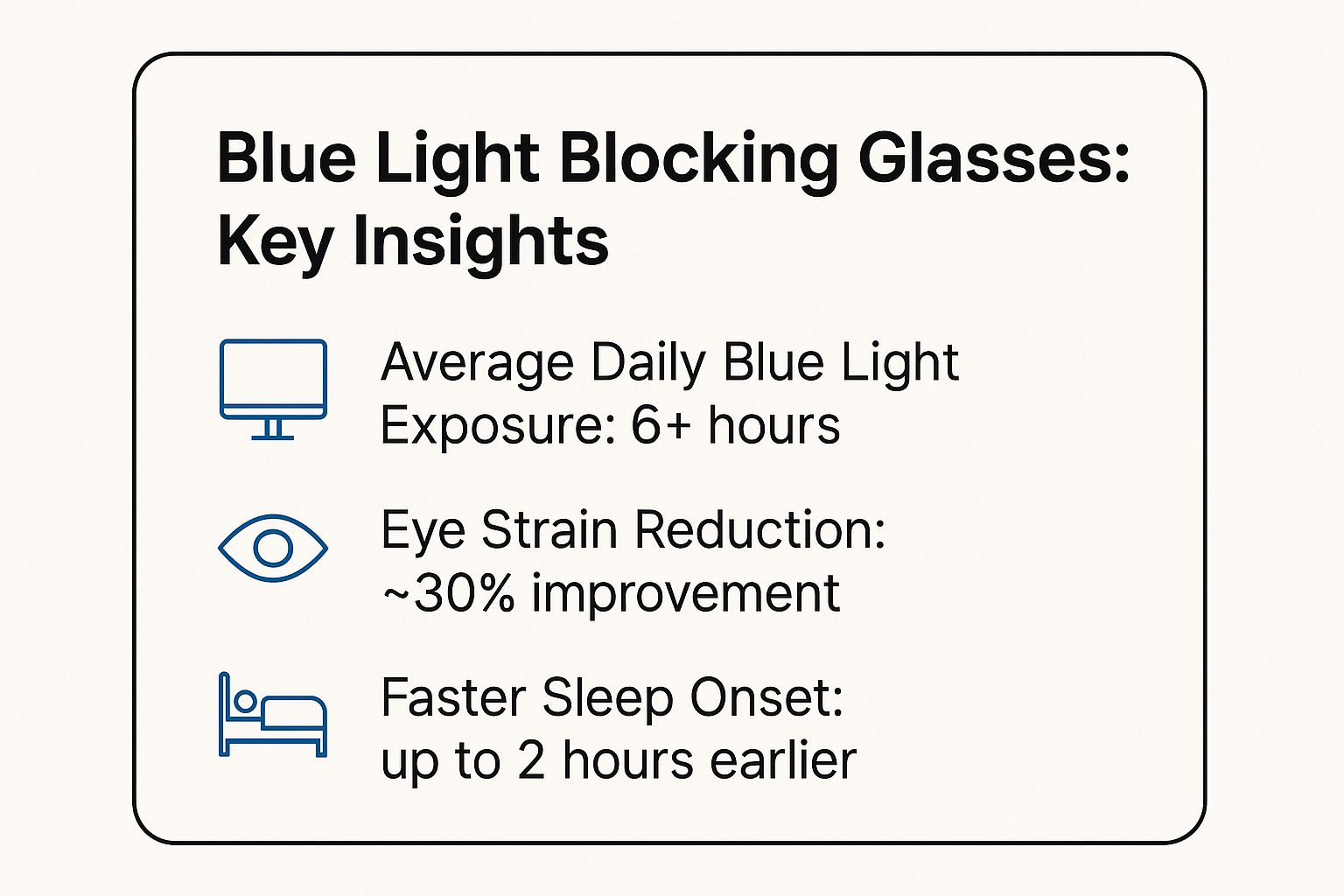
When you consider how much time we spend in front of screens, even a small improvement in eye comfort and falling asleep faster can make a huge difference in your day-to-day life.
To make it easier to see which glasses might work for you, here’s a quick breakdown of how different lenses stack up against common goals.
| Goal | Best Lens Type | How It Works | General Effectiveness |
|---|---|---|---|
| Improve Sleep Quality | Orange Lenses | Blocks nearly all blue and green light to allow natural melatonin production. | Very High |
| Reduce Digital Eye Strain | Clear or Amber Lenses | Filters a smaller percentage of blue light and reduces screen glare. | Moderate |
| Wind Down in the Evening | Amber Lenses | Softens harsh screen light to help your mind and eyes relax before bed. | High |
| General Daytime Use | Clear Lenses | Provides minimal filtering to take the edge off screen light without color distortion. | Low to Moderate |
Ultimately, the right lens depends entirely on your lifestyle and what you’re hoping to fix—whether it’s late-night scrolling or all-day work meetings.
Think of orange lenses as your "night mode" glasses. These are built specifically for evening and pre-bedtime use. They are heavy-hitters, blocking a huge chunk of the blue and green light wavelengths known to shut down your body's production of melatonin (the sleep hormone). When you pop them on an hour or two before you plan to sleep, you’re basically telling your brain, "Hey, it's nighttime," making it much easier to drift off naturally. The deep color of orange glasses is a clear sign they are working to protect your melatonin, which directly helps you get better, more restorative sleep.
Amber lenses are a bit more of a middle-ground option. They filter enough blue light to cut down on that harsh digital glare from your screen, which helps you feel less wired and more relaxed. This makes them perfect for unwinding in the evening while you’re catching up on a show or reading on a tablet. It's a less intense approach than the deep orange lenses, but still highly effective at helping you relax and wind down before bed.
Here’s how a good pair of blue blockers can help you build a better pre-sleep routine:
To figure out if blue light glasses actually work, we first need to get something straight: what’s really causing that screen-related discomfort? While blue light gets all the blame, the tired, achy feeling you get after hours staring at your monitor is often something else entirely: digital eye strain.
Think of your eye muscles like any other muscle. If you held a small weight straight out in front of you for hours on end, your arm would start to burn. Your eyes do the same thing. When you stare at a screen up close, your eye muscles are constantly flexed to keep everything in focus.
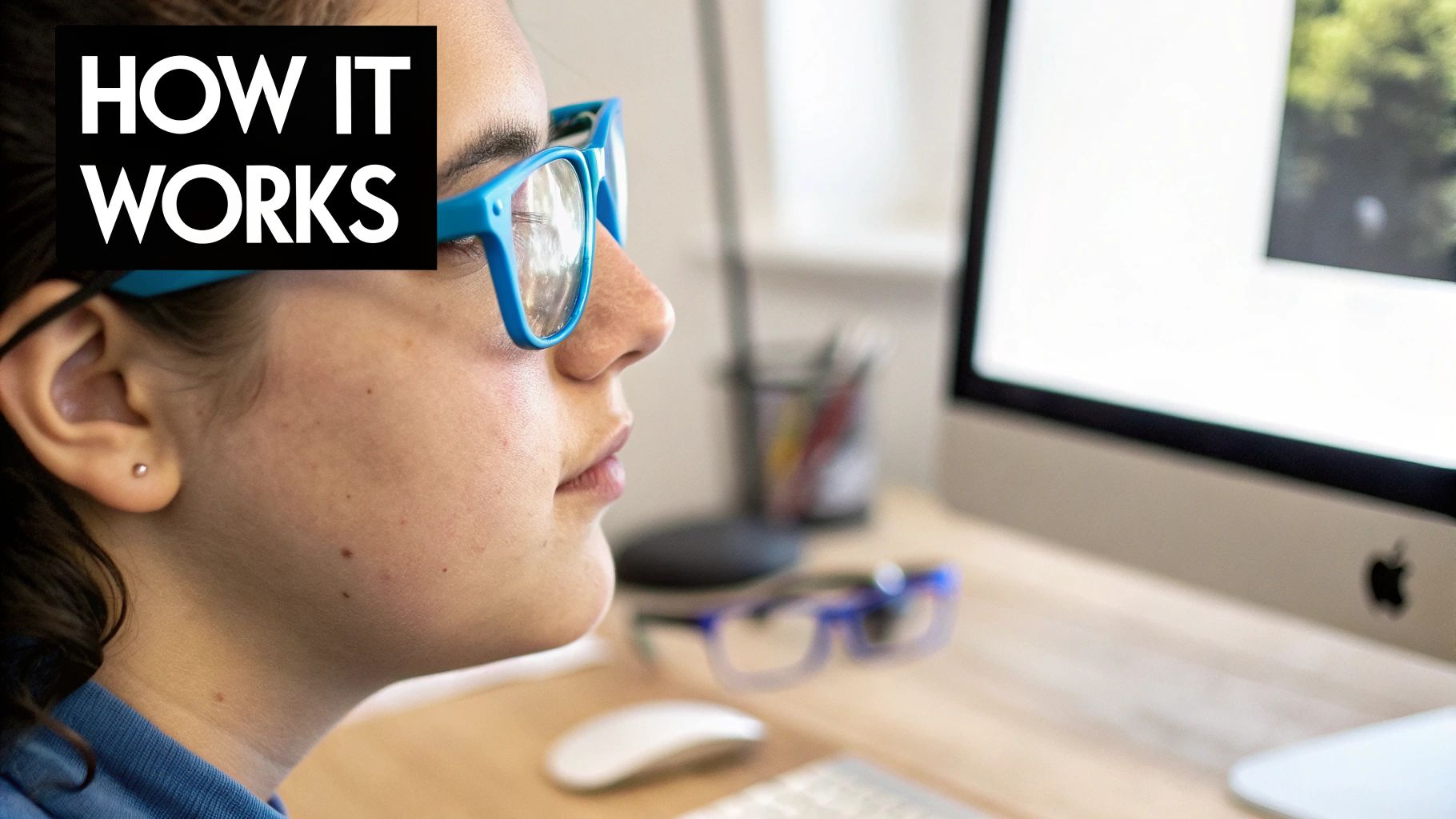
This non-stop effort, mixed with harsh screen glare and the fact that we blink way less, is the real driver behind digital eye strain—not just blue light on its own.
With screen time on the rise, digital eye strain is a bigger issue than ever. When we’re glued to a screen, our natural blink rate can plummet from around 22 blinks per minute down to just 7.6. That’s a massive drop, and it leads directly to the dryness and irritation so many of us feel after a long day at the computer.
This is where blue light blocking glasses, especially those with a noticeable orange or amber tint, really make a difference. They cut down on the harsh, high-energy glare from your screen that forces your eye muscles into overdrive. By softening that light, the glasses give your eyes a chance to relax, easing the tension that builds into strain.
Think of it this way: by filtering out the most intense wavelengths, these glasses essentially lower the "weight" your eye muscles have to hold, providing almost immediate relief during long screen sessions.
While reducing glare is great for comfort, the real magic of orange-lensed glasses is how they help you sleep. Getting blasted with blue light in the evening messes with melatonin—the hormone that signals your body it’s time to wind down. Orange lenses are specifically designed to block those disruptive wavelengths, letting your brain produce melatonin on its natural schedule. Similarly, amber blue light glasses let you relax and wind down by creating a sense of visual calm, dialing back the stimulating effect of screens and helping your mind shift into a more relaxed state. You can dive deeper into practical tips and info over on our blue light blog.
Of all the claims you hear about blue light glasses, the link to better sleep is by far the most solid. It all comes down to your body's internal clock, also known as your circadian rhythm. This internal clock relies on light cues from your environment to figure out when you should be awake and when it’s time to wind down.
The problem is, our modern lives are filled with bright, artificial light, especially in the evening. The blue and green wavelengths pouring out of our phones, laptops, and TVs send a powerful and confusing signal to our brains. It’s like telling your body it's the middle of the afternoon when you're actually trying to get ready for bed. This trickery messes with the natural production of melatonin, the crucial hormone that makes you feel sleepy.
When melatonin production gets pushed back, you end up tossing and turning, feeling wired even when you’re physically exhausted. This is where orange-lensed glasses become a game-changer. They’re specifically designed to filter out nearly all of that disruptive blue light—and even some of the problematic green light—that gets in the way of your body's natural sleep process.
Think of it this way: putting on a pair of orange glasses for an hour or two before you hit the hay acts like a protective shield for your melatonin. It lets your body wind down naturally, on its own schedule, making it much easier to fall asleep and stay asleep.
You can see this in action with glasses like the ones from Element Lux, which have a very noticeable orange tint made for maximum blue light blocking at night.
That deep color is a dead giveaway of their purpose—they prioritize protecting your sleep hormones over perfect color vision.
While best known for sleep, orange lenses also provide significant relief from digital eye strain. By blocking the most intense, high-energy visible (HEV) light, they drastically reduce the harsh glare from screens. This filtering effect acts like a shield for your eyes, preventing your eye muscles from having to work so hard to stay focused. The result is less tension, fewer headaches, and a more comfortable viewing experience, even after hours in front of a computer.
Simply throwing on a pair of glasses is a fantastic start, but they’re most effective when you pair them with other smart sleep habits.
In a similar vein, amber and orange lenses can also help you de-stress and manage anxiety before bed.
While the deep orange lenses are the heavy hitters for sleep, amber glasses have a different—but just as critical—job. Think of them as your personal sunset, helping you transition from a busy, screen-heavy day into a calm, restful evening.
Amber lenses are engineered to filter out a solid amount of stimulating blue light, but without the intense color distortion you get from their orange cousins. The result is an immediate feeling of "visual calm" that just feels good on your eyes.
This makes them perfect for those evening wind-down activities where you still want a fairly normal viewing experience. You can catch a movie, read on your tablet, or scroll through your phone without that harsh, brain-jolting glare that keeps you wired.
That gentle filtering effect does more than just relax your eyes. It sends a powerful signal to your brain that the day is over and it's time to start powering down. By taking the edge off the most intense light from your devices, these glasses help dial back the mental buzz that often leads to evening stress and anxiety.
This gradual shift helps you feel more relaxed and mentally prepped for bed. For anyone asking does blue light blocking glasses work for relaxation, the subtle but very real reduction in visual stress from amber lenses is a game-changer.
Putting on a pair of amber glasses in the evening can become a powerful daily ritual. It’s a simple, effective cue that tells your body and mind the productive part of the day is over, and it's time to rest and recharge.
Because they strike that perfect balance between blue light protection and color clarity, amber lenses are incredibly versatile. They're the go-to tool for anyone looking to build a healthier relationship with their screens in the hours leading up to bedtime.
For an even more powerful wind-down routine, try pairing your amber glasses with other relaxing habits:
Knowing that orange lenses protect your melatonin is one thing, but actually using that knowledge is what really transforms your sleep. While blue light blocking glasses are a game-changer, they're most powerful when you pair them with other solid sleep habits. Think of it as a team effort—when you combine them, you send an undeniable signal to your body that it's time for deep, restorative rest.
Building a better sleep routine really boils down to managing your light exposure. From nagging eye strain to a night of tossing and turning, the right pair of glasses makes a difference you can feel.
This is the single most impactful step you can take. Period.
Putting on a pair of orange-lensed blue light blocking glasses for one to two hours before you plan to sleep is the best way to shield your eyes from those melatonin-killing wavelengths pouring out of your screens. This simple habit tells your brain, "Hey, it's nighttime," allowing your natural sleep hormones to rise and help you fall asleep faster and get much higher-quality rest.
That deep orange tint you see isn't just for style. It's a visual cue that these glasses are serious about blocking the maximum amount of disruptive blue and green light, putting your sleep quality first.
Your body’s internal clock—your circadian rhythm—absolutely thrives on routine. Try to go to bed and wake up around the same time every day. Yes, even on weekends. This simple discipline anchors your natural sleep-wake cycle, making it so much easier to feel sleepy at night and genuinely refreshed in the morning.
A regular sleep schedule acts like an anchor for your circadian rhythm, preventing the "social jetlag" so many of us feel after sleeping in on the weekend. This consistency is fundamental to long-term sleep health.
The environment in your bedroom plays a massive role in how well you sleep. To really optimize it for rest, focus on making it dark, cool, and quiet.
Use blackout curtains to kill any outside light. Set your thermostat to a comfortable, slightly cool temperature. And if you're a light sleeper, a white noise machine or a good pair of earplugs can be a lifesaver for masking disruptive sounds.
You wouldn't jump into a hard workout without warming up, right? The same logic applies to sleep. You need a "wind-down" period.
In the last 30-60 minutes of your day, switch to calming, screen-free activities. Reading a real book, doing some gentle stretching, taking a warm bath, or listening to quiet music are all great ways to signal to your body that the day is over. This ritual helps you mentally unplug from the day's stressors, prepping you for a peaceful night.
For more ideas and info on building these kinds of healthy habits, check out our helpful sleep resources.
In our screen-saturated world, stress isn't just a mental game—it's a visual one, too. The non-stop glare and stimulating light from our devices can keep our brains firing on all cylinders long after we've clocked out for the day. Learning how to truly unwind is critical, and it often starts with giving your eyes a much-needed break.
This is where blue light blocking glasses come in. They're a fantastic tool for managing this very modern, digitally-driven stress. While most people ask does blue light blocking glasses work for sleep, their power to dial down visual stress is a huge piece of the puzzle.
Here are four simple, practical ways to ease daily stress, starting with the easiest one of all.
Think of a pair of amber-lensed glasses as your personal "off switch" for digital overstimulation.
When you slip them on to watch TV or scroll through your phone at night, they immediately soften the harsh screen glare. This simple change creates a sense of visual calm, cutting down on the "it's daytime!" signals being blasted to your brain and making it much easier for your mind and body to shift into relaxation mode.
You don't need a full hour on a meditation cushion to feel the benefits. Just taking five to ten minutes for a quick mindfulness session can do wonders for your nervous system.
Focus on your breath—a slow inhale, a long exhale. This incredibly simple practice helps to quiet those racing thoughts, pulling your attention back to the present moment. In turn, this can help lower cortisol levels and foster a genuine sense of peace.
Pro-tip: Try combining these first two steps. Putting on your amber glasses and then doing a brief meditation creates a powerful evening ritual. It sends a clear message to your body that the day's work is done and it's time to wind down.
Stress has a sneaky way of storing itself as physical tension, usually camping out in our neck, shoulders, and back. A little gentle movement before bed is a great way to show it the door.
Things like light yoga or simple stretching can release that pent-up tension. It not only feels amazing physically but also helps soothe your mind, setting the stage for a much more restful night.
To give your eyes and your brain a real break, you need to disconnect completely. Find a hobby that doesn’t involve a glowing screen.
Whether you're cracking open a physical book, sketching, listening to a podcast, or playing an instrument, stepping away from your devices is essential. It allows your brain to finally disengage from the constant flood of information and notifications, giving you a much-needed mental reset before you hit the pillow.
So, you're thinking about trying blue light glasses, but you've got questions. That's a good thing. Let's tackle some of the most common ones so you can feel confident you're using them the right way.
One of the first things people ask is, "Can I wear blue light glasses all day?" The answer really comes down to the color of the lens. If your glasses have clear or very light yellow lenses, they’re designed for daytime use to help with screen glare. But the darker amber and orange lenses? Those are strictly for evening use. Wearing heavy-duty, sleep-promoting lenses during the day can mess with your body's natural clock, which is the last thing you want.
This brings up another great question: what's the real difference between amber and orange lenses?
Think of it this way. Amber lenses are your "wind-down" glasses. They're perfect for relaxing in the evening while you watch TV or read on a tablet, blocking enough blue light to ease eye strain and help your brain start shifting toward rest.
Orange lenses, like the ones we've perfected at Element Lux, are the heavy hitters. They are specifically engineered for sleep, blocking almost all blue and green light to give your melatonin production the biggest possible boost before you get into bed.
But are they safe? People worry if filtering light could harm their eyes. The answer is a clear and simple no. These glasses are just filters; they don't negatively affect your eye health in any way. In fact, a major review by the Cochrane Collaboration confirmed that these devices have little to no effect on your visual sharpness. If you want to dive into the details, you can read more about these findings and put your mind at ease.
Finally, everyone wants to know, "How quickly will I notice better sleep?" While some people feel a difference the very first night, it's more common to see results after a few days to a week of consistent use.
Consistency is everything. The key is to wear your orange-lensed glasses for 1-2 hours before bedtime every single night. This steady routine is what helps regulate your circadian rhythm for real, lasting improvements.
Once you understand how the different lenses work and when to use them, you can easily make them a part of your daily life. For a little more guidance on picking the right style, check out our helpful videos.
Ready to take back your evenings and get the restorative sleep you deserve? The science is solid, and the right pair of glasses can make all the difference. Discover the visual calm and deep rest that Element Lux glasses provide by exploring our collection today.
Shop Element Lux Blue Light Blocking Glasses Now
Blue light glasses designed for sleep work by filtering out the precise wavelengths of light that halt your body's production of melatonin—the all-important sleep hormone.
When you wear them in the evening, you're essentially sending a clear signal to your brain that it's nighttime. This allows you to wind down naturally, even if you're still using your screens, helping you fall asleep faster and get the deep, restorative rest you need.
Ever felt tired but strangely wired after an evening scrolling on your phone or binging a show on your laptop? You’re definitely not alone. The culprit is almost always the invisible blue light beaming from your favorite devices, and its effect on your brain is far more powerful than you might realize.
Think of blue light as a shot of digital caffeine for your eyes. It has a short, high-energy wavelength that perfectly mimics the bright, midday sun. When your eyes pick up on this light in the evening, it sends a powerful "wake-up" call to your brain, tricking it into thinking it's still daytime.
This biological mix-up directly messes with your body's internal 24-hour clock, known as your circadian rhythm. This natural cycle is responsible for managing your sleep-wake patterns, hormone release, and even your metabolism. To stay synchronized, it relies on environmental cues—primarily light and darkness.
Your circadian rhythm is like a finely tuned orchestra conductor, telling your body when to feel alert and when to feel sleepy. Evening blue light exposure is like a rogue trumpet player blasting a note at the wrong time, throwing the entire symphony into disarray.
The most critical function disrupted by evening blue light is the production of melatonin, the hormone that signals to your body that it’s time for sleep. As darkness falls, your melatonin levels are supposed to rise, making you feel drowsy. But exposure to blue light from screens slams the brakes on this entire process.
In fact, just two hours of screen time before bed can significantly crush your melatonin levels, making it much harder to fall asleep. This explains why you might toss and turn for hours after finally putting your phone down. You've effectively told your brain to stay alert right when it should be preparing for rest.
The table below breaks down how some of our most common evening habits can directly impact this vital sleep hormone.
| Blue Light Source | Typical Evening Use | Impact on Melatonin |
|---|---|---|
| Smartphone / Tablet | Scrolling social media, reading news, checking email | High Suppression: Close proximity to your eyes delivers a concentrated dose of blue light, significantly delaying melatonin release. |
| Laptop / Computer | Working late, streaming videos, online shopping | High Suppression: Similar to phones, direct screen exposure tricks your brain into a state of daytime alertness. |
| Television | Watching movies or TV shows | Moderate to High Suppression: While further away, modern LED TVs emit strong blue light that can still disrupt your circadian rhythm. |
| E-Reader (Backlit) | Reading books before bed | Moderate Suppression: Devices with built-in lights emit less blue light than phones but can still interfere with sleep hormones. |
| LED Lighting | Bright overhead lights or lamps in your home | Significant Suppression: Many modern light bulbs are high in the blue light spectrum, contributing to the overall "daytime" signal. |
It's clear that our modern environment is constantly working against our natural sleep cycles.
To dive deeper into the science behind light and sleep, you can explore more resources on our blue light blog.
Understanding this biological conflict is the first step. By blocking this disruptive light, blue light glasses for sleep act as a shield for your melatonin, allowing your body to follow its natural rhythm and prepare for a night of deep, restorative sleep. This makes them a simple yet powerful tool for anyone looking to improve their rest in our screen-filled world.
While plenty of glasses claim to block blue light, not all lenses are created equal. The color of the lens—specifically orange or amber—determines its primary function, whether it's maximizing sleep quality or helping you relax. That distinct color isn't a style choice; it's a specific technology designed to filter out the most problematic wavelengths of light.
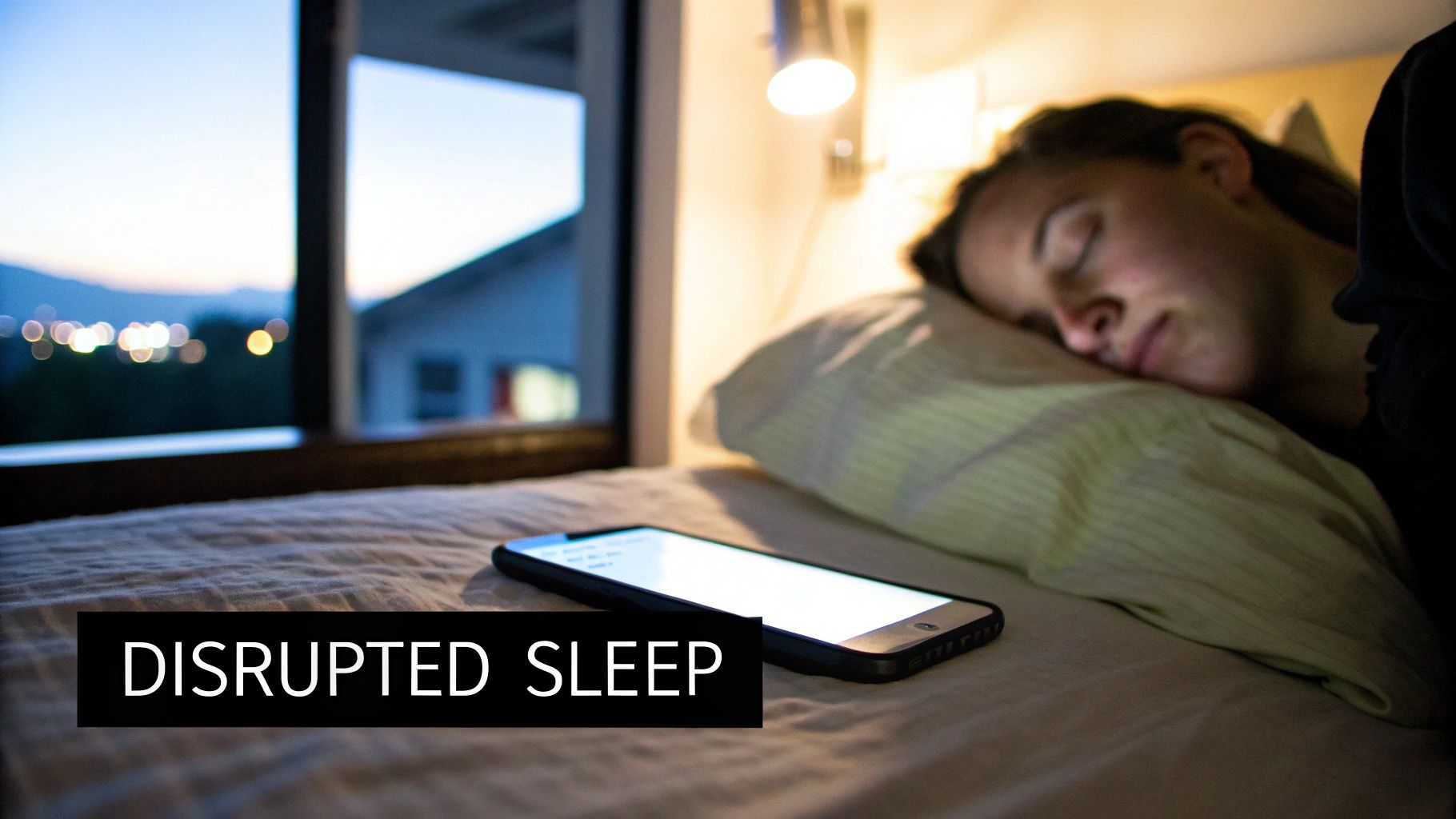
Orange-lensed glasses are engineered for maximum effectiveness against both digital eye strain and sleep disruption.
Alleviating Digital Eye Strain: Ever notice your eyes feel tired, dry, and sore after hours on a screen? That’s digital eye strain, caused by the harsh, high-energy glare from our devices. Orange lenses tackle this by filtering that intense light, which immediately softens the screen's appearance and cuts down on visual stress. This also enhances contrast, so your eyes don't have to work as hard to focus. It’s like turning a glaring bulb down to a soft, warm glow.
The Science Behind Better Sleep: The real magic of orange blue light glasses for sleep is their ability to shield your body's melatonin production. That deep orange tint blocks the most disruptive blue and green light wavelengths. By putting these glasses on an hour or two before bed, you create a personal sunset for your eyes, allowing melatonin levels to rise naturally, even if you’re using a screen.
Think of it this way: your brain is a factory that produces the sleep hormone, melatonin. Blue light is the emergency signal that shuts down the entire production line. Orange-lensed glasses act as the security guard, blocking that signal from ever reaching the factory floor.
Amber-lensed glasses are the perfect tool for your nightly wind-down. They are the ideal bridge between a chaotic, screen-filled day and a genuinely peaceful evening. While orange lenses offer the strongest sleep protection, amber lenses still block a huge amount of blue light, making them perfect for easing the transition from a hectic day to a calm evening. They dial down the "alerting" signals sent to your brain, helping you get into a more relaxed mental state without fully prepping you for immediate sleep.
Knowing how different lenses protect your sleep is a fantastic start. But the real magic happens when you weave them into a solid routine. This holistic approach tackles all the things that can mess with your rest—physical, environmental, and mental.
Improving your sleep doesn't have to be complicated. Start with these proven strategies to build a powerful nighttime routine.
A calm mind is the gateway to a restful night. If you find that stress or anxiety is keeping you up, weaving in some simple relaxation techniques can be a game-changer.
For more tips and information on creating a healthier lifestyle, check out the valuable articles available in our Element Lux resources.
A calm, quiet mind is the gateway to a night of deep, restorative sleep. But if you’re staring at the ceiling with a thousand thoughts racing through your head, that calm can feel miles away. The good news is that you can absolutely learn to wind down. A few simple practices can be a total game-changer, helping lower both mental and physical tension to prepare your body for rest.
The easiest first step is often the most overlooked. By simply wearing blue light blocking glasses in the evening, you significantly cut down on the stimulating, high-energy light that keeps your brain on high alert. This one simple act helps naturally calm your nervous system, making it an effortless foundation for the rest of your wind-down routine.
Creating a pre-sleep ritual doesn't have to be complicated or take a ton of time. The goal is just to send a clear signal to your body that the day is over and it's time to unwind. Here are four effective methods to help you do just that.
Wear Your Blue Light Blocking Glasses
Think of this as your passive, first line of defense against evening anxiety. Popping on a pair of Element Lux glasses an hour or two before bed filters out the harsh, stimulating light from screens and overhead lighting. This simple action lowers the "alertness" signals reaching your brain, which in turn helps you feel calmer and more relaxed without even trying.
Practice Mindfulness Meditation
You don't need to be a zen master to get the benefits of meditation. Just five to ten minutes of a guided mindfulness practice can work wonders for a busy mind. This technique helps slow your heart rate, lower your blood pressure, and quiet the racing thoughts that often hijack your ability to sleep. It trains your brain to let go of the day's worries and simply be present.
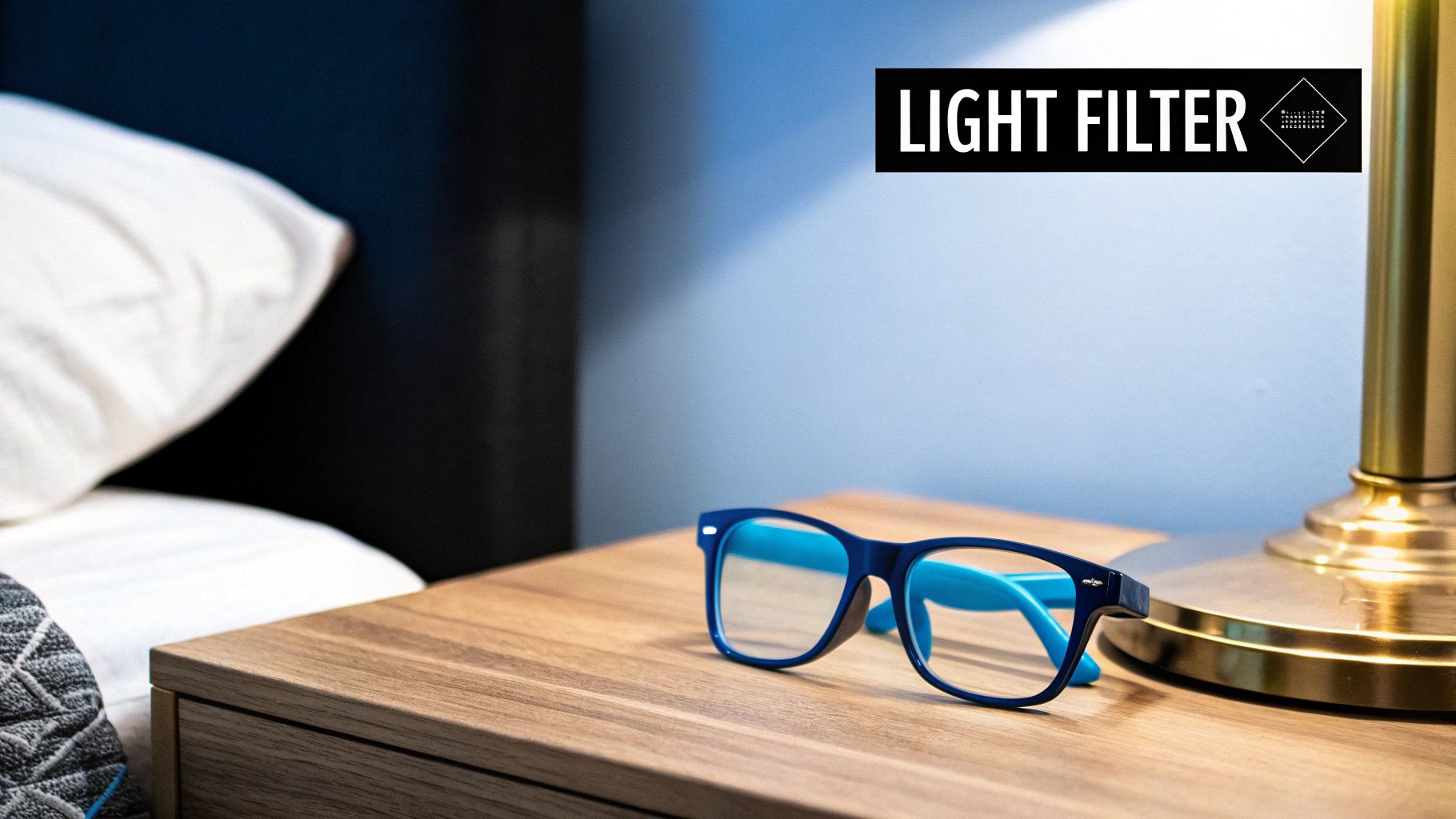
Incorporate Gentle Stretching
Stress doesn't just live in our heads; it gets stored in our bodies as physical tension. Gentle stretching or some light yoga before bed can release the tightness we build up in our neck, shoulders, and back all day. This physical release sends a powerful relaxation signal to your brain, helping your body feel safe and ready for rest.
Try Journaling to Clear Your Mind
Often, the biggest barrier to sleep is rumination—that endless loop of worries, to-do lists, and unresolved thoughts. Journaling is an incredibly powerful tool for stopping this cycle. Just spend a few minutes writing down whatever is on your mind. The act of getting those thoughts out of your head and onto paper provides a mental release, clearing the way for peace and quiet.
By combining these practices, you create a powerful, multi-layered approach to relaxation. Starting with blue light glasses for sleep makes the other techniques even more effective, setting the stage for a truly tranquil evening and a night of deep, uninterrupted rest.
So, you're ready to take back your evenings and get some truly restorative sleep. Awesome. But with all the options out there, how do you pick the right pair of blue light glasses? It really comes down to a few key things: lens color, quality, and of course, comfort.
Let's start with the big one: lens color. You'll mostly see orange and amber options, and they serve slightly different purposes.
Orange lenses are the heavy hitters. They offer maximum protection, filtering out nearly all blue light and even a good chunk of green light. Think of them as your secret weapon for battling eye strain and signaling to your brain that it's time to power down for deep, high-quality sleep.
Amber lenses, on the other hand, are perfect for winding down. They block a significant amount of blue light, enough to help you relax and ease into a calm evening without making you feel instantly ready for bed. They're the ideal bridge between a hectic day and a peaceful night.
Beyond the color of the lens, you need glasses you'll actually want to wear. That's where frame comfort and build quality come in. Look for lightweight materials and a style that sits comfortably on your face. After all, if they're a pain to wear, you're not going to use them consistently.
This whole idea of "digital wellness" is catching on, and the market reflects it. The global blue light blocking glasses market was valued at around $2.9 billion and is expected to almost double to $5.8 billion by 2034. That huge jump is all thanks to our ever-increasing screen time and a growing understanding of how it messes with our health.
The proof is in the data. Just look at how effective these glasses can be.
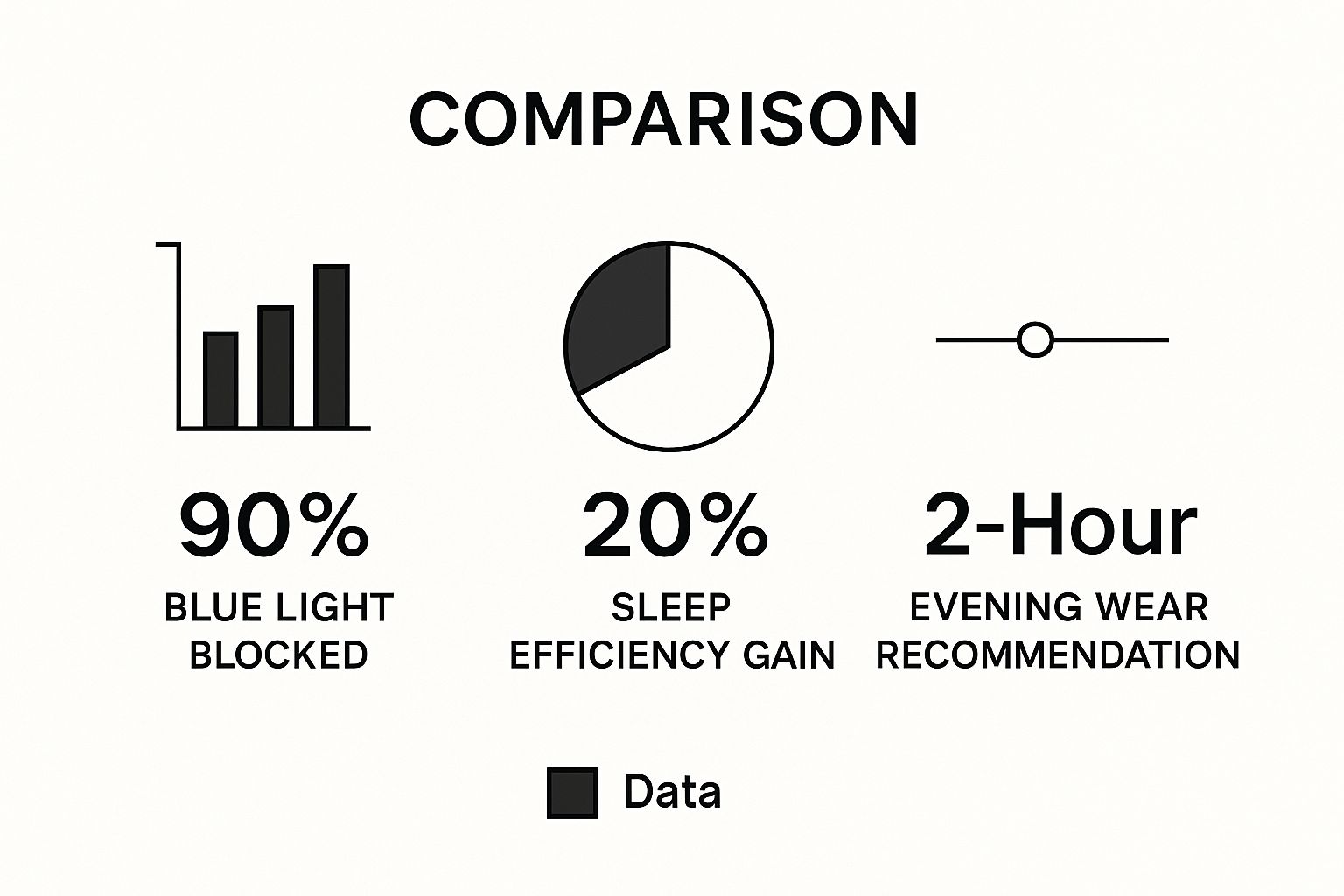
As you can see, popping on a quality pair for just a couple of hours before you hit the hay can make a massive difference in your sleep.
Still on the fence about which color to go with? This simple breakdown should help you decide.
| Lens Color | Blue Light Blocked | Best For | Ideal Time to Wear |
|---|---|---|---|
| Orange | 99%+ | Maximum sleep support, reducing eye strain, and resetting your circadian rhythm. | 2-3 hours before bed, especially if you're sensitive to light or have trouble sleeping. |
| Amber | 75%-90% | General evening use, winding down, reading, or watching TV without overstimulating your brain. | During the evening, after the sun has set, to ease into a relaxed state. |
Ultimately, the best choice depends on your specific goals. Orange is for serious sleep optimization, while amber is great for creating a more relaxed evening environment.
Here’s the thing: blue light glasses for sleep work even better when they’re part of a solid evening routine. Here are a few tips to combine with your new glasses for incredible results.
Top Ways to Get Good Sleep:
Top 4 Ways to Reduce Stress and Relax:
When you bundle these habits together, you create a powerful ritual that tells your body and mind that it's officially time to rest.
Ready to transform your nights and wake up feeling like a new person? Explore the full range of high-quality sleep glasses from Element Lux and find the perfect pair for your evening routine. Shop now and start your journey to better sleep!
If you've ever finished a long day staring at a screen feeling wired, exhausted, and with a dull headache throbbing behind your eyes, you're not alone. That distinct "digital hangover" is a direct result of blue light—a high-energy visible (HEV) light that essentially acts like a shot of caffeine for your brain, keeping you alert long after you’ve shut your laptop.
Our constant connection to phones, computers, and TVs comes with a real, physical cost. Many of us chalk up symptoms like sore eyes, trouble focusing, and persistent headaches to just being "tired," but it's often a clear sign of digital eye strain.
This happens because blue light scatters more easily than other types of light. It forces the tiny muscles in our eyes to work overtime just to stay focused, leading to that all-too-familiar fatigue. It’s a constant, low-level workout your eyes never signed up for.
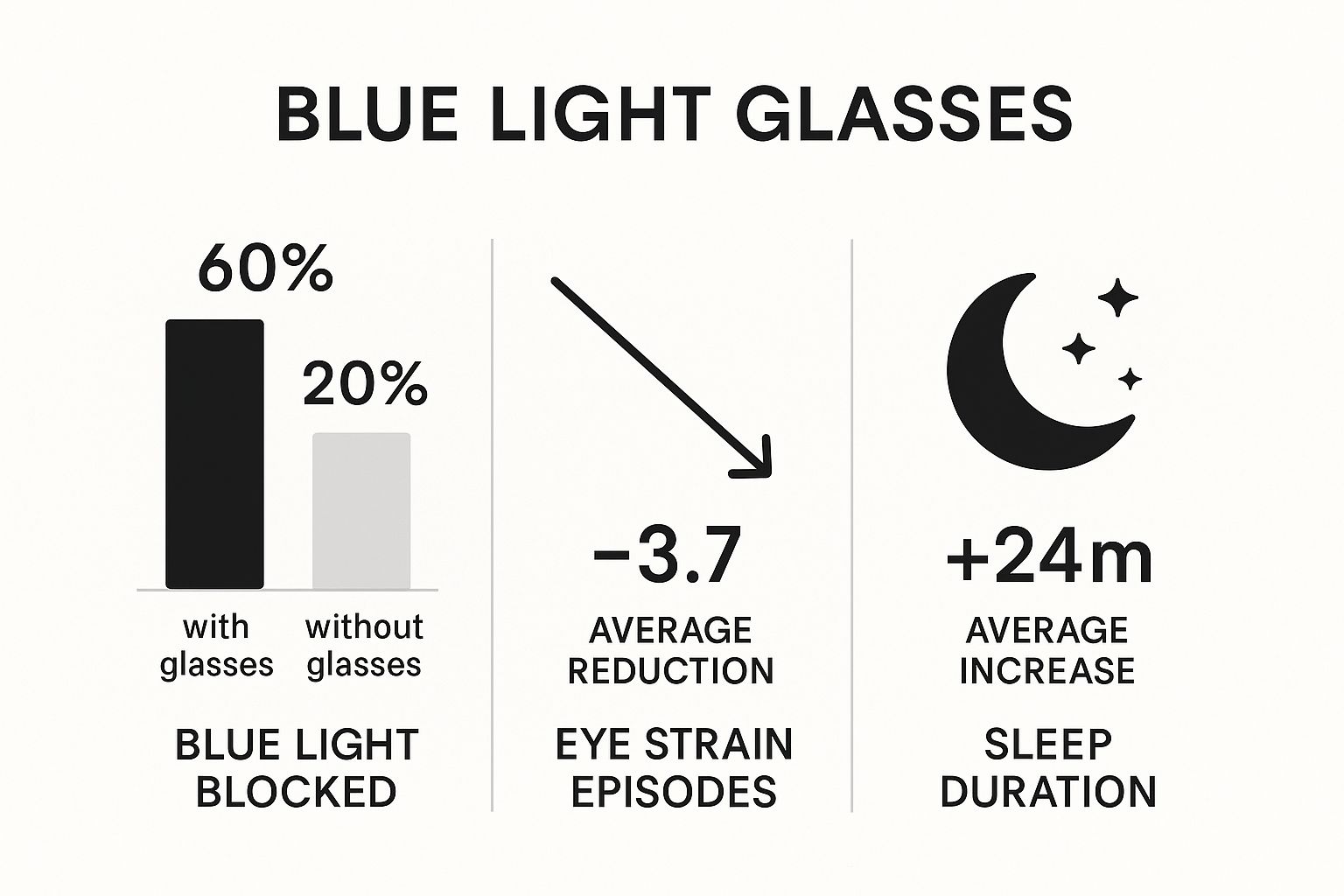
This is where blue light blocking glasses step in. Think of them as a personal bodyguard for your eyes. By filtering out the harshest, most disruptive wavelengths of blue light, they provide almost immediate relief from that piercing screen glare. The result? A much more comfortable viewing experience, whether you're buried in a spreadsheet or just scrolling through your feed.
This one simple change can have a massive impact on your day-to-day well-being by getting to the root of your digital discomfort. And it seems like more and more people are catching on. The global market for blue light blocking glasses was valued at around USD 35.26 million in 2025 and is expected to jump to USD 65.61 million by 2034. That's a huge number of people looking for—and finding—relief.
To give you a quick snapshot, here’s how these glasses directly solve the problems caused by too much screen time.
| Problem From Blue Light | How Blue Light Glasses Provide Relief |
|---|---|
| Sore, tired eyes after screen use | Filters harsh light, reducing the workload on your eye muscles. |
| Headaches and migraines | Eases the intense visual focus required, calming your nervous system. |
| Trouble falling asleep at night | Blocks the light that suppresses melatonin, your natural sleep hormone. |
| Poor sleep quality and grogginess | Allows your body to wind down naturally for deeper, more restorative rest. |
| Blurry vision or difficulty focusing | Reduces screen glare, making it easier for your eyes to maintain focus. |
As you can see, turning this small daily habit into a routine can lead to some major wellness improvements. For a deeper dive into how light management can completely change your health, feel free to explore the resources on our blue light blog.
The real magic isn't just about blocking light; it's about restoring your body's natural rhythm. When your eyes are blasted with blue light in the evening, it tricks your brain into thinking it's still the middle of the day. This confusion slams the brakes on the production of melatonin, the crucial hormone that tells your body it's time to power down and sleep.
By slipping on a pair of Element Lux glasses a few hours before bed, you're sending a clear, unmistakable signal to your brain: the day is done. This simple act allows your body to start its natural wind-down process, making it so much easier to fall asleep, stay asleep, and get the kind of deep, restorative rest you actually need.
Ever feel like the light from your screen isn't a steady glow, but more like a chaotic spray of tiny, high-energy particles? That's not far from the truth. This is essentially what blue light is—a high-energy visible (HEV) light that scatters far more than any other color on the spectrum.
This scattering creates a kind of visual static, blurring the edges of text and images. It reduces contrast and forces your eye muscles into a constant, frantic state of refocusing just to keep things sharp. It’s like trying to read a book while someone is subtly shaking it. Your eyes are working double-time, and that hard work leads directly to the headaches, fatigue, and blurry vision we all know as digital eye strain.
This is where the targeted power of orange colored blue light glasses makes a world of difference. Element Lux orange glasses are engineered to act as a powerful filter, blocking the most disruptive wavelengths of blue light. They cut right through that visual static, which dramatically increases contrast and slashes glare.
The feeling is one of tangible relief. Your eye muscles, finally freed from that constant struggle to focus, can actually relax. Things like analyzing a complex spreadsheet or reading on your tablet late at night become noticeably more comfortable, letting you work or wind down without the physical discomfort.
The core benefit of blue light glasses is simple: by filtering the harshest light, you allow your eye muscles to stop overworking. This reduces strain, prevents headaches, and creates a much more comfortable viewing experience.
While reducing eye strain is an immediate win, the job of orange colored blue light glasses doesn't stop there. By blocking the specific blue light that suppresses melatonin, these glasses become a powerful tool for getting better sleep. Wearing them in the evening sends a clear signal to your brain that the day is ending, allowing your body's natural sleep cycle to kick in on time.
For a gentler transition into the evening, amber blue light glasses offer a perfect middle ground. They help you relax and wind down by taking the harsh edge off artificial lighting without blocking all blue light. This makes them ideal for watching a movie or casual browsing, gently easing your mind and body toward rest.
A great night's rest is built on solid habits, and managing your light exposure is a key pillar.
When the sun goes down, your brain gets a clear signal: it's time to wind down. But what happens when you spend your evenings scrolling on your phone, binge-watching a series, or catching up on work emails? All that bright, artificial light floods your eyes and sends a loud, confusing message to your brain: "Hey, it's still daytime!"
This constant stream of artificial daylight completely throws off your body's internal clock, also known as your circadian rhythm. More importantly, it slams the brakes on melatonin production—the crucial hormone that tells your body it’s time to sleep. The result? That frustrating cycle of tossing and turning, struggling to fall asleep, and waking up feeling like you barely slept at all. This isn't just in your head; it's a very real biological response to the wrong light signals at the wrong time.
This is where orange colored blue light glasses become your secret weapon for a great night's sleep.
Popping on a pair of Element Lux orange glasses a couple of hours before you plan to hit the hay sends an unmistakable signal to your brain that the day is officially over. By filtering out all that disruptive blue light from your screens and overhead lighting, you give your body the green light to start producing melatonin naturally, just as it’s supposed to.
This one simple habit can help you fall asleep faster and sink into those deeper, more restorative stages of sleep that your body craves. In our screen-heavy world, it’s no surprise that eye strain, headaches, and sleep issues are on the rise, all thanks to that high-energy visible (HEV) blue light. Luckily, great blue light blocking glasses are more accessible than ever, making them a go-to tool for professionals, students, and anyone looking to improve their rest.
Think of it like this: orange lenses create an artificial sunset for your brain. Even if your TV is on, your body gets the cue that it’s time to power down, paving the way for a truly restful night.
Getting truly great sleep is all about building a solid routine. While blue light glasses are a total game-changer, pairing them with other proven habits will make your sleep strategy unstoppable.
Your pre-sleep routine isn't just about what you do—it's also about calming your mind. If you’re someone who lies in bed with a racing mind, these simple practices can make a huge difference.
By taking control of your light exposure and adopting a few of these simple routines, you can get your natural sleep cycle back on track. To dive deeper into the science, check out our guide on how our glasses help with sleep.
Not every evening calls for the total blue light shutdown that orange lenses offer. Sometimes, you just want to take the harsh edge off a long day, settle in with a movie, or scroll online without feeling completely wired. This is exactly where amber blue light glasses shine.
Think of amber-tinted glasses as the dimmer switch for your digital world. While heavy-duty orange lenses are for serious sleep preparation, amber lenses provide a much gentler filter. They're designed to soften the intense glare from screens and artificial lights, toning down all that visual noise and helping your brain shift from a high-alert, "go-go-go" state to one of calm and relaxation.
This subtle shift is more powerful than it sounds. By easing the constant stimulation from our devices, amber lenses send a gentle cue to your body that the day is winding down. It makes the whole process of relaxing feel smoother and more natural, paving the way for better sleep later on.
Using amber lenses is all about finding a healthy middle ground. You get to enjoy your evening screen time without the piercing light that so often leads to eye fatigue and mental restlessness. They quickly become a go-to tool for creating a more peaceful pre-sleep environment.
Amber lenses are your best friend for casual evenings. They dial back the mental stimulation and gently signal that the day is ending, making the transition to rest smoother without having to block all blue light.
This helps you stay present and relaxed, whether you're catching up on a show or reading on your tablet.
Building a solid de-stress routine is one of the best things you can do for your well-being. And when you add amber glasses to the mix, these habits become even more effective.
Getting better sleep isn't about finding a single magic trick. It’s about building a smarter, healthier routine. In our screen-filled lives, managing our exposure to light has become one of the most important parts of modern sleep hygiene.
This section is your practical toolkit, filled with actionable strategies to help you get the rest you need. We'll cover everything from foundational habits to the specific ways blue light blocking glasses can help, giving you a clear roadmap to transform your nights and energize your days.
Achieving deep, restorative sleep is absolutely possible when you combine a few powerful habits. Here are the best ways to create a routine that works with your body's natural rhythm, not against it.
Think of orange colored blue light glasses as your most powerful tool for sleep preparation. They are specifically engineered to filter out the high-energy blue light that causes digital eye strain, allowing your eye muscles to finally relax after a long day of staring at screens. But more importantly, filtering that light sends a powerful signal to your brain to start producing melatonin, helping you fall asleep faster.
For evenings when you just want to relax without a total light blockade, amber blue light glasses are perfect. They soften the harsh glare from screens and overhead lights, helping you wind down while you watch a movie or read. It's a gentle transition that calms your mind and makes it easier to prepare for a peaceful night.
The rising popularity of these tools is hard to miss. In North America alone, the anti-blue light glasses market made up 37.85% of global revenue in 2025, hitting nearly USD 994.07 million. This growth is fueled by a growing awareness of these very benefits. You can discover more insights about the anti-blue light glasses market to see the trend for yourself.
Wearing blue light glasses in the evening is like creating an artificial sunset for your brain. It's a clear signal that the day is done, allowing your natural sleep cycle to take over.
A calm mind is absolutely essential for good sleep. If stress and anxiety are what keep you tossing and turning, integrating these simple practices with your blue light glasses routine can make a world of difference.
We've all been there—wired and unable to switch off after a long day staring at screens. It's no surprise. That constant exposure keeps your brain on high alert, feeding directly into evening stress and anxiety.
The connection between light, sleep, and eye strain is pretty clear, but the impact on your mental state is just as real. Creating a calm, intentional transition from a busy day to a restful night is one of the best things you can do for your overall well-being.
This is where the right pair of glasses can be a game-changer. Think of them as a tool to signal "downtime" to your brain and body.
Orange colored blue light glasses are your heavy-hitters for this. By filtering out the harsh, high-energy light that makes your eye muscles work overtime, they provide immediate physical relief. That feeling of relief sends a direct message to your nervous system: it's time to stand down. You can literally feel the day's tension start to melt away.
For a more subtle approach, amber blue light glasses are perfect. They gently dial back the intensity of artificial lights and screen glare without blocking everything. It's just enough to help you relax while watching a movie or scrolling through your phone, creating a much smoother shift into a peaceful state of mind before bed.
Managing your light exposure is powerful, but it's even better when you pair it with other solid sleep habits.
A calm mind is the foundation of a restful night. Adding blue light glasses to your evening wind-down routine can make these practices even more effective.
You're not alone. Figuring out how to get the most out of blue light blocking glasses is the key to actually feeling the benefits. Let's tackle some of the most common questions.
Think of orange colored blue light glasses as your heavy-hitters for the evening. They are specifically designed to block the most disruptive, high-energy light that makes your eye muscles tense up and causes that all-too-familiar digital eye strain.
Even more importantly, this powerful filtering is a clear signal to your brain that it's time to wind down. By blocking that "daytime" light, you allow your body's natural melatonin production to kick in, helping you fall asleep faster and get the kind of deep, restorative rest you need.
Amber blue light glasses are your go-to "wind-down" pair. They're perfect for those more casual evening hours when you're watching a movie, scrolling on the couch, or reading on a tablet.
They work by softening the harsh, artificial glare from screens and overhead lights. This takes the edge off, reducing that feeling of being mentally "wired" and gently easing you into a more relaxed state before bed.
The right lens color really comes down to what you're trying to achieve. Orange is for serious sleep preparation. Amber is for general evening relaxation and taking the edge off screen time.
Great sleep rarely happens by accident—it’s all about building a solid routine. When you combine proven habits with the right tools, you can make a massive difference.
Winding down isn't just about your body; it's about your mind, too. Here’s a simple four-step process to help you unplug and de-stress.
Want to dive deeper? We have a ton of helpful articles and guides in our Element Lux resources.
Ready to reclaim your evenings and finally get the sleep you deserve? The Element Lux collection has the perfect lens for every part of your day. Shop now and feel the difference for yourself.
When you're trying to wind down but your mind is still racing, it’s often because your eyes feel fried from a full day of screen time. The culprit? Artificial blue light from our devices, which is notorious for throwing our natural sleep-wake cycle completely out of whack.
The best blue light blocking glasses are the ones with distinctly orange or amber lenses. These are specifically engineered to filter out the high-energy light that triggers eye strain and messes with your sleep. For serious sleep improvement, orange-lensed glasses like those from Element Lux are the gold standard. If you just want something for evening relaxation, amber lenses strike a fantastic balance. Think of them as a simple but powerful upgrade to your nightly routine.
For thousands of years, our bodies relied on a simple cue: the setting sun. As the light dimmed, our brains would get the signal to start producing melatonin, the hormone that makes you feel sleepy. It was a perfect system.
But now, we have artificial suns in our pockets and on our desks. When you're scrolling on your phone or watching TV late into the evening, the bright blue light bombarding your eyes sends a very different message to your brain: "Hey, it's still daytime! Stay alert!"
This signal effectively hits the brakes on melatonin production, delaying the natural onset of sleep and creating a cascade of frustrating issues.
This hormonal disruption isn't just a minor inconvenience; it has a noticeable impact on how you feel. You might experience:
It's no surprise that as our screen time has gone up, so has the demand for a solution. The global market for blue light blocking glasses was valued at around USD 35.26 million in 2025 and is expected to nearly double to USD 65.61 million by 2034. People are catching on. You can check out the full blue light blocking glasses market trends here.
Let's quickly summarize the core problem and the solution.
This table breaks down how a simple pair of glasses directly addresses the issues caused by artificial light exposure at night.
| Common Problem from Blue Light | How Blue Light Blocking Glasses Help |
|---|---|
| Suppressed melatonin production at night. | Filters out blue light, allowing melatonin to be released naturally. |
| Difficulty falling asleep and a racing mind. | Helps your brain recognize it's evening, promoting relaxation. |
| Digital eye strain, headaches, and dry eyes. | Reduces the harsh, high-energy light reaching your eyes. |
| Waking up feeling tired and unrefreshed. | Supports deeper, more restorative sleep cycles. |
Ultimately, it's about reclaiming your evening.
Blue light blocking glasses are a practical, science-backed tool that creates an "artificial sunset" for your eyes. This allows your body to wind down and prepare for deep, restorative sleep, even if you’re still using your devices.
By filtering out these disruptive wavelengths, you're taking back control of your light environment. It’s a simple change that sets the stage for a better night's rest and a more energized tomorrow.
For a deeper dive into how different types of light impact our biology, feel free to explore the guides on the Element Lux blue light blog.
When your main goal is better sleep, not all blue light glasses are created equal. While lots of lenses offer some filtering, orange lenses are the undisputed champions for anyone serious about optimizing their rest.
They're specifically engineered to block nearly all blue light and a good chunk of green light—the exact wavelengths that hit the brakes on your body's melatonin production.
Think of it this way: putting on a pair of orange-lensed glasses is like creating your own personal sunset. It's a powerful visual cue that tells your brain the day is done and it's time to wind down. This works even if you're still reading on a tablet or wrapping up some work on your laptop.
The biology here is refreshingly simple. When you wear orange colored blue light glasses for at least 90 minutes before bed, you're shielding your eyes from the disruptive light in your environment. This shield allows your pineal gland to get the message that darkness has fallen, which kicks off the natural release of melatonin. It’s not about forcing your body into sleep; it's about removing the artificial roadblocks stopping it from doing what it's built to do. The result is you fall asleep faster and spend more time in the deep, restorative stages of rest.
It’s clear people are catching on. The market for non-prescription blue light blocking glasses was valued at roughly $9.76 billion in 2021 and is expected to hit around $14.45 billion by 2025. That kind of growth shows a huge shift toward using technology to solve the very problems that technology created. You can dig deeper into this expanding market's data on cognitivemarketresearch.com.
Beyond just prepping you for sleep, orange colored blue light glasses offer immediate relief for tired, overworked eyes. The intense, high-energy visible (HEV) light blasting from our screens creates a kind of visual "noise." This forces the tiny muscles in your eyes to work overtime just to stay focused, leading to digital eye strain symptoms like dryness, headaches, and fatigue. Orange lenses cut right through that harsh glare, creating a much softer and more comfortable viewing experience. By filtering out the most jarring wavelengths, they give your eye muscles a chance to finally relax.
By dramatically reducing visual stimulation, orange-lensed glasses don't just protect your sleep cycle. They also help calm your nervous system, making them a fantastic tool for winding down after a stressful day.
Adding orange lenses to a solid nightly routine can be a game-changer. Here are the top ways to get your body and mind ready for quality sleep:
If a racing mind is keeping you up, pairing your glasses with relaxation techniques can make a huge difference.
While orange lenses are your best friend for a good night's sleep, their benefits start the second you put them on—especially if you're battling digital eye strain.
Picture the intense blue light from your screens as a kind of visual "noise." It’s harsh, it’s high-energy, and it puts your eye muscles on constant high alert. That relentless effort is exactly what causes the classic symptoms of eye fatigue: dryness, headaches, and that gritty, tired feeling after a long day in front of the computer. Your eyes are just plain overworked from processing an unnatural amount of intense light.
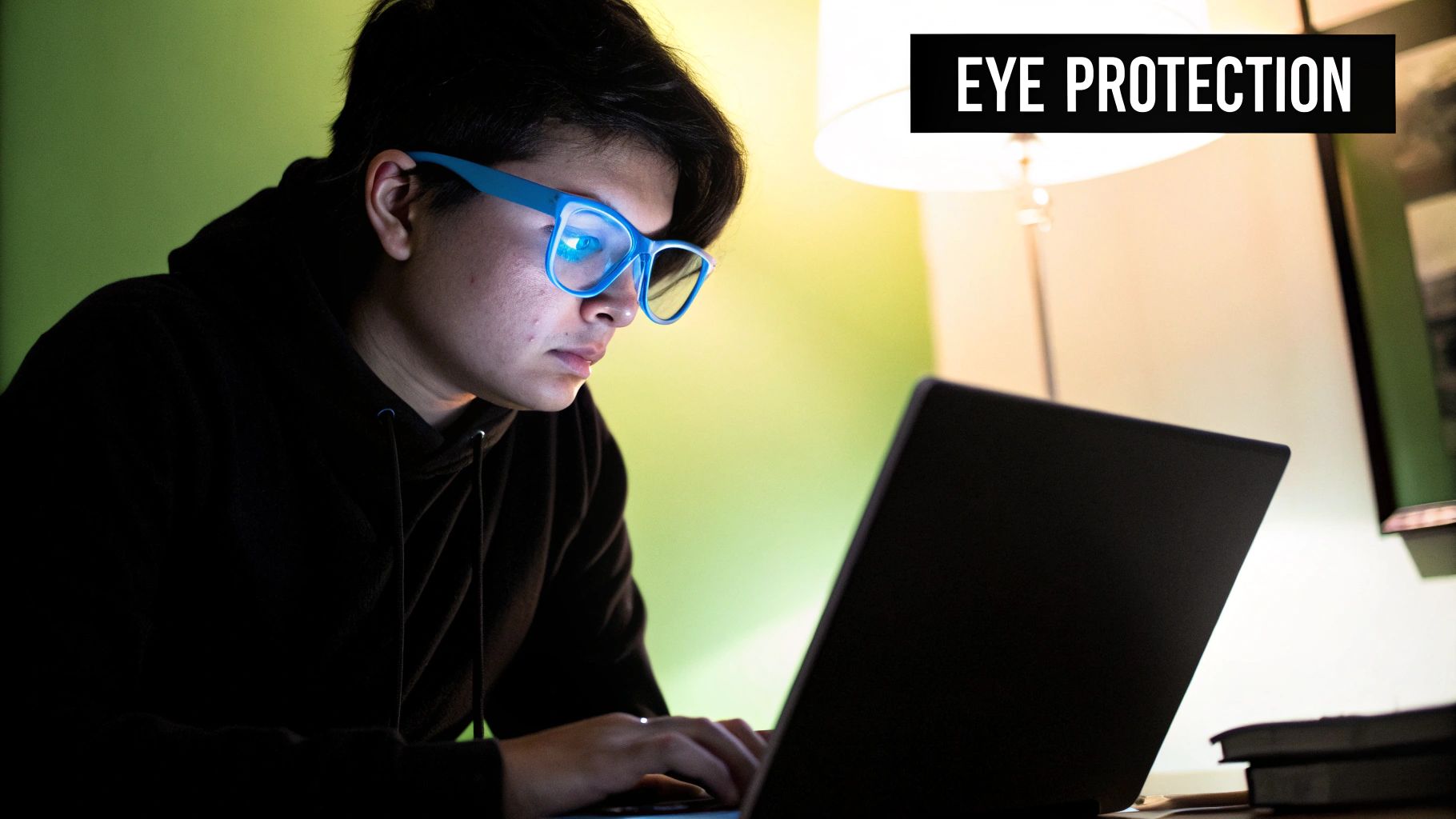
Think about how sunglasses cut the blinding glare on a sunny day. Orange lenses do the same thing for screen light. They slice right through the harshness, filtering out the most aggressive, high-energy wavelengths to create a visual experience that is significantly softer and more comfortable.
This filtering effectively creates a “digital comfort zone” for your eyes. With less harsh light to process, the tiny ciliary muscles in your eyes can finally relax, easing the constant tension that leads to headaches and strain.
By softening what your eyes have to take in, orange lenses do more than just protect them. They help calm your entire nervous system, making them a fantastic tool for winding down and de-stressing after a visually demanding day.
What about more casual evening activities, like watching a movie or reading on a tablet? For those times, amber blue light glasses let you relax and wind down by offering the perfect middle ground. They block a serious amount of blue light but still allow for better color perception than their deeper orange cousins. Imagine the warm, cozy glow of candlelight. Amber lenses replicate that feeling, transforming the stark, stimulating light of your screen into something much more soothing. This gentle shift is a game-changer for easing the transition from a busy day to a peaceful evening.
Pairing your glasses with a solid evening routine can dramatically improve your sleep. Here are four foundational habits to get you started:
If it's anxiety keeping you awake, a few simple practices can help quiet your mind before bed.
Orange lenses are the heavy hitters when you're serious about sleep. But sometimes, you just need to chill out without going into full sleep-prep mode. That’s where amber blue light glasses come in.
Think of them as the perfect middle ground for unwinding. They're ideal for those evenings when you want to watch a movie or read on your tablet—easing into the night without the intensity of a deep orange lens. Amber lenses are designed to block a good chunk of blue light, but they don't mess with your color perception nearly as much. The result is a noticeable, yet totally natural, shift in your environment that feels instantly calming.
Ever notice how relaxing the warm glow of candlelight or a dim table lamp feels? Amber blue light glasses let you relax and wind down by creating that same atmosphere for your eyes, no matter what’s on your screen. They turn that harsh, stimulating blue and white light into a soft, warm hue.
This isn’t just about making your screen look nicer; it has a real effect on your body. By softening the light, you help soothe your nervous system, making it easier to shift gears from a busy, alert day to a state of rest.
Wearing amber glasses at night is like turning down the visual volume on the world. It helps calm an overstimulated mind, making it easier to switch off and get your body ready for sleep.
Adding amber lenses to a solid wind-down routine can make a huge difference in how well you sleep. Here are a few key strategies to pair with your glasses for the best results:
If a racing mind is what’s keeping you up, your evening routine is the perfect time to tackle it. Combining these simple practices with your amber lenses can help you finally get some peace and quiet.
Think of the best blue light blocking glasses as a powerful tool, but not a silver bullet. They work best when they're part of a solid, healthy sleep routine—the cornerstone of your nightly wind-down ritual. By combining their benefits with a few other simple habits, you can create a powerful system that signals to your body it’s time for deep, restorative rest.
This isn't about a massive lifestyle change. It's about small, intentional tweaks that tell your body and mind it’s time to switch off and recharge.
So much of our evening is spent staring at screens. This forces our eye muscles to work overtime processing harsh, high-energy light, which is exactly what leads to that all-too-familiar feeling of digital eye strain—dryness, tension, and fatigue. Orange colored blue light glasses help with eye strain by filtering out the most aggressive wavelengths, softening everything you see and allowing your eye muscles to finally relax. It's a simple change that dramatically reduces the physical stress on your eyes, making evening screen time far more comfortable.
The technology behind quality lenses is designed for maximum comfort and protection. This infographic summarizes the key performance metrics you should expect from a high-quality pair.
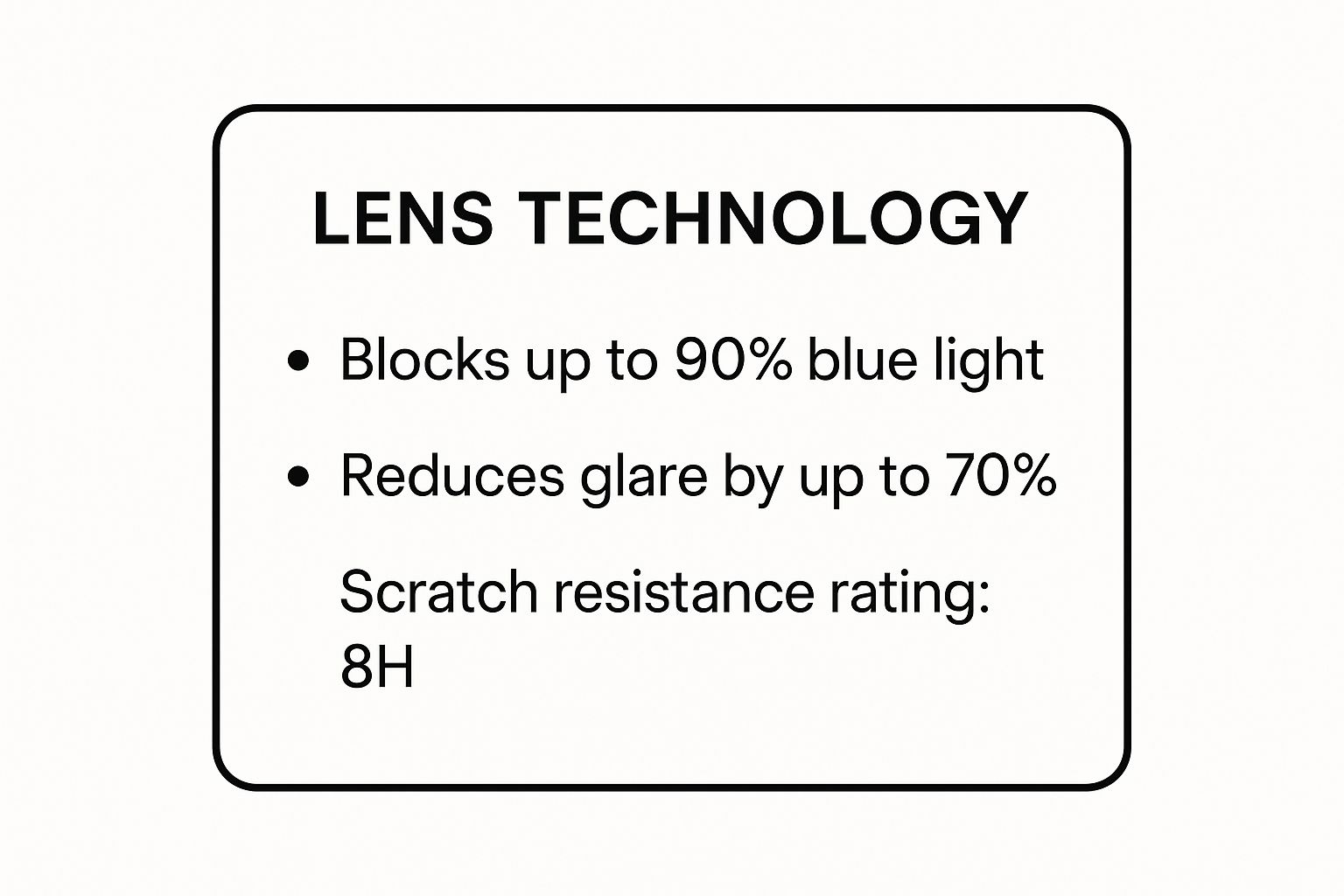
As you can see, the combination of high blue light filtration, glare reduction, and durability creates a much better, and more comfortable, visual experience.
Beyond just eye comfort, the real magic happens on a hormonal level. When you wear orange colored blue light glasses in the evening, you create an artificial sunset for your brain. This sends a powerful signal that the day is over, giving your body the green light to start producing melatonin—the hormone that makes you feel sleepy. This is how orange colored blue light glasses help with sleep. Similarly, amber blue light glasses let you relax and wind down. They create a warm, cozy visual atmosphere that helps calm your nervous system, making the transition from a busy day to a restful evening feel natural.
By filtering out stimulating light, both orange and amber glasses help your mind switch off. This reduces the mental "noise" that often keeps people awake, paving the way for a quicker and deeper sleep.
For the best results, fold your new glasses into a bigger strategy. A holistic approach to sleep hygiene is what truly moves the needle.
To help you put this all together, here’s a simple checklist you can follow each evening. Think of it as a step-by-step guide to telling your body it's time to rest.
| Your Evening Sleep Hygiene Checklist | ||
|---|---|---|
| Time Before Bed | Action Item | Why It Works |
| 2-3 Hours | Finish your last big meal. | Avoids digestive disruption and heartburn that can interfere with sleep. |
| 90 Minutes | Put on your blue light blocking glasses. | Signals your brain to start producing melatonin by blocking stimulating light. |
| 60 Minutes | Turn off bright overhead lights; use dim lamps instead. | Reduces overall light stimulation, creating a calmer, sleep-friendly environment. |
| 30 Minutes | Put away all screens (phone, TV, tablet). | Eliminates the primary source of blue light and mental stimulation. |
| 15 Minutes | Engage in a relaxing activity like reading a book or light stretching. | Helps quiet your mind and release physical tension before getting into bed. |
Following a consistent routine like this night after night can fundamentally change your relationship with sleep. It trains your body and mind for rest, making it easier to fall asleep faster and wake up feeling refreshed.
If it's anxiety and a racing mind keeping you up, pair your glasses with these simple but effective relaxation techniques.
It’s a vicious cycle, isn't it? You’re stressed, so you can’t sleep. Then you’re exhausted from not sleeping, which just cranks your stress levels even higher. The way out of this loop isn't about forcing yourself to relax; it's about creating an environment that tells your brain and body it's safe to power down.
Think of it as building a gentle off-ramp from a busy day to a quiet night. Luckily, there are a few simple, powerful ways to do just that.
Our eyes are taking in a constant stream of high-energy light from all our screens, and that alone can keep our brains buzzing. The first, and maybe easiest, step is to filter out that harsh visual "noise." When you put on a pair of orange or amber-lensed glasses, you’re literally turning down the intensity of your surroundings.
This simple change can have a profound effect on an overstimulated nervous system. By shifting your world to a softer, warmer glow, you give your brain a break, which can help lower cortisol and bring on a feeling of calm. It's a completely effortless way to start winding down.
Once you’ve softened the light around you, it's time to quiet the noise inside your head. Racing thoughts are the number one culprit behind evening anxiety, and a quick mindfulness or breathing exercise can work wonders.
You don't need a fancy app for this. Just find a quiet spot and pay attention to your breath for 10 minutes. A great pattern to start with is the 4-7-8 technique:
Repeating this a few times helps kick your parasympathetic nervous system—your body's "rest and digest" mode—into gear. You'll feel your heart rate slow and those racing thoughts begin to fade.
Stress doesn't just stay in your head. It works its way into your muscles, creating tight spots in your neck, shoulders, and back. Releasing that physical tension is a huge part of getting your body ready for truly restorative sleep.
Take 10-15 minutes for some slow, gentle stretches. Focus on the areas that feel knotted up from the day. Simple moves like neck rolls, shoulder shrugs, or a gentle spinal twist can help release all that stored-up tension, signaling to your body that it’s time to relax.
So often, what keeps us awake is the mental to-do list that won’t stop spinning: all the worries, tasks, and things we can't forget. A "brain dump" is a fantastic way to get all that clutter out of your head before you lie down.
Grab a notebook and just write down everything that's on your mind. Don't worry about organizing it or making it pretty. The idea is to get it all out of your head and onto the paper so it stops circling when you’re trying to sleep.
It's clear people are catching on. As we all deal with more screen time, the demand for tools to manage it is growing. The market for anti-blue light glasses is expected to hit about $2.63 billion in 2025, which shows a massive global shift toward protecting ourselves from digital burnout. You can discover more insights about the anti-blue light glasses market to see the full picture.
By weaving these four practices into your evening, you create a powerful wind-down ritual. Using the best blue light blocking glasses tackles the external stress from your environment, while mindfulness, stretching, and journaling quiet the internal chatter. Together, they give you a complete toolkit to calm your mind, relax your body, and set the stage for a great night's sleep.
As you start looking into blue light blocking glasses for your nightly routine, a few questions always seem to pop up. Getting the specifics straight will help you use them effectively and feel good about your choice.
Let's clear up some of the most common queries.

The deep tint of orange colored blue light glasses is there for a reason—it’s engineered for maximum effect. By blocking nearly all the stimulating blue and green light from screens, these lenses give your brain the all-clear to start producing melatonin. This is how orange colored blue light glasses help with sleep, allowing you to fall asleep faster and get more restorative rest.
At the same time, this powerful filtering cuts down on the harsh visual "noise" from devices. This is how orange colored blue light glasses help with eye strain. Your eye muscles finally get a chance to relax, easing the fatigue, headaches, and dryness that so often come with long hours in front of a screen.
Amber blue light glasses let you relax and wind down by offering a softer approach for your evening. They filter out a significant amount of blue light but still allow for better color perception than their deeper orange cousins. The result is a warm, cozy visual atmosphere that helps your nervous system settle down.
Think of amber lenses as a tool for gently transitioning from a busy day to a calm evening. They're perfect for watching a movie or reading on a tablet, helping you relax without the full-on "sleep mode" intensity of orange lenses. You can learn more about how our glasses work and find additional tips for better sleep in our detailed guide.
When you integrate blue light glasses into a solid sleep hygiene routine, you really amplify their benefits. A few key habits can make a huge difference.
If anxiety is what's keeping you up at night, pairing your glasses with a few simple relaxation techniques can work wonders to quiet a racing mind.
At Element Lux, we're all about providing high-quality blue light blocking glasses that genuinely improve your sleep and reduce eye strain. Our glasses are designed to be a simple, effective tool for anyone looking to make their evenings more relaxing and boost their overall health.
Discover the perfect pair for your nightly routine and start your journey to better sleep.
If you're looking for better sleep and a way to combat that tired, gritty-eyed feeling after a long day on the computer, you'll want to focus on blue light glasses with amber or orange lenses. These are designed specifically for evening use, and they're incredibly effective at filtering out the exact type of light from screens that messes with our sleep and causes eye strain.
Before we get into picking the right pair, let's quickly break down what blue light actually is. Think of the light you see as a rainbow, with colors from red all the way to violet. Blue light is at the high-energy, more intense end of that spectrum, packing a much bigger punch than warmer colors like yellow or orange.
This high-energy light is all around us in nature—the sun is our biggest source, by far. It's not inherently bad; in fact, it plays a vital role in setting our internal body clock, what scientists call our circadian rhythm. During the day, sunlight hits our eyes and tells our brain it's time to be awake, alert, and productive. It’s nature’s alarm clock.
The problem is, our modern lives have us staring at artificial sources of blue light long after the sun has set. Our phones, laptops, and TVs are constantly blasting out these high-energy waves, essentially sending a non-stop "it's daytime!" signal to our brains, even late at night.
This constant exposure throws our natural cycles out of whack in two major ways. First, it slams the brakes on melatonin production, the hormone that signals to your body that it's time to wind down and sleep. It's like trying to fall asleep in a bright room with someone flicking the lights on and off—your brain just stays wired.
Second, the intense, flickering light from screens leads directly to digital eye strain. If you've ever experienced these symptoms, you know what I'm talking about:
Our bodies simply aren't built to handle this much bright, blue-rich light after dark. This fundamental mismatch between our ancient biology and modern technology is why managing your light exposure has become so important for overall wellness. For a deeper dive, you can explore the articles in our online resources.
Once you grasp this conflict, it becomes clear why filtering blue light isn't just a gimmick for comfort—it's about helping your body get back to its natural, healthy rhythm.
When it comes to protecting your eyes at night, not all blue light glasses are created equal. If you're looking for serious protection, orange-colored lenses are the heavyweights. They're specifically engineered to filter out the most disruptive wavelengths of light, bringing immediate relief from eye strain and setting you up for a great night's sleep.
This powerful filtration is a game-changer for digital eye strain. By cutting down the harsh glare and flickering from screens, orange lenses allow your eye muscles to finally relax. The high-energy blue light that forces you to squint and strain is significantly reduced, which can alleviate the tired, blurry, or dry feeling you get after hours in front of a computer. It’s a feeling of visual comfort you'll notice right away.
But the real magic happens when it's time for bed. The primary benefit of orange-colored glasses is their ability to protect your body’s natural sleep cycle. By blocking nearly all blue and green light from reaching your eyes for just 1-2 hours before bed, you send an undeniable signal to your brain to start producing melatonin. This is the essential hormone that governs your sleep-wake cycle, and wearing these glasses helps your body produce it on schedule, making it easier to fall asleep and stay asleep.
While orange lenses offer the ultimate nighttime protection, their slightly lighter amber counterparts are perfect for helping you relax and wind down. Think of them as creating a "digital sunset." They block enough blue light to safeguard your melatonin and ease eye strain but let more color through, which is ideal for watching a movie or browsing online without a major color shift.
Amber lenses create a gentle transition, easing your mind from an alert, daytime state into a calm, pre-sleep mode, making them a fantastic tool for your evening relaxation ritual.
By filtering the specific light that keeps you feeling "wired and tired," blue light glasses help your body and mind relax naturally. This makes them a crucial tool for anyone looking to improve their evening routine and get more restorative rest.
It's clear people are catching on. The global market for blue light blocking glasses was valued at USD 35.26 million in 2025 and is expected to hit USD 65.61 million by 2034. This boom is fueled by professionals, students, and gamers all looking for relief from spending so much time in front of screens.
Adding blue light glasses to your routine is a cornerstone of better sleep and relaxation, but it works best when combined with other healthy habits.
Top Ways to Get Good Sleep:
Top 4 Ways to Relax and Reduce Anxiety:
Ready to see the difference for yourself? You can explore a collection of effective amber and orange lenses in the Element Lux shop.
While the heavy-duty orange lenses are fantastic for maximum nighttime protection, they aren't always what you need. Sometimes, a softer touch is better, especially for casual evening activities. This is where amber-lensed glasses really shine as the perfect choice for winding down.
Amber lenses hit a sweet spot. They block a serious amount of sleep-disrupting blue light but still let more color through than their darker orange cousins. That subtle difference makes them ideal for watching a movie or browsing your favorite sites, where seeing colors as they're meant to be seen just makes the experience better.
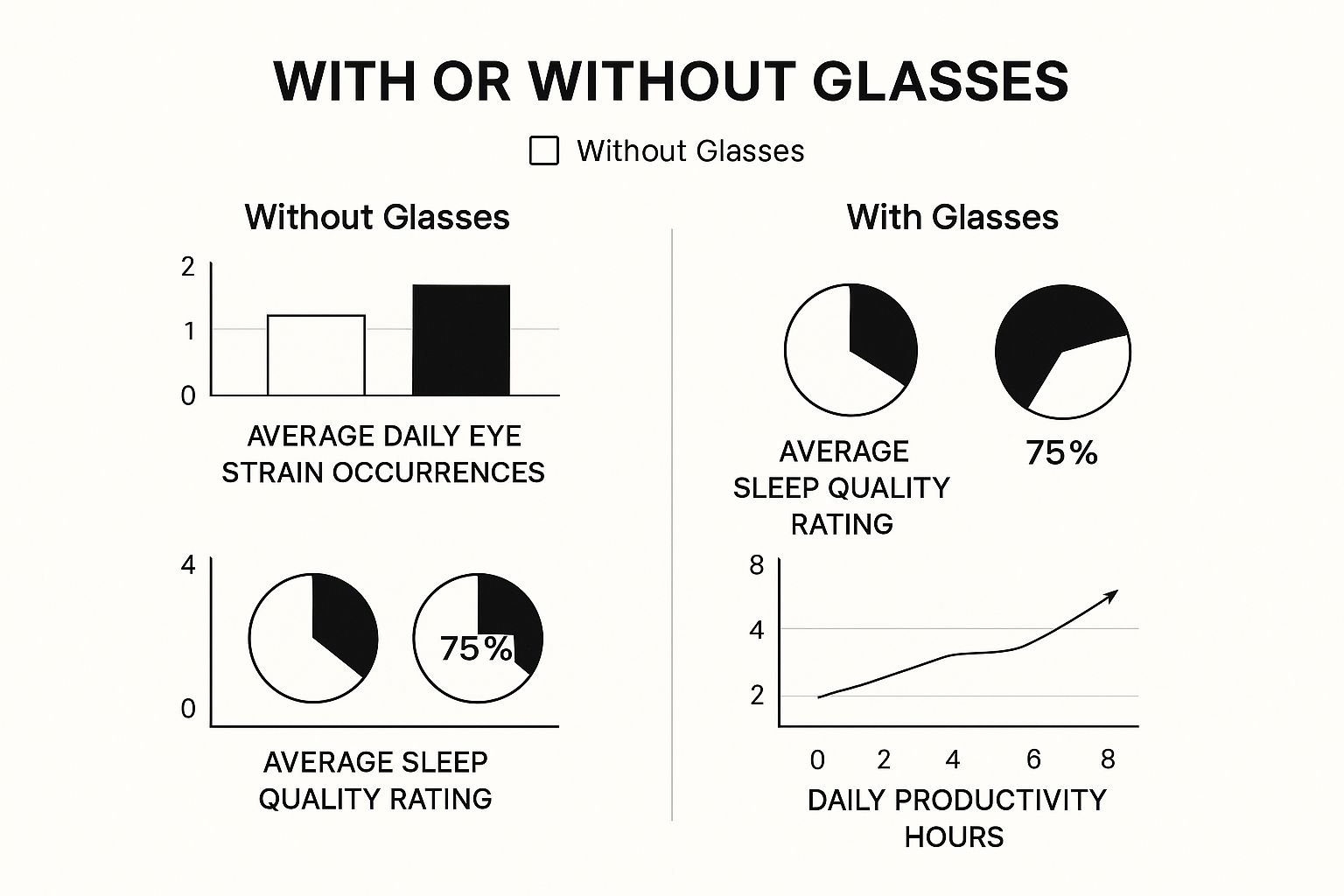
Think of amber glasses as creating a "digital sunset" for your eyes. They gently filter out the harsh, stimulating light from your screens, helping your brain ease from an alert, daytime state into a calm, pre-sleep mode without completely changing your vision. This makes them an excellent tool for anyone looking to relax and de-stress at the end of the day.
The infographic below shows the huge difference in daily eye strain, sleep quality, and even productivity between people who use blue light glasses and those who don't.
As you can see, consistently wearing the right lenses can lead to a real drop in eye strain and a major boost in how well-rested people feel.
So, how do you choose between the two main players in nighttime blue light protection? This table breaks down the key differences to help you decide which tint is right for your evening routine.
| Feature | Orange Lenses | Amber Lenses |
|---|---|---|
| Blue Light Blocking | Maximum (99%+) | High (90-98%) |
| Color Distortion | High (world looks orange) | Moderate (warms colors) |
| Best For | Pre-sleep wind-down, reading, combating insomnia | Watching TV, casual browsing, gaming |
| Ideal Time to Wear | 1-2 hours before bed | 2-3 hours before bed |
Ultimately, both are great tools. Orange is your go-to for serious sleep preparation, while amber offers a more versatile, relaxed experience for general evening screen time.
Making amber lenses part of your nightly routine is a huge first step, but you can get even more out of them by pairing them with other relaxation strategies. When you combine them, you send a powerful signal to your body that it's officially time to rest.
By filtering the specific wavelengths that keep your mind buzzing, amber glasses help your body and mind relax naturally. This makes them a vital tool for anyone looking to improve their evening routine and get more restorative rest.
Here are a few simple ways to build a powerful relaxation ritual:
Finding a great pair of blue light glasses is a fantastic first step, but they really shine when they're part of a bigger sleep strategy. Think of them as a key player on a team dedicated to getting you deep, restorative rest. When you combine them with other proven habits, you create a powerful routine that signals to your body it’s time to power down for the night.
The market for these glasses is exploding, which tells you just how many people are looking for better sleep solutions. Market data projects the global anti-blue light glasses industry will grow to USD 1,839.55 million in 2025, with a forecast CAGR of 7.90%. North America is leading the charge, holding about 37.85% of the market—a share driven by our growing health awareness and near-constant use of digital devices. You can learn more about the anti-blue light glasses market growth here.
Improving your sleep routine doesn't have to be complicated. By focusing on a few core habits, you can dramatically boost your sleep quality and start waking up refreshed. Here are the most effective strategies to try tonight.
Wear Blue Light Blocking Glasses: This is your first line of defense against nighttime light. Pop on your amber or orange glasses 1-2 hours before bed to block the specific wavelengths that crush melatonin production. It's the clearest signal you can send your brain that it's nighttime.
Create a Sleep Sanctuary: Your bedroom should be a haven for rest, not a multi-purpose room. Keep it cool, pitch-black, and quiet to minimize disruptions and create the perfect environment for deep sleep.
Stick to a Consistent Schedule: This one is a game-changer. Try to go to bed and wake up around the same time every single day—yep, even on weekends. That consistency is what trains your body's internal clock, or circadian rhythm.
Watch What You Consume: Be mindful of stimulants like caffeine or nicotine, especially in the afternoon and evening. It’s also smart to skip heavy meals or too much alcohol right before bed, as both can seriously mess with your sleep quality.
Here are four ways you can start dialing down evening stress and anxiety.
We all know the feeling. Staring at screens late into the night, followed by restless sleep and a lingering sense of stress. That constant blast of bright blue light can leave you feeling "wired and tired"—your body is exhausted, but your brain just won't shut off. The good news is that with a few simple evening habits, you can calm your mind and body, setting the stage for truly restorative sleep.
It all starts with managing your light exposure. Think of it as the foundation of a calming evening routine. When you wear the best blue light glasses—the ones with orange or amber lenses—you effectively lower the physiological "alarm" that screens trigger in your brain. It's a clear signal that it's time to unwind.
This isn't just a niche idea anymore; people are catching on. The global market for anti-blue light glasses is expected to jump from USD 1.43 billion in 2023 to a whopping USD 3.57 billion by 2030. Why? Because more and more of us are looking for real solutions to the eye strain and sleep problems caused by our devices. You can read more about the global trends in anti-blue light glasses to see how big this shift is.
Simply putting on your glasses is a great start, but pairing them with other calming activities sends an even stronger signal to your body to de-stress. Here are four effective strategies to work into your evening.
Wear Blue Light Blocking Glasses
This is your most powerful first step. By putting on a quality pair 1-2 hours before bed, you're shielding your melatonin production from the disruptive effects of screens. This makes it far easier to actually feel calm and ready for sleep.
Practice Gentle Movement or Mindfulness
This doesn't mean you need an intense workout. We're talking about a short, gentle walk, a few simple stretches, or just five minutes of deep breathing. The goal is to release physical tension and quiet down a busy mind.
Journal to Offload Mental Clutter
If your thoughts are racing, get them out of your head and onto paper. Spending a few minutes writing about your day or jotting down tomorrow's to-do list can create a sense of closure and mental peace.
Set Firm Digital Boundaries
This one takes discipline, but it's a game-changer. Make a conscious choice to disconnect from stressful content. Close the work laptop. Stop the endless news scroll. Put your phone away an hour before you plan to sleep.
By combining these simple yet effective habits, you create a holistic approach to managing evening anxiety. Wearing blue light glasses becomes the cornerstone of a routine that supports both your mental and physical well-being.
As you start looking for the right pair of blue light glasses, a few questions are bound to pop up. Let's tackle some of the most common ones so you can feel confident you're making the best choice for your eyes and your sleep.
Lots of people ask how a simple pair of colored lenses—especially orange ones—can have such a big impact. It’s pretty simple, actually. When you put on a pair of orange-colored blue light glasses, they filter out the most intense, high-energy light blasting from your screens. This instantly cuts down on glare and boosts the contrast, letting your eye muscles finally relax. That digital eye strain—the dryness, the blurriness, the headaches—starts to fade away.
When it comes to sleep, the effect is even more profound. By blocking the specific blue wavelengths that shut down your body's melatonin production, orange-colored glasses send a powerful signal to your brain: it's nighttime. Your body gets the hint and starts producing the hormones you need for a deep, restorative night's rest. Amber lenses do a great job here too, being perfect for winding down with a movie or some casual scrolling.
Think of wearing the right blue light glasses in the evening as more than just an eye comfort trick. It's a core part of a healthy sleep routine that works with your body's natural rhythm, not against it.
While glasses are a fantastic tool, they're most effective when you pair them with other smart sleep habits.
We all know that anxiety and a racing mind are sleep's worst enemies. A calming evening ritual can make all the difference.
By putting these simple practices into place, you're building a powerful routine for both your mind and body. If you want to take a deeper dive, you can learn more about how our glasses help with sleep on our blog.
Ready to feel the difference for yourself? Element Lux offers high-quality amber and orange lenses designed to crush eye strain and help you get the rest you deserve. Find your perfect pair today and take back your evenings.
