Ever feel like your body is on a completely different time zone than the rest of the world? That frustrating, out-of-sync feeling is at the heart of what’s known as a circadian rhythm disorder.
The most obvious signs are trouble falling asleep at a "normal" time, waking up way too early, or fighting a deep, persistent fatigue during the day that’s far more than just being tired.
Think of your body as having an internal master clock. This clock, your circadian rhythm, is like a conductor for an orchestra, making sure everything from your sleep-wake cycle to your hormones and digestion runs on a synchronized schedule. It’s what makes you feel naturally alert in the morning and sleepy at night.
A circadian rhythm disorder happens when that internal conductor loses the beat. Suddenly, your body’s clock is in direct conflict with the 24-hour day everyone else is living on. This isn't just a few rough nights of sleep; it's a constant, disruptive pattern that can seriously get in the way of your life.
This isn't a rare problem, either. Circadian rhythm sleep disorders (CRSD) are surprisingly common. In the United States, for instance, delayed sleep phase disorder—just one type of CRSD—affects anywhere from 7% to 16% of adolescents. As chronic health issues and our population's average age increase, experts expect to see these numbers climb. You can explore more data on sleep disorder trends to see the bigger picture.
So, how do you know if you're dealing with a bad week of sleep or something more? A few nights of tossing and turning due to stress is one thing. But a consistent inability to line up your sleep schedule with your daily responsibilities usually points to a deeper issue.
Here’s a quick rundown of what a true circadian rhythm disorder looks like:
This is why daytime fatigue is one of the biggest complaints. It’s a classic sign that something is fundamentally off with your internal clock.
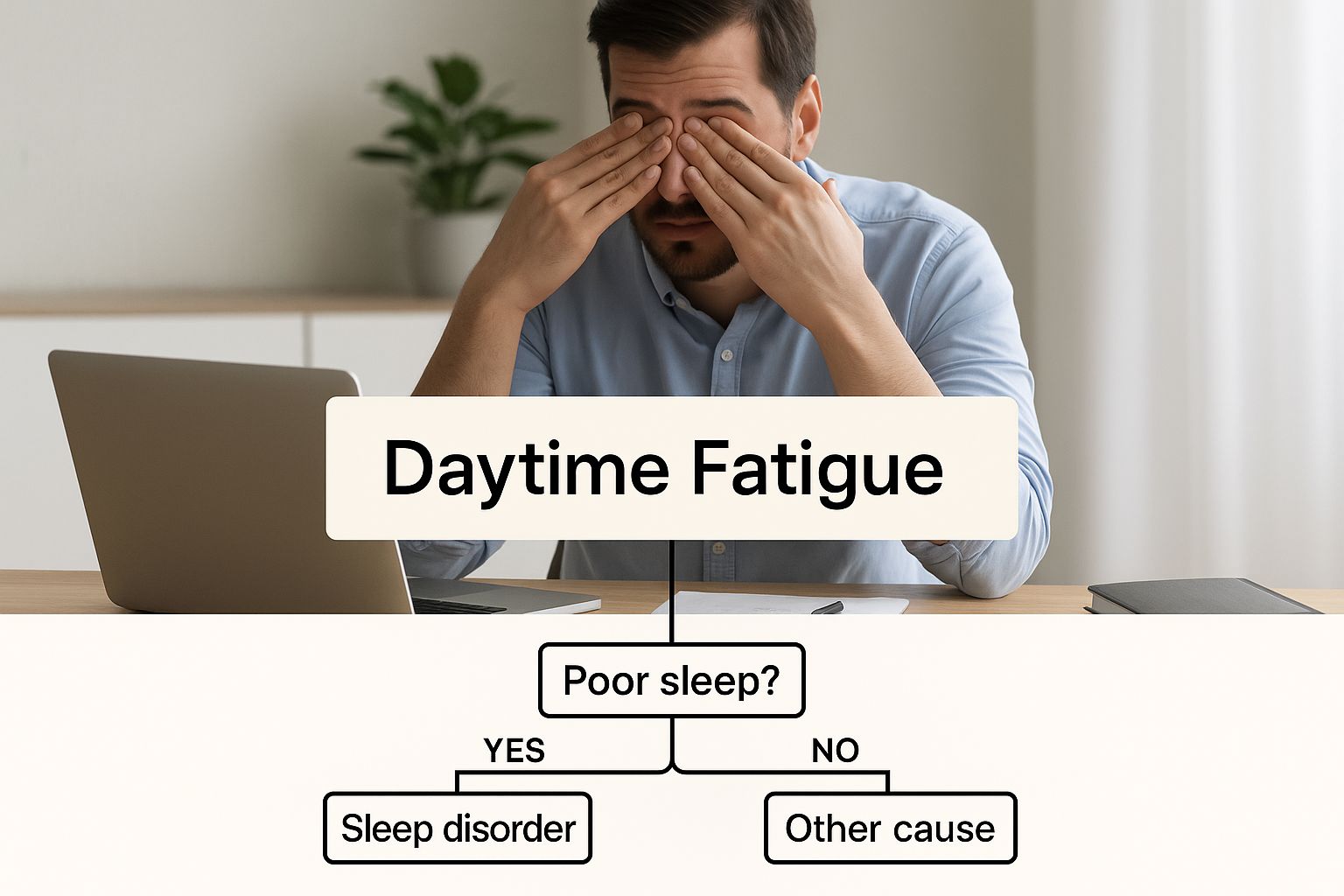
As the image shows, the struggle doesn't end when the sun comes up. A misaligned body clock turns a nightly problem into a daily battle against exhaustion.
To help clarify, here’s a simple breakdown of how to tell the difference between a normal sleep problem and a potential disorder.
| Symptom | Typical Bad Night's Sleep | Potential Circadian Rhythm Disorder |
|---|---|---|
| Trouble Falling Asleep | Occasional difficulty due to stress, caffeine, or a late movie. | A consistent pattern of not feeling tired until hours after your desired bedtime (e.g., 2 AM or later). |
| Waking Up Too Early | Waking up early once in a while, often able to go back to sleep. | Regularly waking up much earlier than planned (e.g., 4 AM) and being unable to fall back asleep. |
| Daytime Fatigue | Feeling tired the next day but recovering after a good night's rest. | Chronic, heavy exhaustion and brain fog that persist daily, even if you technically got enough hours of sleep. |
| Schedule Impact | You can adjust your sleep schedule back to normal within a day or two. | You feel a constant, biological pull to sleep and wake at "off" hours, regardless of your schedule. |
Spotting these persistent patterns is the first step. While a bad week of sleep is frustrating, recognizing the signs of a true disorder means you can start looking for real, effective solutions.
Knowing the symptoms of a circadian rhythm disorder is the first step, but understanding what’s causing them is where the real solution lies. More often than not, the culprits are hiding in plain sight, woven into our daily routines. Modern life, with its constant demands and glowing screens, has a knack for putting us at odds with our own internal clocks.
One of the biggest disruptors? Artificial blue light. When you’re staring at your phone, tablet, or computer late into the evening, that bright, blue-toned light is sending a powerful message to your brain: "It's still daytime!" This sneaky signal suppresses the production of melatonin—the hormone that tells your body it's time to sleep—making it incredibly difficult to wind down.
While late-night screen time is a major offender, it’s certainly not the only thing that can throw your internal clock for a loop. Several other lifestyle and environmental factors can lead to those persistent circadian rhythm disorder symptoms.
At the end of the day, all these factors create a mismatch between our biology and our environment. Getting a handle on how they work—especially the pervasive issue of blue light—is essential. If you want to dive deeper, feel free to explore our blue light blog for more insights.
By pinpointing the specific culprits in your own life, you can start taking targeted steps to get your sleep cycle back on track.
When your internal clock is off-kilter, the fallout goes way beyond just feeling sleepy. Think of a chaotic sleep schedule as a stress multiplier—it directly messes with your mental and emotional stability. This kicks off a nasty cycle: poor sleep tanks your mood, and a low mood makes getting good sleep feel impossible.
This link between your body clock and your mental health isn't just in your head; it's deeply biological. The brain chemicals that keep your mood steady, like serotonin, are produced on a strict daily schedule. When that rhythm gets thrown off, your brain’s entire chemical balance can go haywire, leaving you irritable, emotionally fragile, and struggling to cope with everyday stress.
This connection is so strong that researchers now see circadian rhythm disruption as a major contributor to mental health conditions like major depressive disorder (MDD). It's a huge issue, with estimates suggesting that about 20% of people worldwide deal with mood or anxiety disorders tied to the circadian disruptions of modern life. In fact, recent studies are showing that a wonky internal clock can even be used as a reliable digital marker to flag when someone might need psychiatric help. You can read the full research on circadian disruption and mood to see how deep this connection goes.
So, what does this all mean? It means your emotional struggles aren't happening in a vacuum. They are fundamentally intertwined with your body's most basic internal rhythms.
Understanding and accepting this connection is the first real step toward finding solutions that tackle both your sleep and your mental health at the same time. You’re not just tired—your entire system is sending a clear signal that it needs to get back in sync.
One of the most powerful ways to manage your circadian rhythm is to control your light exposure, especially after the sun goes down. This is where specialized, light-filtering lenses come into play. Think of them as creating a personal sunset, sending a clear signal to your brain that it’s time to wind down—even when you’re surrounded by bright artificial lights from screens and bulbs.
By strategically blocking specific wavelengths of light, these glasses protect your body's natural production of melatonin. That’s the crucial hormone that tells your body it's time to sleep. It’s like putting up a shield against the very light that keeps you feeling wired and awake long after you should be resting.
When you need serious help getting your sleep cycle back on track, orange-colored lenses are the heavy hitters. They’re designed to filter out the most disruptive, high-energy blue and green light wavelengths that wreak havoc on your internal clock. By blocking this harsh light, they combat digital eye strain, reducing the gritty, tired feeling and headaches associated with screen time. The moment you put them on, you’re essentially telling your brain the day is over. This allows your melatonin levels to rise naturally, making it much easier to fall asleep and achieve deep, restorative rest.
Here's an example of our Element Lux orange glasses, designed for maximum light filtering.
As you can see, that distinct orange tint is what does the hard work, transforming a bright, stimulating screen into a warm, sleep-friendly light source.
While orange lenses are your go-to for serious sleep preparation, amber-colored blue light glasses offer a gentler approach, letting you relax and wind down. They're perfect for those earlier evening hours when you want to de-stress. These lenses filter a smaller portion of blue light, creating a warm, cozy light environment that takes the edge off stimulating artificial lights. Popping on a pair of amber glasses after work can make the transition from a busy, high-alert day to a calm, restful evening feel much smoother, allowing both your mind and body to begin relaxing.
You can learn more about how our glasses help with sleep and figure out which lens is the right fit for your nightly routine.
By blocking the specific light frequencies that suppress melatonin, blue light blocking glasses can be a simple yet effective way to realign your sleep cycle with your desired schedule, directly combating common circadian rhythm disorder symptoms.
Not sure whether to go with orange or amber? It really comes down to what you're doing in the evening and how sensitive you are to light. This table breaks it down to help you decide.
| Lens Color | Primary Benefit | Best For |
|---|---|---|
| Orange | Maximum Melatonin Protection & Sleep Induction | Wearing 1-2 hours before bed, especially if you have significant sleep issues or are using screens late at night. |
| Amber | Relaxation & Reduced Eye Strain | Winding down after work, reading, or watching TV in the early evening to create a calm, stress-free environment. |
Ultimately, many people find having both pairs useful—amber for general evening relaxation and orange for the final pre-sleep stretch.
Alright, you understand the symptoms and what might be causing your internal clock to go haywire. That's the first big step. Now, let's talk about how to actually reclaim your nights and feel human again during the day.
This isn't about some massive life overhaul. It's about making small, smart changes to your routines—for both your mind and your body—that add up to a huge difference. Think of it as actively steering your internal clock back on track.
The right tools can make this whole process much easier. One of the single most powerful things you can do is manage the light you see in the evening. This is where specialized blue light blocking glasses come in. They send the right signals to your brain, prepping it for sleep long before your head hits the pillow.
A great pair of glasses is even more effective when you pair them with solid, healthy habits. Here are the top ways to improve your sleep quality and get your internal clock back in sync:
Here’s an example of our Element Lux amber glasses, which are designed to create that calming visual environment.
The warm tint of these lenses cuts the harsh glare from artificial lights, helping to ease that feeling of being "on edge" and preparing your mind for a peaceful night.
By creating a shield against disruptive artificial light, blue light blocking glasses become a key part of a holistic strategy to manage circadian rhythm disorder symptoms and improve overall well-being.
Stress and anxiety are absolute sleep-killers. If you can quiet your racing mind in the evening, you’ll find it so much easier to fall asleep.
When you start digging into the world of circadian rhythm disorders, a lot of practical questions pop up. Let's tackle some of the most common ones to give you a clear path forward for feeling and sleeping better.
If you've ever felt that gritty, headache-inducing eye strain after a long day in front of a computer, you know the feeling. Orange-colored blue light glasses are fantastic for combating exactly that. They work by filtering out the specific, high-energy blue light wavelengths that blast out of our screens.
This intense light is a major culprit behind visual fatigue, dryness, and tension headaches. By blocking a huge chunk of it, orange lenses create a much softer, warmer visual experience. It instantly makes evening screen time more comfortable and puts way less stress on your eyes.
Beyond just eye comfort, orange-colored blue light glasses are a game-changer for your sleep. When your eyes take in blue light at night, it essentially tricks your brain into thinking it's still high noon. This confusion shuts down your body's production of melatonin—the critical hormone that tells you it's time to sleep.
Orange lenses act like a shield, blocking those disruptive signals. This allows your melatonin levels to rise naturally as the evening goes on, just as they should. Try wearing them for 90 minutes to two hours before bed. You’ll be amazed at how it can help you fall asleep faster and get the kind of deep, restorative rest your body is craving.
Think of amber blue light glasses as your "winding down" tool. They let you relax and unwind by filtering a good amount of blue light, making them less intense than orange lenses. This makes them perfect for easing into a calm, relaxed state in the early evening.
The warm, gentle light they create helps your nervous system shift gears from a state of high alert to one of tranquility. Pop on a pair of amber lenses to help you transition from a hectic day to a peaceful night, letting you de-stress and prepare your mind for sleep.
The bottom line is this: managing your light exposure in the evening is one of the most powerful things you can do to support a healthy circadian rhythm. When you use the right tools, you can give your brain the clear signal it needs to rest.
Great sleep isn't about one magic bullet; it's about building a consistent, supportive routine. And if you want to dive deeper, you can always explore the topics in our Element Lux resources library.
Here are the essentials:
