Yes, there's a definite link between blue light and headaches, and it almost always comes down to digital eye strain. When you stare at a screen for hours, the high-energy visible (HEV) light forces your eyes to work overtime, leading to fatigue, tension, and that all-too-familiar head pain.
Ever wrapped up a long day at the computer with a throbbing headache? You’re not alone. The digital devices we depend on are often the direct cause of that discomfort, and the real culprit is the specific kind of light they pump out.
This high-energy light, what we call blue light, acts like a constant, low-level stressor on your eyes. Imagine a persistent, quiet hum in the background—you might be able to ignore it for a bit, but eventually, its non-stop presence starts to cause real irritation and fatigue.
After hours of exposure, this relentless stimulation triggers a condition known as digital eye strain. This isn't just about feeling tired; it’s a cluster of physical symptoms that are a direct pipeline to head pain.
The connection between screen time and head pain isn't just a hunch—it's well-documented. One study looking into our screen habits found a powerful link between long-term blue light exposure and how often people get headaches.
A huge number of participants, many of whom were clocking 7–9 hours on screens every day, reported a significant increase in both tension-type and migraine headaches. It's a clear reminder of how our daily digital routines can directly mess with our physical well-being. You can learn more about the study's findings on blue light and headaches to see the data for yourself.
But this constant exposure does more than just wear out your eyes. It also keeps your brain on high alert. The intensity of blue light is a powerful signal to your mind that it’s daytime, which makes it incredibly difficult to relax and properly wind down, even long after you’ve shut off your devices.
So, how do you know if your headaches are the direct result of too much screen time? The signs of digital eye strain tend to build up slowly over the day. If you notice a pattern, blue light is likely the cause.
Here are the most common signs that your headaches are tied to screen use.
| Symptom | Description |
|---|---|
| Dull Ache Behind the Eyes | A nagging, persistent pressure that feels like it’s building up right behind your eye sockets. |
| Sensitivity to Light | You might find that normal indoor lighting suddenly feels overwhelmingly bright or harsh after hours on a screen. |
| Blurred Vision | Your focus gets fuzzy, especially when you try to look away from your screen at objects in the distance. |
| Tension Headaches | This classic symptom feels like a tight band is being squeezed around your forehead, a direct result of strained eye and facial muscles. |
Recognizing these symptoms is the crucial first step. Once you identify blue light as the trigger, you can start looking for real solutions—like blue light blocking glasses, which are specifically designed to filter out this aggressive light and bring some much-needed relief.
To really get why blue light and headaches are so connected, we have to look at how our eyes and brain uniquely process this one part of the light spectrum. Unlike other colors, blue light has a shorter wavelength and packs more energy, which is particularly harsh for the sensitive network of nerves in our eyes.
Think of it like a sound that's just a bit too high-pitched. You can hear other noises just fine, but that one specific frequency is grating and can even become painful after a while. Blue light works the same way on a special set of light-sensitive cells in our retinas.
These cells are called intrinsically photosensitive retinal ganglion cells (ipRGCs). Their main job isn't to help you see, but to talk directly to the parts of your brain that manage pain and emotion. When these cells get blasted with high-energy blue light from our screens, they go into overdrive.
This overstimulation kicks off a cascade of distress signals that travel from your eyes straight to your brain. These signals race along the trigeminal nerve, a major neural highway that’s famous for its role in triggering migraine pain.
When this nerve gets agitated by the constant stream of blue light signals, it can lead to that awful throbbing pain and intense pressure we know as a severe headache or migraine.
This direct line of communication is also why so many of us experience photophobia, or extreme light sensitivity, during a headache. Your brain is already on high alert, and any more light—especially blue light—just cranks up the volume on those pain signals, making everything feel so much worse.
This diagram shows just how simple but powerful that connection is.
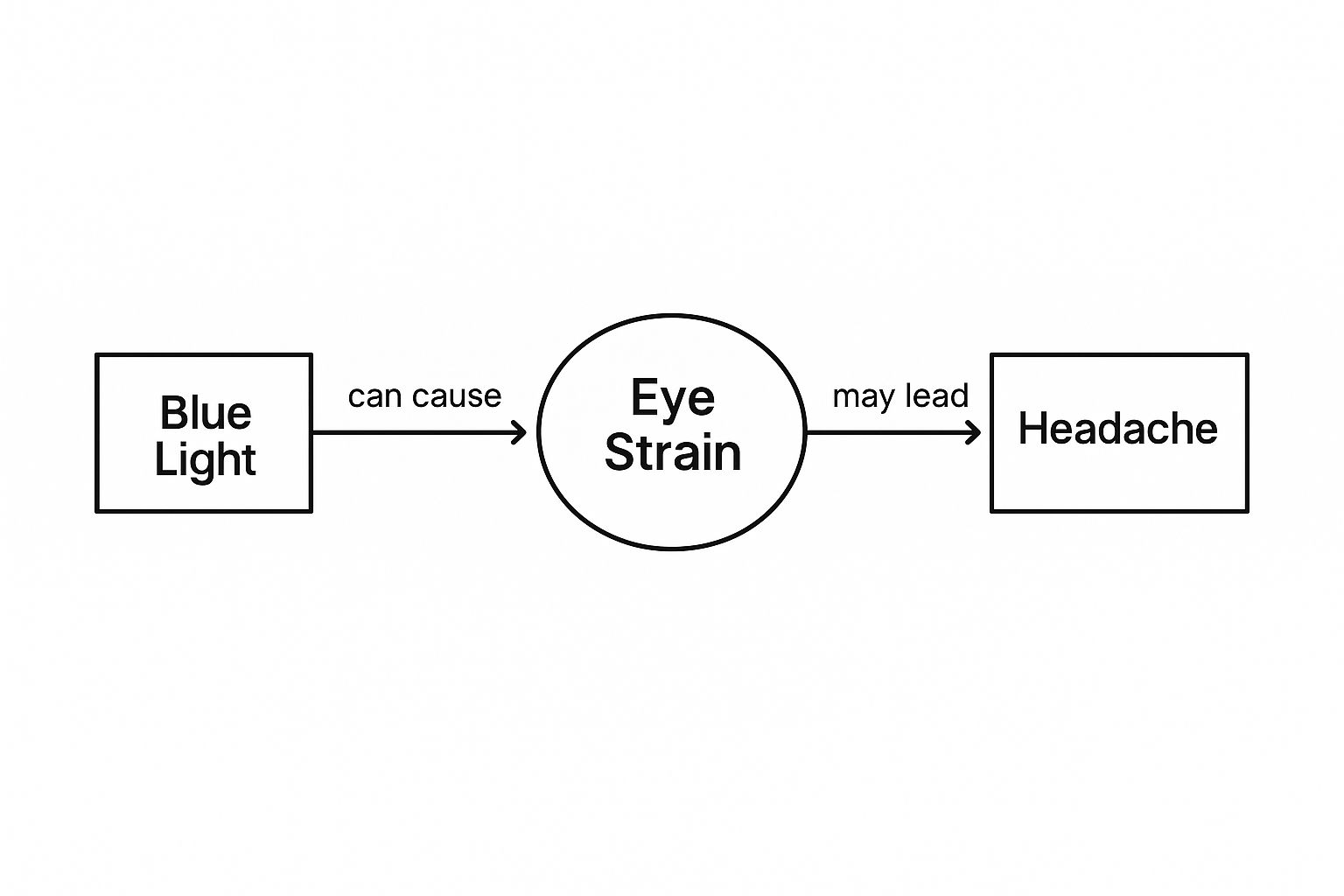
As you can see, the path is pretty direct: persistent blue light exposure causes eye strain, which then acts as a direct trigger for headaches.
If you suffer from migraines, this whole process is dialed up to eleven. Research has shown that the brains of migraineurs are uniquely hypersensitive to blue light.
It’s a huge issue, considering migraines affect nearly 15% of the population worldwide, and over 80% of attacks come with severe light sensitivity. Groundbreaking studies from Harvard Medical School found that blue light consistently makes headache pain worse for migraine sufferers. This response is so deeply ingrained that it even happens in blind patients who can’t consciously "see" the light but whose neural pathways still react to it. It just goes to show how hardwired this trigger is in our nervous system.
Key Takeaway: Blue light doesn't just make your eyes feel tired; it actively fires up pain-sensitive nerve cells in your brain. That’s why managing your exposure isn’t just about comfort—it's a critical strategy for preventing headaches.
Cutting down your exposure to these specific wavelengths can help calm this overactive pathway. You can learn more about managing your screen time and its effects by exploring our comprehensive blue light blog. By filtering out the most aggressive light, you give your brain and your nerves a much-needed break, which can dramatically reduce how often and how intensely you experience screen-related headaches.
Ever get that feeling after a long day of screen time? Your mind is buzzing, you feel wired but tired, and actually winding down seems impossible. This is where amber and orange-lensed blue light glasses come into play. They aren't just for daytime use; they're a powerful tool for tackling digital fatigue and stress.
Think of them as creating an "artificial sunset" for your brain. Unlike the clear lenses you might wear during the day, these darker, warmer tints are specifically designed to filter out the most disruptive wavelengths of blue light. Putting on a pair sends a clear signal to your body: the day is ending, and it's time to calm down.
Staring at bright screens forces the tiny muscles in your eyes to work overtime, leading to that all-too-familiar feeling of fatigue, tension, and even headaches. Orange-colored glasses drastically reduce this workload.
By cutting out the harsh, high-energy blue light, they let your eye muscles relax and soften the digital glare. This physical relief sends a ripple effect to your brain. When your eyes aren't constantly sending stress signals, the mental fatigue that builds up from hours of focused screen time starts to melt away.
By blocking the most aggressive light, orange-lensed glasses help your mind transition from a state of high alert to one of calm. This makes it easier to de-stress and prepare for restorative rest, which is crucial for preventing blue light and headaches.
This is where amber and orange lenses really shine, especially in the evening. They are specifically designed to block the exact wavelengths of blue light known to suppress melatonin—the hormone that makes you feel sleepy. The warm tint of amber lenses helps create a calming visual environment, letting you relax and wind down naturally after a long day.
When you wear them for an hour or two before bed, you're essentially protecting your body's natural sleep cycle from your devices. Your brain can start producing melatonin on schedule, helping you not only fall asleep faster but also achieve a deeper, more restorative sleep. And when you sleep well, your brain has the time it needs to recover, making it far less likely you'll wake up with a headache.
If you're looking for glasses designed for this purpose, you can explore the options at Element Lux.
Pairing your blue light glasses with a solid evening routine is the best way to set yourself up for success. Think of it as creating a complete "wind-down" ritual.
Top Ways to Get Good Sleep:
Top 4 Ways to Reduce Stress or Anxiety and Relax:
Ever wondered why a late night doomscrolling often leads to a pounding headache the next morning? It’s not your imagination. The connection starts with how the blue light from our screens throws your body's internal clock, or circadian rhythm, completely out of whack.
Think of your body's rhythm like a well-rehearsed orchestra. Blue light is the one loud, off-key instrument that ruins the whole performance.
When you’re staring at a screen after dark, that blast of high-energy light tells your brain it's still daytime. This mix-up causes it to hit the brakes on producing melatonin, the crucial hormone that signals it's time to wind down. Without that "go to sleep" message, you're left tossing and turning, and any sleep you do manage is often shallow and unsatisfying.
This is where the blue light and headaches link becomes crystal clear. Poor sleep makes you far more sensitive to pain, leaving you vulnerable to tension headaches and even triggering migraines the following day. It's a vicious cycle: you get bad sleep, which makes the effects of blue light feel even worse.
This is where a good pair of orange-colored blue light glasses, like ours at Element Lux, can be a game-changer. They act as a shield, specifically filtering out the exact blue and green light wavelengths that stop your body from making melatonin. Orange colored blue light glasses help with sleep by protecting your natural melatonin production, allowing you to fall asleep faster and achieve deeper, more restorative rest.
Slipping them on in the evening is like drawing the curtains on the digital world. It allows your brain to finally get the message that the day is over and start preparing for rest.
Artificial light, especially the intense blue light in the 380-500 nm range pouring from our screens, is a known migraine trigger. Its high energy doesn't just mess with your sleep; it can directly activate the neural pathways that cause headache pain. When your sleep-wake cycle is already disrupted, you're that much more susceptible.
By blocking these disruptive wavelengths, orange-lensed glasses allow your body to produce melatonin naturally and on schedule. The result? You don't just fall asleep faster—the quality and depth of your sleep improve dramatically. To see the science in action, you can learn more about how our glasses help with sleep right here.
Making orange-lensed glasses part of a solid evening routine can completely transform your nights. Here are a few simple but powerful habits to reclaim your rest.
Top Ways to Get Good Sleep:
Top 4 Ways to Reduce Stress or Anxiety and Relax:
Knowing the "why" behind blue light and headaches is half the battle. Now, let’s get to the "how"—the practical steps you can take to fight back. By combining the right gear with a few smart habits, you can dramatically improve your sleep, lower your stress, and keep those nagging digital headaches from ever starting. It all begins with taking control of your light environment.

The single most powerful tool in your evening arsenal is a quality pair of amber or orange-tinted blue light glasses. These lenses are engineered to specifically filter out the intense, melatonin-killing light from our screens. When you pop them on for an hour or two before hitting the pillow, you're essentially creating a protective bubble for your brain, allowing your natural sleep cycle to kick in right on schedule.
Think of your glasses as the main event and your other habits as the supporting cast. Together, they create a powerful synergy that leads to better rest and fewer headaches. When your body finally gets the deep, restorative sleep it's been craving, it becomes far more resilient to daily stressors that might otherwise trigger pain.
Top Ways to Get Good Sleep:
Better sleep quality is a direct route to fewer headaches. And beyond just sleep, those orange lenses play a huge role in helping you de-stress after a long, screen-filled day.
The warm, gentle tint of amber and orange glasses is more than just functional—it's calming. It provides a visual cue that helps shift your overstimulated nervous system from "go" mode to "wind-down" mode. This is absolutely critical for managing stress, which is one of the biggest headache triggers out there.
Here are four simple ways to relax in the evening:
If you've ever dealt with tension headaches or migraines, you know that chronic stress is often public enemy number one. Modern life has us all constantly "on," and the physiological stress from staring at bright screens all day just pours fuel on the fire. Getting a handle on this daily strain is absolutely essential if you want to find real relief from persistent head pain.
The simplest, and honestly one of the most effective, techniques starts when the sun goes down.
By slipping on a pair of amber or orange-tinted blue light glasses, like the ones from Element Lux, you immediately start to dial back the stimulating effects of your screens. It’s a simple act, but it tells your mind and body to begin winding down naturally, easing you into a relaxed state and signaling that the day's chaos is officially over.
This one little habit can make a massive difference in your battle against both blue light and headaches.
While glasses are an incredible tool, they work even better when you pair them with other relaxation techniques. Think of it as building a comprehensive defense system against stress-induced head pain. Each strategy supports the others, helping to quiet your nervous system and release physical tension at the same time.
When you actively manage your body's stress response, you become far more resilient to your headache triggers. The goal is to lower your baseline stress level so that daily hiccups don't automatically escalate into pain.
Here are four of my go-to methods for reducing stress and finding a sense of calm, especially after a long day glued to a screen.
Make Blue Light Blocking Glasses Your Evening Ritual. Seriously, make this a non-negotiable part of your nightly routine. The warm tint of the lenses acts as a powerful cue to your brain, telling it to shift gears from high-alert mode to rest-and-relax mode. You'll feel the mental fatigue from your screens start to melt away.
Practice Mindful Breathing. You don't need an hour-long meditation session. Just five minutes of slow, deep, intentional breathing can lower your heart rate and soothe your entire nervous system. It's the perfect antidote to the physiological "fight or flight" response that both stress and blue light can trigger.
Get Moving, Gently. Stress has a nasty habit of showing up as physical tension, especially in the neck and shoulders—a classic cause of tension headaches. A few gentle stretches or even a short, leisurely walk can release that tightness and get your blood flowing properly again.
Carve Out Time for a Screen-Free Hobby. Give your eyes and your brain a real, honest-to-goodness break from digital stimulation. Pick up a physical book, put on some music, or work on a craft. This allows your visual and nervous systems to fully decompress and recover from the day.
So, how do these orange-lensed glasses actually pull off the magic trick of reducing eye strain? It's all about filtering. Orange colored blue light glasses help with eye strain by blocking the harshest, highest-energy wavelengths of blue light pouring out of our digital screens.
Think of it this way: your eye muscles are constantly working to focus on that bright, intense light. By filtering it, the glasses essentially turn down the volume, giving those muscles a much-needed break. This is what helps stop that physical tension and fatigue that builds into a nasty headache after a long day in front of the computer.
But what about sleep? That's where they really shine. Orange colored blue light glasses help with sleep by specifically blocking the blue light that messes with melatonin—the hormone that tells your brain it's time to sleep. By stopping that signal, the glasses help your body stick to its natural circadian rhythm.
Putting them on in the evening is like sending a clear message to your brain: "Hey, it's nighttime now. Time to wind down." This helps you fall asleep faster and get the kind of deep, restorative rest your body is craving.
Similarly, how amber blue light glasses let you relax and wind down is by creating a calming visual environment. It's a subtle cue to your nervous system to shift gears from high-alert daytime mode to a more relaxed state. That mental transition is absolutely key for dialing down stress and anxiety before you hit the pillow.
Of course, glasses work best when you pair them with other healthy habits.
Top Ways to Get Good Sleep:
Top 4 Ways to Reduce Stress or Anxiety and Relax:
Ready to take back your evenings and say goodbye to screen-related headaches for good? It's amazing what the right pair of glasses can do. Explore the collection at Element Lux and find the perfect fit for your routine today at https://element-lux.com/shop-now.
