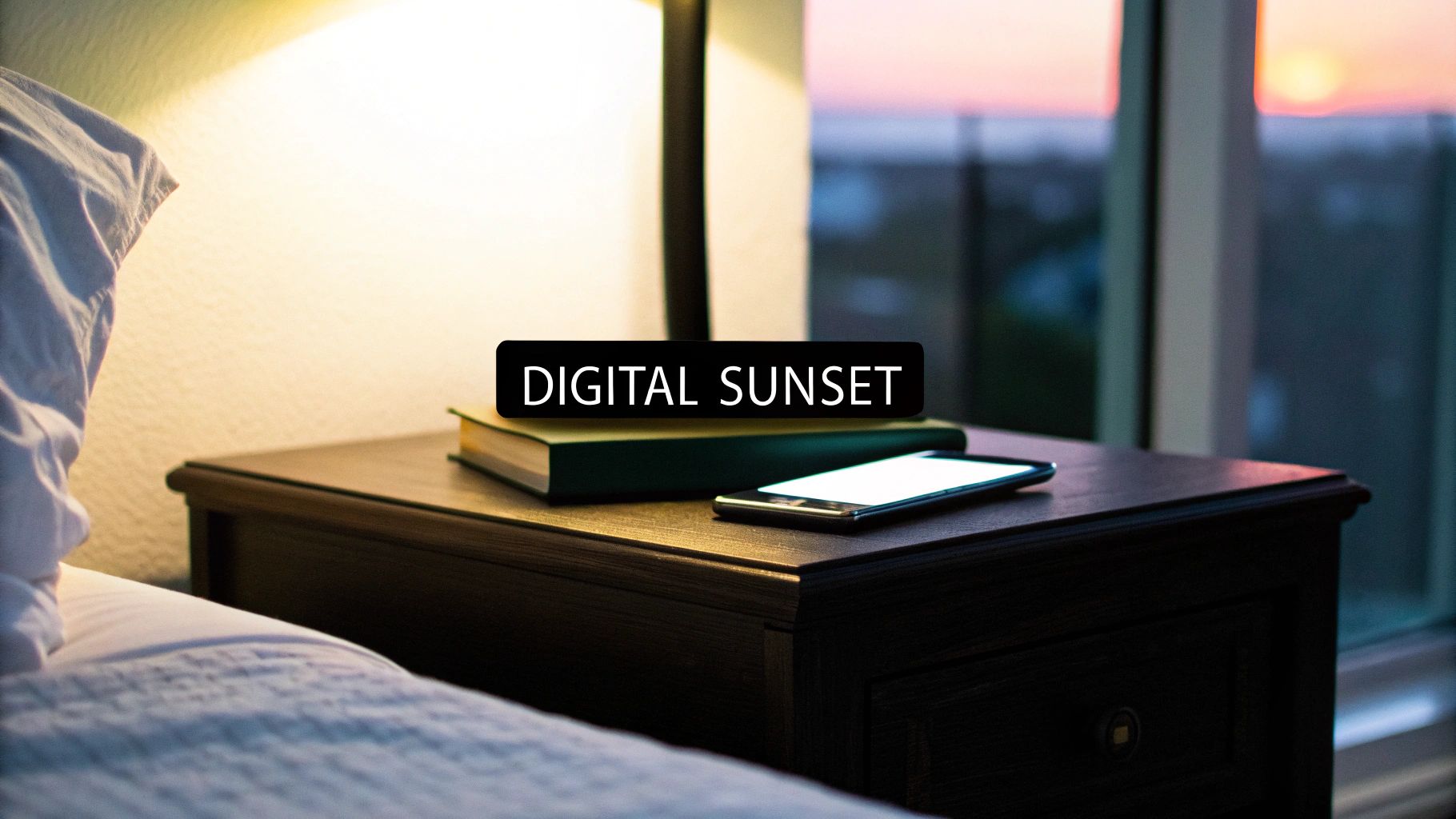
That nightly scroll through your phone feels pretty harmless, right? A simple way to wind down. But it's often the real reason you’re tossing and turning at night and hitting snooze five times in the morning. A good night's sleep is the foundation of a productive and happy day, and this habit might be undermining it.
The truth is, all that screen time before bed is messing with your body's natural sleep-wake cycle. Getting a handle on this connection is the first step to reclaiming the deep, restorative rest you need to actually feel good. Remember, sleep isn't a luxury; it's essential for your health and well-being.
In a world that never seems to switch off, winding down often just means switching from one screen to another. Maybe you're catching up on a show, doom-scrolling through social media, or firing off one last email. It's become so normal it feels like part of our relaxation routine.
But here’s the catch: that "relaxing" habit might be the very thing robbing you of the quality sleep your mind and body are screaming for.
Sleep isn't a luxury. It's a fundamental biological need, the bedrock for mental clarity, physical energy, and emotional stability. While you're asleep, your body is hard at work repairing itself, supporting healthy brain function, and getting you ready for the day ahead. This nightly reset is crucial for everything you do.
When you consistently get bad sleep, it creates a ripple effect across your entire life. Skimping on the recommended seven to nine hours isn't just about feeling tired. It's about setting yourself up for a whole host of chronic health issues and making your daily life harder than it needs to be. The importance of sleep cannot be overstated.
Poor sleep can tank your:
This makes the conversation about screen time before bed more than just a lifestyle tip—it’s a critical health discussion centered on the importance of sleep.
The way you feel all day is a direct reflection of how you slept all night. Think of it as the essential reset button that prepares you to handle whatever life throws at you.
For thousands of years, our sleep was dictated by one thing: the sun. When the sun went down, our brains started producing melatonin, the hormone that signals it's time to sleep. Simple.
Today, we're surrounded by artificial suns—our smartphones, tablets, laptops, and TVs.
These devices blast our eyes with a specific type of light that powerfully mimics daylight, sending a loud and clear—but very wrong—signal to your brain. This guide will break down the science of how your screens are quietly tricking your brain into staying wide awake. And more importantly, we’ll get into some simple, effective ways to break the cycle and protect your sleep, which is one of the most important things you can do for your health.
Think of your brain's sleep system like a light switch that’s wired directly to the sun. For thousands of years, this internal clock—your circadian rhythm—followed a simple, natural pattern. When the sun went down, your brain started producing a crucial hormone called melatonin, gently signaling that it was time to rest and recover.
This ancient biological rhythm is the foundation of good health and is vital for getting the restorative sleep you need. But the bright, artificial light beaming from your phone, tablet, or laptop is a powerful imposter, perfectly mimicking the midday sun. When you get screen time before bed, you're sending your brain a confusing and disruptive message: "Hey, it's still daytime!"
This exposure actively slams the brakes on your natural melatonin production, keeping you alert and wired exactly when your body is supposed to be winding down. Understanding this biological trick is the first step toward reclaiming your sleep and well-being.
Melatonin is often called the "hormone of darkness," and for a good reason. Its release is triggered by dimming light, and it’s the conductor that orchestrates your body's transition into sleep. But here's the catch: not all light is created equal when it comes to stopping this process.
The light from our digital devices is packed with short-wavelength blue light. Research has shown time and again that this specific part of the light spectrum is the most potent at fooling the brain and shutting down melatonin. One study even found that exposure to blue light in the evening can significantly delay the onset of sleep.
It’s like a dam holding back a river. As evening approaches, your brain gets ready to open the melatonin floodgates. But every minute you spend staring at a screen is like adding another layer of concrete to that dam, preventing the natural flow of sleep signals and pushing your bedtime later and later. This directly impacts your ability to get the important sleep your body requires.
This constant disruption does more than just make it harder to fall asleep; it throws your entire circadian rhythm out of whack. Your internal clock governs a lot more than just sleep—it also manages your appetite, mood, and energy levels all day long.
When your sleep-wake cycle is consistently thrown off by evening screen use, you might start to notice:
This vicious cycle of poor sleep can have serious consequences, since quality rest is non-negotiable for cognitive function, emotional balance, and physical repair. Recognizing how blue light is impacting your routine is the first step toward taking back control and acknowledging the importance of sleep. For a deeper dive, you can learn more about blue light and its effects on our blog.
The problem isn't just the light itself, but the timing. Blasting your eyes with daylight-mimicking blue light after sunset directly contradicts the signals your body needs to prepare for deep, healing sleep.
The impact of screen time before bed goes beyond just melatonin suppression. The light from your screens also directly stimulates special photoreceptors in your eyes that are hard-wired for alertness.
These receptors, known as intrinsically photosensitive retinal ganglion cells (ipRGCs), send signals straight to your brain's master clock. When they detect blue light, they tell your brain to be awake, sharp, and vigilant. That’s a fantastic survival mechanism during the day, but at night, it becomes a massive roadblock to the calm, relaxed state you need for sleep.
This means that even if you don't feel wired from the video you're watching or the article you're reading, the light alone is working against your body's natural drive to sleep. It’s a silent, physiological process that keeps your brain in a state of wakefulness, sabotaging your best efforts to get the rest you need to function. The importance of overcoming this cannot be stressed enough.
When late-night scrolling consistently sabotages your sleep, the consequences ripple out much further than just feeling groggy the next morning. Quality sleep isn't a luxury—it’s a fundamental pillar of good health. Mess with it, and your brainpower, mood, and physical well-being start to pay the price.
Think of sleep as your body’s nightly maintenance crew. It’s the time when your brain files away memories, your muscles repair themselves, and your hormones get back in balance. Interrupting this crucial process night after night is like sending the crew home before the job is done. Eventually, the whole system starts to wear down. The importance of sleep is evident in how deeply these disruptions affect us.
One of the first things to go when sleep is in short supply is your cognitive performance. A sleep-deprived brain just can’t focus, pay attention, or solve problems like it should. Simple tasks suddenly feel like monumental efforts, and your ability to learn and remember new things takes a nosedive.
It’s not just mental fog, either. A lack of restorative sleep throws your emotional regulation completely out of whack. You might find yourself snapping at people, feeling anxious, or dealing with wild mood swings. That’s because the part of your brain that keeps emotional responses in check—the amygdala—goes into overdrive without proper rest, making it harder to cope with everyday stress.
Chronic sleep deprivation doesn't just make you tired; it fundamentally alters how you think and feel. Protecting your sleep is one of the most effective ways to safeguard your mental and emotional resilience.
The scale of this problem is huge. Research shows that adults who use screens for more than two hours at night get an average of only 5.9 hours of sleep—way below the recommended seven to nine. This screen time can slash critical REM sleep (the stage vital for memory) by about 18%. You can dig into more of these screen time statistics to see the full picture.
The damage from poor sleep runs deep, impacting your physical health in serious and long-lasting ways. Your body relies on that downtime to keep its complex systems running smoothly. When that gets disturbed, the fallout can be severe, highlighting the true importance of sleep.
Here are just a few ways chronic sleep loss can hurt your body:
Ultimately, cutting back on evening screen time is more than just a "sleep hack." It’s a foundational practice for keeping your mind sharp, your mood stable, and your body healthy for the long haul. Prioritizing a solid sleep routine is one of the best investments you can possibly make in your overall well-being.
It’s tempting to point the finger at blue light for all our sleep woes, but that’s only half the story. The content you’re scrolling through, watching, or reading on your screen plays a huge part in why you’re still wide awake at 2 AM. To get quality sleep, you need a calm mind—and binging a thriller or getting into a social media debate is the exact opposite of calm.
Think of your brain like a car engine. To get ready for sleep, you need to let it cool down and settle into a quiet idle. But when you fire up a suspenseful TV show, scroll through a heated political thread, or check that one last work email, you're not idling. You're flooring it. This kind of screen time before bed jolts your brain into a high-alert, problem-solving state, making that gentle drift into sleep feel almost impossible.
Not all content is created equal. A chill nature documentary won't rev your engine nearly as much as a competitive online game or a doom-and-gloom news report. The problem is that most digital content is designed to hook you and keep your attention, which creates a state of cognitive arousal.
This mental stimulation goes head-to-head with your body's natural urge to rest. Your body might feel tired, but your brain is still buzzing—processing information, guessing what’s next, or having an emotional reaction to what it’s seeing. You end up in a frustrating standoff: your body is ready for bed, but your mind is running a marathon. It completely undermines the restorative sleep you need.
Let’s look at how swapping out certain activities can dramatically shift your pre-sleep mindset.
| Activity | Psychological State Induced | Impact on Sleep Readiness |
|---|---|---|
| Watching a suspenseful movie or TV show | Anticipation, anxiety, emotional investment | High. Keeps the brain alert and engaged, delaying sleep onset. |
| Reading a physical book (fiction or non-fiction) | Relaxation, focus, imaginative immersion | Low. Calms the mind and encourages a transition to a restful state. |
| Scrolling through social media | Comparison, emotional reactivity, distraction | High. Triggers emotional responses and cognitive overload. |
| Gentle stretching or meditation | Mindfulness, physical relaxation, stress reduction | Low. Actively prepares both the mind and body for sleep. |
| Playing a competitive video game | High alertness, problem-solving, adrenaline | Very High. Puts the brain into a peak performance mode, fighting sleep signals. |
| Listening to a calm podcast or audiobook | Passive engagement, relaxation | Low. Allows the mind to wind down without active visual stimulation. |
As you can see, the type of activity matters just as much as the screen itself. Choosing a passive, calming alternative can make all the difference in achieving the important sleep you need.
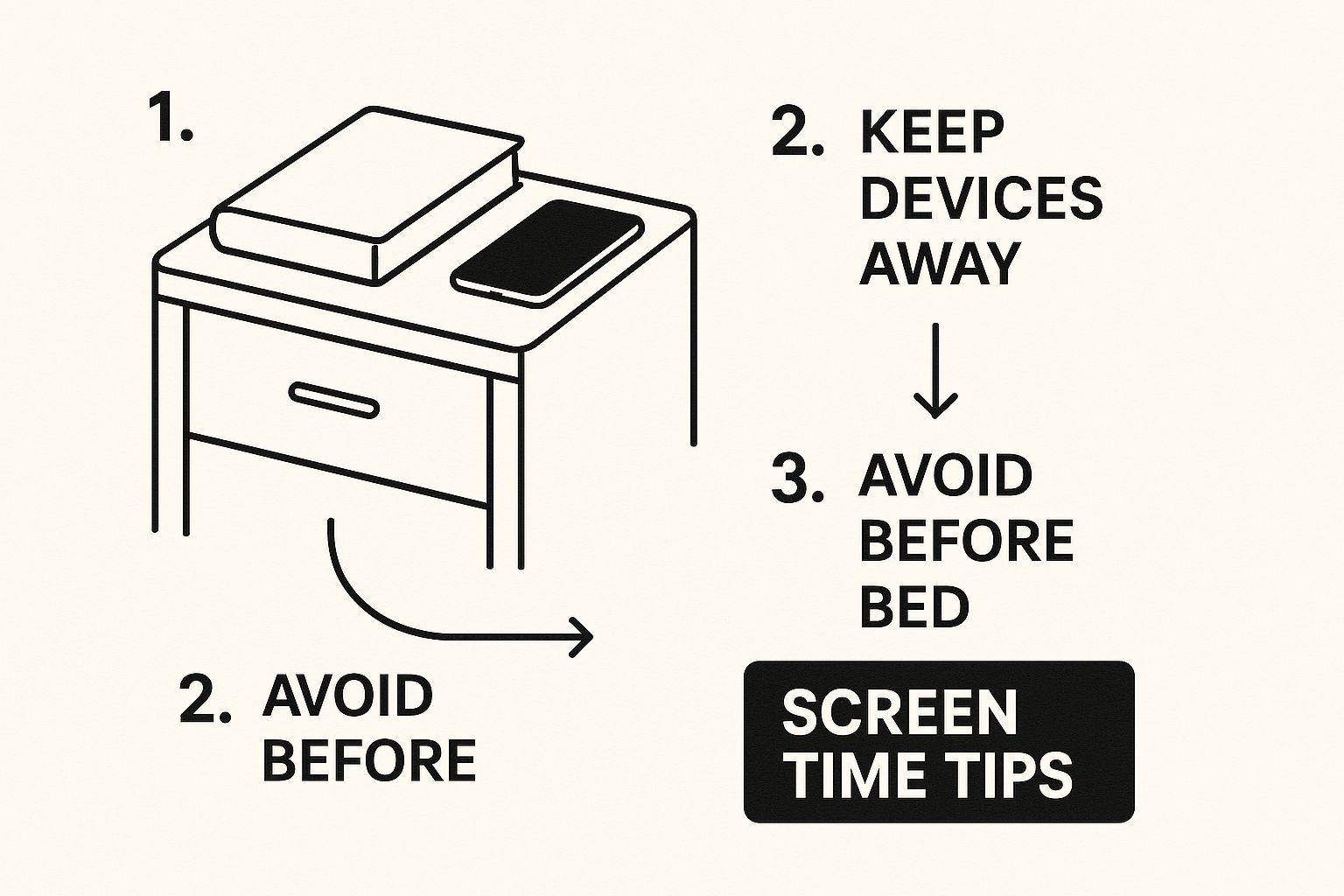
The image above nails a simple but powerful point: swapping an active screen for a quiet activity like reading a book is a direct way to help your mind prepare for rest.
Beyond keeping your brain wired, there’s another sneaky sleep thief at work: time displacement. This is what happens when that "one last video" becomes a rabbit hole, and suddenly it's an hour past your bedtime. The captivating nature of our feeds is designed to do exactly that.
That lost time is stolen directly from your sleep budget. A huge study of over 45,000 young adults found a direct line between using screens in bed and sleep problems. For every extra hour of screen time in bed, the risk of insomnia shot up by 59%, and on average, people lost about 24 minutes of sleep each night. What's really telling is that the type of activity—whether social media, movies, or studying—didn't matter. They all wrecked sleep, mostly by pushing bedtime later and later. You can dive deeper into these sleep and screen time findings to see the full picture.
Engaging content doesn't just keep your mind awake; it actively steals the minutes and hours you've allocated for essential rest. This isn't just about delaying sleep—it's about fundamentally shortening the time your body has to repair and recharge.
At the end of the day, getting deep, restorative sleep is about more than just having a dark, quiet room. It demands a quiet mind. Protecting that precious hour before you hit the pillow from mentally stimulating content is just as crucial as managing your blue light exposure. It’s a non-negotiable step in signaling to your brain that the day is done and it’s finally safe to power down. The importance of sleep makes this one of the most vital habits to cultivate.
Knowing how screens mess with your sleep is one thing. Actually doing something about it is where the magic happens. The good news? You don't need to throw your phone in a lake to see a difference. Small, consistent changes can send a powerful signal to your brain that it’s finally time to power down.
It all starts with building a relaxing bedtime routine that actively gets you ready for deep, restorative sleep. The importance of sleep hygiene cannot be overstated.
The single most powerful trick in the book is creating a "digital sunset." This is simply a dedicated, screen-free buffer zone of 60 to 90 minutes before you plan to be asleep. Think of it as a gentle off-ramp for your brain, giving it time to slow down from the high-speed highway of daily pings and notifications.
This quiet period lets your melatonin levels rise naturally and your mind settle down, paving the way for a much smoother transition into sleep. It’s the perfect antidote to the blue light and overstimulation that keeps so many of us wired at night.
So, what are you supposed to do during this "digital sunset"? The goal is to swap screen-based habits for calming activities that genuinely help you relax. This isn't about taking something away; it's about upgrading your evening with something better.
Here are a few great alternatives to scrolling:
Of course, the modern challenge is that screens are everywhere. The global average screen time has climbed to a staggering 6 hours and 40 minutes per day. Americans are slightly higher at around 7 hours and 3 minutes, and for Gen Z, that number rockets to about 9 hours daily. You can check out more of these widespread screen time trends for yourself.
Given those numbers, a complete pre-bed detox can feel like a tall order.
If going completely screen-free feels impossible right now, don't sweat it. You can use a few harm-reduction strategies to minimize the damage while you work on building better habits.
The goal is progress, not perfection. Even small adjustments to how you use screens in the evening can lead to huge wins for your sleep quality.
Start with these practical tips tonight:
By combining a dedicated wind-down period with these practical tools, you're creating a powerful, multi-layered defense for your sleep. You’re not just avoiding the bad stuff—you're actively inviting the calm your body needs to rest, recover, and wake up ready for whatever comes next.
Turning your bedroom into a true sanctuary for rest is one of the most powerful moves you can make against the ails of screen time before bed. Think about it: your environment is constantly sending signals to your brain. When you optimize your space for sleep, you’re sending a loud, clear message that the bedroom is for one thing—rest and rejuvenation.
A great first step is to declare your bedroom a "no-screen zone." This helps your brain build a rock-solid connection between your bed and sleep, not your bed and endless scrolling. Once your mind learns that getting into bed means it's time to power down, falling asleep starts to feel less like a chore and more like an automatic reflex. This directly supports the importance of sleep in your daily life.
Your body’s internal clock is incredibly tuned in to its surroundings, especially temperature, light, and sound. Nailing these three elements can make a night-and-day difference in your sleep quality.
A cool room is non-negotiable for quality rest. Your body's core temperature naturally dips as it preps for sleep, and a cooler bedroom—somewhere between 60 and 67 degrees Fahrenheit—helps that process along. If your room is too warm, it can actually fight against this natural drop, leaving you restless and waking up all night.
Darkness is just as critical. Even tiny slivers of light from a streetlamp or the glowing charger across the room can mess with your melatonin production and throw your sleep cycles out of whack.
Creating a pitch-black environment sends the clearest possible signal to your brain that it's time for deep, uninterrupted sleep. It’s a simple but profound way to work with your body's natural rhythms, not against them.
Finally, you need quiet. Unexpected noises can yank you right out of the deepest, most restorative stages of sleep, even if you don't remember waking up. By taking control of your sleep environment, you’re basically building a fortress to protect your precious downtime.
Crafting this perfect sleep environment doesn't have to be complicated or break the bank. Just a few smart additions can make a huge difference in your ability to fall asleep and stay that way.
Here are a few items worth considering:
When you deliberately shape your physical space, you create an environment that actively supports your sleep goals. It makes restorative rest feel less like a struggle and more like the natural, easy end to your day.
As you start tweaking your evening routine, you're bound to have some questions. It's totally normal. Nailing down the details of how to manage screen time before bed is the key to creating a wind-down ritual that actually works for you and gets you the deep sleep you need.
Let’s dive into a few of the most common ones we hear.
While features like 'Night Shift' or 'Dark Mode' are definitely a good start, they're not the whole solution. These settings dial down the harsh blue light coming from your screen by giving it a warmer, amber glow. That's great for taking the edge off and reducing how much your screen messes with your melatonin.
But here’s the catch: it's not just about the light, it's about the stimulation. Binge-watching a tense thriller, firing off one last work email, or getting sucked into a heated debate on social media still puts your brain on high alert. That’s the opposite of what you want before trying to sleep. The importance of sleep lies in both physical and mental relaxation.
Think of night mode as a solid harm-reduction tool. It’s better than nothing, but a truly screen-free buffer before bed is still the gold standard for telling your brain it's time to power down.
A warm-toned screen is better than a bright blue one, but a calm, screen-free mind is the gold standard for preparing your body for deep, restorative rest.
Absolutely. In fact, this is one of our favorite screen-time alternatives. The huge difference here is that you're not staring directly into a light source. Listening to an audiobook or a relaxing podcast is a much more passive activity than scrolling, typing, or watching a video.
The trick is to do it right. Cue up your podcast or book, turn the screen completely off, and put your device face down. This way, you get to unwind and enjoy your content without any of the disruptive blue light. It’s a perfect addition to a digital sunset routine.
This is the best part—many people feel a real difference in just a few nights. After consistently cutting back on evening screen time, you might find yourself falling asleep faster and waking up feeling sharper and more rested than you have in a long time.
But for the deep, lasting benefits—like fully resetting your internal clock—consistency is everything. Give it a few weeks. Sticking with your new habit helps your body’s circadian rhythm find its natural groove again. The more you protect your sleep, the more profound the payoff will be. The importance of sleep is cumulative; every good night builds on the last.
For more ideas on building healthy sleep habits, check out the articles in our sleep resource center.
At Element Lux, we're all about helping you take back your nights. Our blue-light-blocking glasses are specifically designed to shield your eyes and support your body's natural sleep-wake cycle, making it that much easier to wind down peacefully. See how they can become a key part of your evening routine by exploring our collection at https://element-lux.com/shop-now.
