If you spend your days staring at a screen, you already know your standard glasses probably aren't cutting it. The best glasses for office work are built differently—they come loaded with features like blue light filtering and anti-reflective coatings designed to fight digital eye strain and protect your sleep. Quality sleep is the cornerstone of a productive day, and the right eyewear is a critical tool in achieving it.
These specialized lenses are optimized for the intermediate distance of a computer screen, a crucial difference from your general-purpose glasses.
That gritty, tired-eye feeling and dull headache you get after a long day? It isn't just a sign of hard work. It’s a clear signal that your everyday glasses are struggling to keep up with your digital life, ultimately impacting your ability to get the restorative sleep you need.
Most standard prescription lenses are designed for one of two things: seeing far away (distance) or up close (reading). But they often completely miss the specific, fixed distance of a computer monitor that dominates the modern workday.
This creates a subtle but constant strain. Your eyes are forced to work harder to maintain focus on a screen that's typically 20-26 inches away—that awkward intermediate zone that standard glasses just weren't built for. This mismatch is a huge driver of what's known as Computer Vision Syndrome (CVS), a collection of symptoms caused by spending too much time in front of screens.
The issue is twofold: the fixed focal distance and the harsh light our screens blast out.
Digital devices are a major source of high-energy visible (HEV) blue light, which is notorious for messing with our natural sleep patterns. Constant exposure, especially later in the day, tricks your brain into thinking it's still high noon. This suppresses the production of melatonin, the essential hormone that tells your body it’s time to sleep. Without quality sleep, focus and productivity suffer the next day.
This chart really puts the challenges office workers face into perspective.
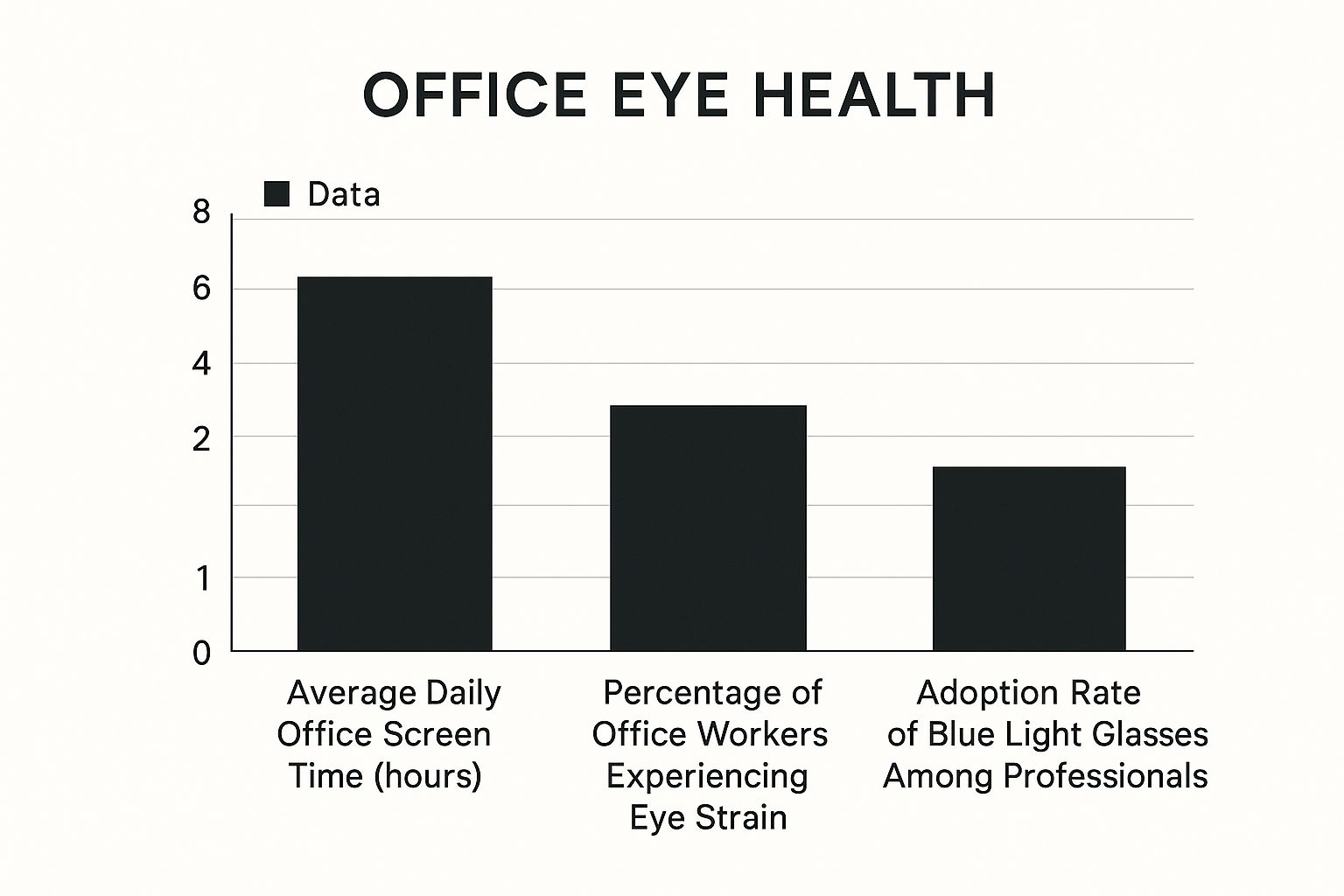
The data makes it crystal clear: long hours in front of screens directly correlate with high rates of eye strain, yet surprisingly few people are using eyewear designed to protect them and their sleep.
Before we dive deeper, let's quickly break down the key differences between your everyday pair and glasses made for the office.
| Feature | General Purpose Glasses | Specialized Glasses for Office |
|---|---|---|
| Focal Point | Optimized for distance or close reading, not intermediate ranges. | Fine-tuned for the 20-26 inch distance of computer screens. |
| Blue Light Filtering | Typically has no blue light filter unless added as an extra. | Includes built-in blue light filtering to block harmful HEV light. |
| Lens Coatings | Standard anti-scratch coatings are common. | Comes with advanced anti-reflective and anti-glare coatings. |
| Primary Goal | To correct general vision errors (nearsightedness, farsightedness). | To reduce digital eye strain, improve comfort, and protect sleep. |
As you can see, it's not just about a prescription—it's about having the right tool for the job.
This constant visual effort does more than just tire your eyes out. The American Academy of Ophthalmology reports that over 40% of Americans feel the burn of digital eye strain, with symptoms like blurred vision, headaches, and painfully dry eyes. This is a massive problem, and it's fueling the demand for specialized lenses that can actually handle our screen-heavy lives.
Choosing the right glasses for office work isn't just about clearer vision. It's a strategic decision to improve your focus, reduce daily discomfort, and safeguard your sleep quality for better overall health.
By ignoring these issues, you're risking more than just a bit of discomfort. Poor sleep caused by blue light exposure can tank your productivity, mess with your mood, and even lead to long-term health problems. You can learn more about the science of blue light on our blog.
Specialized office glasses are designed to break this vicious cycle. They offer a simple yet powerful tool to protect your eyes and, just as importantly, your rest, because a good night's sleep is non-negotiable for peak performance.
When you're shopping for a great pair of glasses for office work, it’s easy to get caught up in the frames. But the real magic, the part that actually saves your eyes and improves your sleep, is in the lens technology.
Choosing the right lenses isn't just about correcting your vision. It's about actively protecting your eyes from the unique challenges of a screen-heavy workday and, just as importantly, preserving your natural sleep cycle. Think of them as a high-performance tool, specifically calibrated for your work environment.
Unlike standard glasses, specialized office lenses are built with layers of technology designed to filter out the bad light and enhance the good. The goal is simple: keep your eyes comfortable and make sure your brain gets the right signals for rest when the day is done, because quality sleep underpins everything else.
First up, and arguably the most important feature, is blue light filtering. The screens on our computers, tablets, and phones all blast out high-energy visible (HEV) blue light, which mimics the light from the sun. During the day, that's not a huge problem.
But as you work into the afternoon and evening, that continuous exposure can trick your brain into thinking it's perpetually noon. This artificial daylight suppresses your body's production of melatonin—the hormone that signals it's time to wind down.
Without that crucial signal, you can shut your laptop after a long day feeling wired and exhausted at the same time. This makes it tough to fall asleep, often leading to a night of restless, poor-quality rest. Good office lenses act as a shield, selectively filtering out the most disruptive wavelengths.
This is about more than just feeling less tired. Getting consistently good sleep is fundamental for cognitive function, mood regulation, and overall health. By wearing blue light filtering glasses during your workday, you help keep your body’s natural circadian rhythm on track, making the transition from work to rest feel a whole lot smoother.
Next, let's talk about anti-reflective (AR) coatings. Office environments are a minefield of visual noise—harsh overhead lights, glare from windows, and even reflections bouncing off your own screen. An AR coating works to eliminate these distracting reflections from both the front and back of your lenses.
The result is a crisper, clearer view. Your screen looks sharper, which significantly reduces the hard work your eye muscles have to do just to maintain focus. Less squinting means less end-of-day fatigue.
Think of it like trying to have a conversation in a noisy restaurant versus a quiet library. The AR coating is like a noise-canceling headphone for your eyes, quieting all that visual chaos so you can focus effortlessly. This mental ease contributes to a calmer state of mind, which is essential for winding down and achieving deep sleep.
Finally, the lens type itself is a huge piece of the puzzle. Your everyday glasses probably aren't optimized for the specific intermediate distance of a computer screen. This is where specialized office lenses really shine.
You’ll generally discuss two main options with your optometrist:
Choosing the right lens technology is a conversation you absolutely need to have. It's the step that transforms your glasses from a simple vision corrector into an essential tool for productivity, comfort, and a great night's sleep.
Ever finish a long day at the office, shut your laptop, and find your mind is still racing? You feel exhausted but strangely wired, making a good night's rest feel completely out of reach. It’s a frustrating cycle, and the culprit might be the very thing you've been staring at all day—your computer screen.
What you wear on your face during work hours has a direct, and often overlooked, impact on how well you sleep at night. The connection is all about how our bodies interpret light. Digital screens blast out high-energy blue light, which closely mimics the light of the midday sun. This constant exposure sends a powerful, and confusing, signal to your brain: "It's daytime!" even when it’s 4 PM and the sun is starting to dip.
This biological mix-up throws a wrench in a critical natural process. As evening approaches, our bodies are supposed to produce a hormone called melatonin. Think of melatonin as the "sleep hormone"—it’s the signal that tells your body it's time to wind down. But when your brain is flooded with artificial blue light, melatonin production gets shut down.
The result? You have trouble falling asleep, your nights are restless, and you wake up feeling groggy. Quality sleep isn't a luxury; it's the foundation for cognitive function, mood stability, and overall health. Without it, your productivity and well-being take a serious hit.
This is where specialized glasses for office work can be a game-changer. High-quality lenses with blue light filtering technology act as a protective shield for both your eyes and your internal clock. They're designed to selectively block the most disruptive wavelengths of blue light, preventing them from messing with your melatonin production.
By wearing these glasses throughout your workday, you're helping your body maintain its natural circadian rhythm. Your brain starts getting the right light cues again, allowing it to produce melatonin at the right time. Suddenly, the transition from a busy workday to a restful evening feels much smoother and more natural.
By filtering out artificial blue light, office glasses help your brain recognize that the workday is ending. This simple change can be the key to unlocking deeper, more restorative sleep and waking up ready to tackle the day.
Think about Sarah, a graphic designer who regularly worked late to meet deadlines. For months, she struggled to unwind after work. Despite being bone-tired, she’d lie awake for hours, her mind buzzing. Her sleep was broken and unsatisfying, leaving her drained and unfocused the next day. This lack of restorative sleep started a cycle of poor performance and increased stress.
Skeptical but desperate, she decided to try a pair of office glasses with a strong blue light filter. The change wasn't overnight, but after about a week of wearing them consistently, she noticed a huge difference. She started to feel naturally sleepy in the evenings. Instead of tossing and turning, she was falling asleep faster and, more importantly, staying asleep.
This isn't just about feeling less tired. To learn more about how the right eyewear can help you rest better, check out our guide on how our glasses help with sleep. A good pair of office glasses does more than just protect your eyes from strain—it protects your fundamental need for restorative sleep.
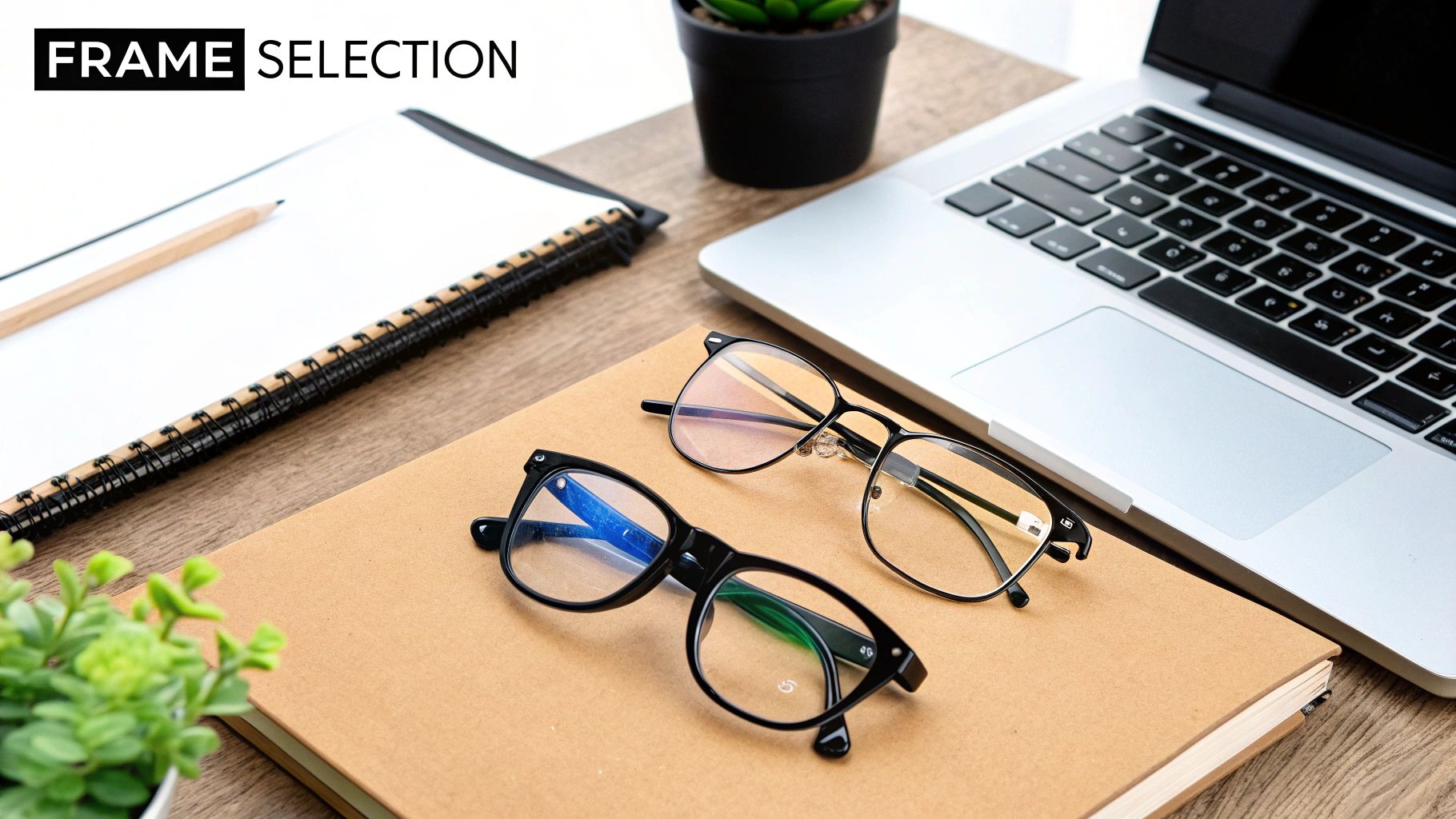
While the lenses are doing all the heavy lifting to protect your eyes, the frames are what make or break the experience. Let's be real—if your glasses are uncomfortable, you're just not going to wear them.
An ill-fitting or heavy pair can be a huge distraction. Think pressure points behind your ears, headaches, or that constant, annoying nose-slide that pulls you out of your focus. Picking the right frames is about finding that sweet spot between durability, all-day comfort, and a style that looks professional.
Think of it this way: your glasses are a tool you rely on for 8+ hours a day. Just like a good ergonomic chair, the right frames are crucial for preventing physical discomfort and keeping you in the zone. Reduced physical stress during the day is another key factor in being able to relax and achieve deep sleep at night.
When you're wearing glasses from your morning coffee to your last email, every single gram counts. Heavy frames create noticeable pressure on the bridge of your nose and ears, which can quickly lead to headaches and fatigue that have nothing to do with your screen.
To avoid this, look for frames made from materials known for being both feather-light and tough:
Choosing a lightweight material means your glasses won't become a burden, letting you focus on your work, not the weight on your face.
Frame size isn't just about how you look; it's about how you see. The right size directly impacts your field of vision, which is especially critical if you're considering occupational progressive lenses with different viewing zones.
A frame that's too small or narrow can literally cut off parts of the lens you need to see your desk setup clearly.
The goal is to find a frame large enough to give you an unobstructed view of your entire screen setup. You shouldn't have to constantly tilt or turn your head to see clearly. A wider field of vision means less strain on your neck and your eyes.
We've all seen the demand for functional, stylish office eyewear grow. The global business glasses market is valued at around $15 billion in 2025 and is set to keep growing. This is driven by our non-stop screen time and a greater understanding of how the right features—like blue light filtering and smart lens design—can genuinely improve our work and sleep. You can dive deeper into the eyewear market at Archive Market Research.
Here's a quick rundown of what to look for in a great pair of office frames.
| Feature | Why It Matters for Office Use | Recommended Materials/Styles |
|---|---|---|
| Lightweight Construction | Prevents pressure points, headaches, and fatigue during long workdays. | Titanium, TR-90, high-quality acetate. |
| Adjustable Nose Pads | Allows for a custom fit to keep glasses from sliding down your nose. | Silicone or metal nose pads that can be molded to your nose bridge. |
| Proper Temple Length | Ensures the arms fit securely and comfortably behind your ears without digging in. | Look for frames where the arms curve gently just past the ear. |
| Sufficient Lens Height | Provides a wide vertical field of vision, crucial for multi-monitor setups and progressive lenses. | Avoid overly narrow or "short" lens shapes. Rectangular or soft-square shapes are often ideal. |
Ultimately, a well-chosen frame is the final piece of the puzzle. When your frames fit perfectly, you'll forget you're even wearing them—and that's exactly the point.
So, you’ve got your new office glasses. That’s a huge first step. But think of them as a powerful tool in your toolkit, not the entire solution. To really get the benefits—like fewer headaches and better sleep—you need to build some healthy habits around them.
It's all about creating an environment where your eyes can finally relax. When your new eyewear and your daily habits work together, that’s when the magic happens. You'll feel less strain and find it much easier to wind down for a restful night. After all, a good night's sleep is the ultimate productivity hack.
One of the best things you can do for your eyes is unbelievably simple: the 20-20-20 rule. I recommend this to everyone, and it's a game-changer for fighting digital eye strain.
Here's the drill: every 20 minutes, you look away from your screen at something at least 20 feet away for a full 20 seconds. That's it. This tiny action gives the muscles inside your eyes a chance to relax from the constant close-up focus they're locked into.
Set a timer on your phone or computer to remind you at first. Before you know it, it'll become a natural part of your workflow, giving your eyes a much-needed reset and helping you stay focused longer without that nagging discomfort.
Even the most advanced glasses can't fight a bad desk setup. Poor ergonomics are a major source of eye strain, but luckily, a few small tweaks can make a massive difference.
By pairing specialized glasses with smarter workstation habits, you’re building a powerful defense against digital eye strain. This doesn't just make your workday more comfortable—it helps your body and mind relax, paving the way for better sleep.
It's no surprise that more people are looking for these solutions. The global market for office lenses is expected to reach $2.5 billion by 2025, a clear sign that computer vision syndrome is a widespread problem. As awareness grows, the link between a healthy work environment and quality eyewear becomes undeniable.
Want to learn more about creating a healthier workspace? We have a ton of helpful articles in our Element Lux resources.
When you're diving into the world of specialized eyewear, a few questions are bound to pop up. Getting straight answers is the best way to land a pair of office glasses that actually makes a difference for your eyes and, just as importantly, your sleep. Let's get into some of the most common ones.
That's a great question, and it really comes down to the type of lenses you choose.
If you go with single-vision computer glasses, they're specifically designed for one thing: looking at your screen. They're perfect for desk work, but anything in the distance will look blurry.
Occupational progressive lenses, on the other hand, are a bit more flexible. They have a large zone for your screen distance, with smaller areas for reading up close and seeing farther away. This makes them a solid choice for wearing around the office, but you'll definitely want to switch back to your regular glasses for something like driving. The key is to use the right tool for the job to protect both your vision and your sleep cycle.
It's easy to get these two mixed up, but they're built for completely different jobs. Reading glasses—the kind you grab at the pharmacy—are just simple magnifiers. They're meant for close-up tasks, usually about 12-16 inches from your eyes.
Office glasses are a whole different ballgame. They're fine-tuned for the intermediate distance of a computer screen, which is typically 20-26 inches away. More importantly, they pack in crucial features like blue light filtering and anti-reflective coatings. These technologies work together to fight digital eye strain and, critically, help protect your body's natural sleep cycle from disruptive artificial light.
Absolutely. High-quality blue light filtering glasses can be a game-changer for your sleep. When you're in front of a screen, especially in the afternoon and evening, that intense blue light tells your brain to stop producing melatonin.
Melatonin is the hormone that signals your body to wind down for the night. By blocking a huge chunk of this artificial light, your glasses help your body stick to its natural circadian rhythm. This makes it much easier to fall asleep, stay asleep, and get the deep, restorative rest you need.
Think of them as a shield for your internal clock. They help your brain tell the difference between the stimulating glow of a screen and the natural darkness of evening, which is the foundation of a healthy sleep-wake cycle.
You've invested in lenses with advanced coatings, so you want to treat them right. Whatever you do, don't use your shirt, a paper towel, or harsh cleaners. They'll create tiny scratches that ruin the anti-reflective and blue light filtering layers.
Here's a simple routine that works every time:
Sticking to this method will keep your lenses in top shape and make sure their protective tech keeps working for you, safeguarding your vision and your sleep for the long term.
Ready to stop letting screen time ruin your sleep? The specialized amber lenses from Element Lux block over 99% of disruptive blue light, helping you wind down naturally. Explore our collection and find the perfect pair to protect your eyes and reclaim your rest.
